Cavity Oscillations
腔体振荡
The single frequency cavity resonance suggests a parallel with the single resonant frequency of a mass on a spring. In fact, the term "acoustic mass" is sometimes used in connection with such oscillations.
单频腔体的共振现象暗示了与质量弹簧系统单共振频率的类比。事实上,'声质量'这一术语有时用于描述此类振荡。
 |
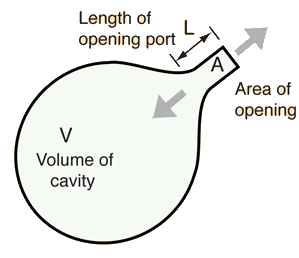
Thinking of the cavity resonance in terms of an oscillating mass of air can give some intuition about why the physical properties of the cavity affect the resonant frequency as they do. You can visualize the process of pushing extra air into the cavity to produce an overpressure. That overpressure represents stored energy in a way analogous to lifting a mass on a spring above its equilibrium position. If the opening to the cavity is larger, the excess air can escape more rapidly to bring the pressure down to atmospheric, and this leads to a higher cavity resonant frequency. If the neck of the cavity is longer, there is more resistance to the flow of the excess air and the resonant frequency is lowered. If the cavity volume is increased, then it takes a greater excess mass of air to produce a given overpressure, and it therefore takes longer for that excess pressure to be relieved. The larger cavity will have a lower resonant frequency.
将腔体的共振视为空气中振荡的质量可以提供一些直觉,以理解腔体的物理特性为何会影响共振频率。你可以想象将额外的空气推入腔体以产生过压的过程。这种过压可以类比为将质量提升到弹簧的平衡位置之上所储存的能量。如果腔体的开口更大,多余的空气可以更快地逸出,使压力下降至大气压,这会导致共振频率升高。如果腔体的颈部更长,则空气流动的阻力更大,共振频率会降低。如果腔体的体积增大,则需要更多的额外空气质量才能产生给定的过压,因此这种过压需要更长时间才能释放。较大的腔体会有较低的共振频率。
|
Again visualizing the mass on a spring, we know that if we lift it from equilibrium and allow it to fall, it will not stop when it reaches that equilibrium point but will overshoot it and oscillate about equilibrium because the work we did to lift the mass put energy into the elastic system. Likewise, when we have done work to increase the pressure in a cavity, we have given it energy and as the air rushes out, it will overshoot the equilibrium (atmospheric pressure) and produce a slight vacuum in the cavity. This elastic system produces the cavity resonance, but it is highly damped and will not continue to oscillate like a mass on a spring.
再次想象弹簧上的质量,我们知道如果将其从平衡位置提起并释放,它不会在到达平衡点时停止,而是会超过平衡点并围绕平衡点振荡,因为提升质量所做的功将能量输入弹性系统。同样地,当我们对腔体内的压力做功以增加压力时,我们给它输入了能量,当空气逸出时,它会超过平衡点(大气压)并使腔体产生轻微的真空。这种弹性系统产生腔体共振,但这种共振高度阻尼,不会像弹簧上的质量那样持续振荡。
|
Index
Wave concepts
Resonance concepts
索引 波的概念 共振概念 |