Microwave Ovens
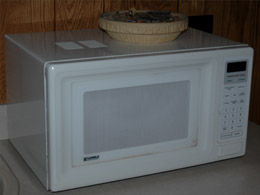 | The microwave radiation of microwave ovens and some radar applications is produced by a device called a magnetron. Modern microwave ovens operate at the frequency 2,450 MHz. 微波炉和某些雷达应用产生的微波辐射是由一种称为磁控管的设备产生的。现代微波炉工作频率为2,450 MHz。 |
By federal regulation, microwave ovens are limited to 5 milliwatts (mW) of microwave radiation per square centimeter at approximately 2 inches from the oven surface. This limit is far below the level known to harm people. The microwave radiation would be expected to drop off according to the inverse square law, so at 20 inches it would be down by about a factor of 100.
Considering the frequency of 2,450 MHz, the wavelength of microwave oven radiation is about 12 cm and the quantum energy of a microwave photon is about 1 x 10⁻⁵ eV. The radiation interaction at such energies for free molecules can contribute to molecular rotation and vibration, but such resonant interactions are not a major factor in the heating of liquids and solids in a microwave oven. The average thermal energy at 20°C is about 1/40 eV, so any ordered molecular rotational or vibration created by the microwave interaction is quickly randomized by collisions with molecules of kinetic energy 2500 times greater than the microwave photon energy provided. The major mechanism for heating water in a microwave oven is described as dielectric heating. The microwaves exert torques exerted on the molecular dipole moments of the water molecules and other molecules and that would be expected to cause some heating. However, the detailed modeling of water heating described in Chaplin suggests that the major effect of the microwaves is from work done on the hydrogens rather than invested in the reorientation of the molecular dipoles of the water molecules.
Usually, the major heating effect of microwaves in an oven is the heating of the water included in the material. If you are heating pure water, the heating can be modeled more precisely. For pure water, the penetration of the microwaves into the water can be modeled and is charaterized by the depth of penetration which drops the microwave power by a factor 1/e, representing the absorption of 63% of the microwave power. For water at 25°C, this penetration depth is approximately 1.4 cm according to Chaplin.
Reference:
Water and Microwaves from "Water Structure and Science" by Martin Chaplin.
| Transport of energy by electromagnetic waves
电磁波传输能量 |
Wave concepts
Electromagnetic wave concepts
Electromagnetic spectrum
| HyperPhysics*****Electricity and Magnetism
HyperPhysics ***** 电学和磁学 | R Nave |