Bilingual edition: English is preserved and Chinese follows each unit. Terminology uses the confirmed v20260916 glossary; automated semantic review remains traceable.
中英双语版:英文原文完整保留,中文紧随对应单元;术语采用 v20260916 确认表,自动语义审校结果可追溯。

You may click on any of the types of radiation for more detail about its particular type of interaction with matter. The different parts of the electromagnetic spectrum have very different effects upon interaction with matter. Starting with low frequency radio waves, the human body is quite transparent. (You can listen to your portable radio inside your home since the waves pass freely through the walls of your house and even through the person beside you!) As you move upward through microwaves and infrared to visible light, you absorb more and more strongly. In the lower ultraviolet range, all the uv from the sun is absorbed in a thin outer layer of your skin. As you move further up into the x-ray region of the spectrum, you become transparent again, because most of the mechanisms for absorption are gone. You then absorb only a small fraction of the radiation, but that absorption involves the more violent ionization events. Each portion of the electromagnetic spectrum has quantum energies appropriate for the excitation of certain types of physical processes. The energy levels for all physical processes at the atomic and molecular levels are quantized, and if there are no available quantized energy levels with spacings which match the quantum energy of the incident radiation, then the material will be transparent to that radiation, and it will pass through. If electromagnetic energy is absorbed, but cannot eject electrons from the atoms of the material, then it is classified as non-ionizing radiation, and will typically just heat the material.

您可以点击任何一种辐射类型,以了解其与物质相互作用的特定方式。电磁谱的不同部分对物质的相互作用有非常不同的影响。从低频无线电波开始,人体相当透明。(您可以在家里听便携式收音机,因为这些波可以自由穿过房屋墙壁,甚至穿过您身边的人!)随着向微波、红外线和可见光方向移动,吸收变得越来越强。在较低的紫外线范围内,来自太阳的全部紫外线都在皮肤的薄层外被吸收。当进一步进入电磁谱的X射线区域时,您又会变得透明,因为大部分吸收机制已经消失。此时,您只吸收一小部分辐射,但这种吸收涉及更剧烈的电离事件。电磁谱的每一部分都有适合激发特定物理过程的量子能量。在原子和分子水平上,所有物理过程的能级都是量子化的,如果不存在与入射辐射量子能量相匹配的量子能级,则材料对该辐射透明,会使其通过。如果电磁能量被吸收,但无法从材料的原子中击出电子,则该辐射被归类为非电离辐射,通常只会加热材料。

Electromagnetic spectrum annotated with physiological effects

标注有生理效应的电磁光谱
Index
索引
 
HyperPhysics***** Quantum Physics
HyperPhysics ***** 量子物理
R Nave
Go Back
返回


Microwave Interactions

微波相互作用

The quantum energy of microwave photons is in the range 0.00001 to 0.001 eV which is in the range of energies separating the quantum states of molecular rotation and torsion. The interaction of microwaves with matter other than metallic conductors will be to rotate molecules and produce heat as result of that molecular motion. Conductors will strongly absorb microwaves and any lower frequencies because they will cause electric currents which will heat the material. Most matter, including the human body, is largely transparent to microwaves. High intensity microwaves, as in a microwave oven where they pass back and forth through the food millions of times, will heat the material by producing molecular rotations and torsions. Since the quantum energies are a million times lower than those of x-rays, they cannot produce ionization and the characteristic types of radiation damage associated with ionizing radiation.

微波光子的量子能量在0.00001到0.001 eV之间,这处于分子旋转和扭转量子态分离能量的范围内。微波与非金属导体以外的物质相互作用将导致分子旋转,并因这种分子运动产生热量。导体将强烈吸收微波和任何较低频率的微波,因为它们会引起电流,从而加热材料。大多数物质,包括人体,对微波 largely 透明。高强度的微波,如在微波炉中,它们在食物中反复穿来穿去数百万次,将通过产生分子旋转和扭转来加热材料。由于量子能量比X射线低百万倍,因此它们不能产生电离,也不能产生与电离辐射相关的典型辐射损伤。

Interaction of radiation with matter

辐射与物质的相互作用
Index
索引
 
HyperPhysics***** Quantum Physics
HyperPhysics ***** 量子物理
R Nave
Go Back
返回


Infrared Interactions

红外相互作用

The quantum energy of infrared photons is in the range 0.001 to 1.7 eV which is in the range of energies separating the quantum states of molecular vibrations. Infrared is absorbed more strongly than microwaves, but less strongly than visible light. The result of infrared absorption is heating of the tissue since it increases molecular vibrational activity. Infrared radiation does penetrate the skin further than visible light and can thus be used for photographic imaging of subcutaneous blood vessels.

红外光子的量子能量在0.001到1.7 eV之间,这处于分子振动量子态分离的能量范围之内。红外线比微波吸收更强,但比可见光弱。红外吸收的结果是组织加热,因为这增加了分子振动活动。红外辐射比可见光能穿透皮肤更远,因此可以用于拍摄皮下血管的影像。

Interaction of radiation with matter

辐射与物质的相互作用
Index
索引
 
HyperPhysics***** Quantum Physics
HyperPhysics ***** 量子物理
R Nave
Go Back
返回


Visible Light Interactions

可见光相互作用
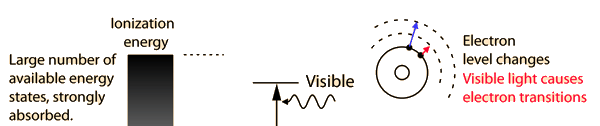
The primary mechanism for the absorption of visible light photons is the elevation of electrons to higher energy levels. There are many available states, so visible light is absorbed strongly. With a strong light source, red light can be transmitted through the hand or a fold of skin, showing that the red end of the spectrum is not absorbed as strongly as the violet end.

While exposure to visible light causes heating, it does not cause ionization with its risks. You may be heated by the sun through a car windshield, but you will not be sunburned - that is an effect of the higher frequency uv part of sunlight which is blocked by the glass of the windshield.

Interaction of radiation with matter

辐射与物质的相互作用
可见光光子的吸收主要通过将电子提升到更高的能级来实现。由于存在许多可选的状态,因此可见光被强烈吸收。在强光源下,红光可以通过手或皮肤褶皱传输,这表明光谱的红色部分不像紫色部分那样被强烈吸收。虽然暴露在可见光下会导致加热,但其不会引起离子化作用。你可能通过汽车挡风玻璃被太阳加热,但不会被晒伤——这是由于阳光中较高频率的紫外部分被挡风玻璃阻挡而产生的效果。
Index
索引
 
HyperPhysics***** Quantum Physics
HyperPhysics ***** 量子物理
R Nave
Go Back
返回


Ultraviolet Interactions

紫外光相互作用

The near ultraviolet is absorbed very strongly in the surface layer of the skin by electron transitions. As you go to higher energies, the ionization energies for many molecules are reached and the more dangerous photoionization processes take place. Sunburn is primarily an effect of uv, and ionization produces the risk of skin cancer.

近紫外光在皮肤表层被电子跃迁强烈吸收。当能量升高时,许多分子的电离能被达到,更危险的光致电离过程发生。晒伤主要由紫外光引起,而电离过程会产生皮肤癌的风险。

The ozone layer in the upper atmosphere is important for human health because it absorbs most of the harmful ultraviolet radiation from the sun before it reaches the surface. The higher frequencies in the ultraviolet are ionizing radiation and can produce harmful physiological effects ranging from sunburn to skin cancer.

平流层中的臭氧层对人类健康至关重要,因为它能吸收大部分来自太阳的有害紫外线辐射,防止其到达地表。紫外线中的高频成分属于电离辐射,可引起从晒伤到皮肤癌等有害的生理效应。

Health concerns for UV exposure are mostly for the range 290-330 nm in wavelength, the range called UVB. According to Scotto, et al, the most effective biological wavelength for producing skin burns is 297 nm. Their research indicates that the biological effects increase logarithmically within the UVB range, with 330 nm being only 0.1% as effective as 297 nm for biological effects. So it is clearly important to control exposure to UVB.

对于紫外线暴露的健康担忧主要集中在波长为290-330纳米的范围内,这个范围被称为UVB。根据Scotto等人研究,产生皮肤灼伤最有效的生物波长是297纳米。他们的研究指出,在UVB范围内,生物效应随波长增加而对数增长,330纳米的生物效应仅为297纳米的0.1%。因此,控制UVB的暴露显然非常重要。

Interaction of radiation with matter

辐射与物质的相互作用
Index

Reference
Scotto, et al.
索引参考Scotto等
 
HyperPhysics***** Quantum Physics
HyperPhysics ***** 量子物理
R Nave
Go Back
返回


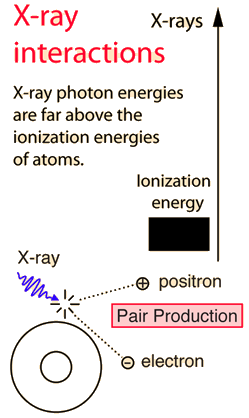
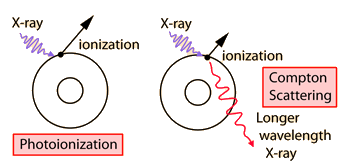
Since the quantum energies of x-ray photons are much too high to be absorbed in electron transitions between states for most atoms, they can interact with an electron only by knocking it completely out of the atom. That is, all x-rays are classified as ionizing radiation. This can occur by giving all of the energy to an electron (photoionization) or by giving part of the energy to the electron and the remainder to a lower energy photon (Compton scattering). At sufficiently high energies, the x-ray photon can create an electron positron pair.
由于X射线光子的量子能量太高,对于大多数原子来说,无法被电子在不同状态之间的跃迁所吸收,因此它们只能通过将电子完全从原子中击出的方式与电子相互作用。也就是说,所有X射线都被归类为电离辐射。这可以通过将全部能量给予电子(光电效应)或部分能量给予电子而剩余能量转化为较低能量的光子(康普顿散射)来实现。在足够高的能量下,X射线光子可以产生电子-正电子对。

Interaction of radiation with matter

辐射与物质的相互作用
Index
索引
 
HyperPhysics***** Quantum Physics
HyperPhysics ***** 量子物理
R Nave
Go Back
返回