Black Holes in Binary Systems双星系统中的黑洞
After collapse to the neutron star stage, stars with masses less than 2-3 solar masses should remain neutron stars, gradually radiating away their energy, because there is no known mechanism for further combination, and forces between neutrons prevent further collapse. But this neutron force is the last stand, and our best calculations indicate that this repulsion which prevents collapse cannot withstand the gravity force of masses greater than 2 to 3 solar masses. Such neutron stars would collapse toward zero spatial extent - toward a "singularity". Once they collapsed past a certain radius, the "event horizon", then even light could not escape: black hole. 在坍缩到中子星阶段后,质量小于2-3倍太阳质量的恒星应保持为中子星,逐渐辐射掉其能量,因为尚无已知的机制能使其进一步结合,中子之间的力也阻止了进一步坍缩。但这种中子力是最后的防线,我们的最佳计算表明,这种阻止坍缩的排斥力无法承受大于2到3倍太阳质量的重力力。这样的中子星将坍缩至零空间范围——趋向于一个‘奇点’。一旦坍缩超过一定半径,即‘事件视界’,连光也无法逃脱:黑洞。
Since black holes by their very definition cannot be directly observed, proving their existence is difficult. The strongest evidence for black holes comes from binary systems in which a visible star can be shown to be orbiting a massive but unseen companion. The indirect evidence for the black hole Cygnus X-1 is a good example of the search for black holes. Another excellent candidate in an object which was discovered in one of the Magellanic Clouds. Some astronomers think the binary system V404 Cygni is the strongest candidate yet. 由于黑洞本身无法直接观测,证明其存在是困难的。黑洞存在的最强证据来自双星系统,其中一颗可见的恒星被证明在绕一个质量大但不可见的伴星运行。黑洞Cygnus X-1的间接证据是寻找黑洞的典型例子。另一个优秀的候选者是在大麦哲伦星云中发现的一个天体。一些天文学家认为双星系统V404 Cygni是目前最强的候选者。
|
Index Black hole concepts 索引 黑洞概念 | ||
|
Go Back
返回 |
Cygnus X-1天琴X-1
Doppler studies of this blue supergiant in Cygnus indicate a period of 5.6 days in orbit around an unseen companion. The B-type blue supergiant (HDE226868) is projected to have a mass of about 25 solar masses. The mass of the companion is calculated to be 8-10 solar masses, much too large to be a neutron star. 对天鹅座中这颗蓝超巨星的多普勒研究显示,它绕着一个看不见的伴星运行,周期为5.6天。这颗B型蓝超巨星(HDE226868)预计具有约25倍太阳质量。伴星的质量被计算为8-10倍太阳质量,这太庞大以至于不可能是一个中子星。
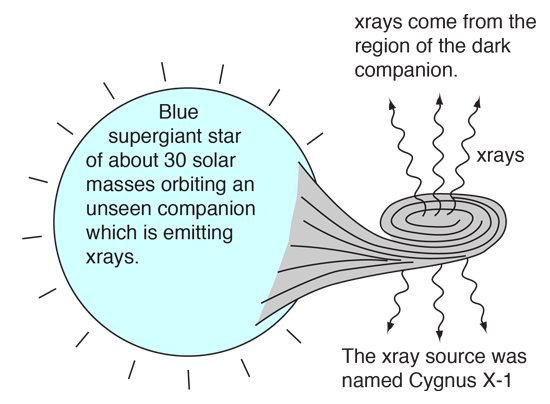
![]() 1. An x-ray source was discovered in the constellation Cygnus in 1972 (Cygnus X-1). X-ray sources are candidates for black holes because matter streaming into black holes will be ionized and greatly accelerated, producing x-rays. 1. 1972年,在天鹅座中发现了一个X射线源(天鹅座X-1)。X射线源被认为是黑洞的候选体,因为物质流入黑洞时会被电离并显著加速,产生X射线。
2. A blue supergiant star, about 25 times the mass of the sun, was found which is apparently orbiting about the x-ray source. So something massive but non-luminous is there (neutron star or black hole). 一颗蓝超巨星,质量约为太阳的25倍,被发现正在围绕X射线源运行。因此,那里似乎存在一个质量大但不发光的天体(中子星或黑洞)。
3. Doppler studies of the blue supergiant indicate a revolution period of 5.6 days about the dark object. Using the period plus spectral measurements of the visible companion's orbital speed leads to a calculated system mass of about 35 solar masses. The calculated mass of the dark object is 8-10 solar masses; much too massive to be a neutron star which has a limit of about 3 solar masses - hence black hole. 3. 对蓝超巨星的多普勒研究表明,它围绕暗物体的公转周期为5.6天。利用公转周期加上可见伴星的轨道速度测量,得出系统的质量约为35个太阳质量。暗物体的质量计算为8-10个太阳质量;这太巨大,不可能是中子星,因为中子星的质量上限约为3个太阳质量——因此应为黑洞。
This is of course not a proof of a black hole -- but it convinces most astronomers. 这当然不是证明存在黑洞——但足以说服大多数天文学家。
Further evidence that strengthens the case for the unseen object being a black hole is the emission of X-rays from its location, an indication of temperatures in the millions of Kelvins. This X-ray source exhibits rapid variations, with time scales on the order of a millisecond. This suggests a source not larger than a light-millisecond or 300 km, so it is very compact. The only possibilities that we know that would place that much matter in such a small volume are black holes and neutron stars, and the consensus is that neutron stars can't be more massive than about 3 solar masses. 进一步支持该未见天体为黑洞的证据是其位置发出的X射线,这表明温度可达数百万开尔文。这种X射线源表现出快速变化,时间尺度约为毫秒量级。这表明其尺寸不超过光-毫秒或300公里,因此非常紧凑。我们已知能将如此多物质压缩到如此小体积的可能只有黑洞和中子星,共识认为中子星的质量不可能超过约3个太阳质量。
|
Index Black hole concepts Reference Chaisson & McMillan Ch. 22 索引 黑洞概念 参考 Chaisson & McMillan 第22章 | ||
|
Go Back
返回 |
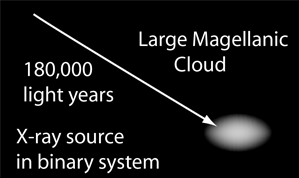
Magellanic Cloud Black Hole大麦哲伦星团黑洞
An object called LMC X-3 discovered in the Large Magellanic Cloud in 1982 had all the earmarks of a black hole. How can "black hole" status be verified? 1982年在大麦哲伦星云中发现的名为LMC X-3的天体具有所有黑洞的特征。如何验证“黑洞”状态?
![]()
|
Index Black hole concepts 索引 黑洞概念 | ||
|
Go Back
返回 |
Black Hole in V404 CygniV404天琴座中的黑洞
The variable star V404 Cygni had been observed to go through several nova stages, or temporary brightening episodes. Then a strong X-ray outburst was observed by the Ginga satellite in 1989 associated with the star. 变星V404天琴座曾被观测到经历几个新星阶段,或暂时变亮的事件。然后,1989年, Ginga卫星观测到该星伴随的强X射线爆发。 Observations with the William Hershel Telescope led to a characterization of the star as a G or K star (and therefore a low mass star) which was orbiting about a companion with a period of 6.473 days. Analysis of the orbit led to a mass of 8-15.5 solar masses for the unseen companion, considered to be much too massive to be a neutron star. The picture that emerges from the data is that a star about two-thirds as massive as the Sun is in close orbit around a black hole of mass about 12 solar masses. The black hole's gravity would distort the star and steal mass from it. The gas flow is apparently not uniform, but when enough collects in an acretion disc around the black hole, then an outburst can occur, causing the brightness to increase to hundreds of times the normal brightness. Gas spiraling into the black hole can accelerate to the point that it produces a burst of X-rays, as this system did in 1989. Associated with that burst, the visible output increased by about 200 times. 从数据中得出的图景是,一颗质量约为太阳两倍的星体在一颗质量约为12个太阳质量的黑洞附近紧密轨道运行。黑洞的引力会扭曲该星体并从其夺取质量。气体流动显然并不均匀,但当足够多的气体聚集在黑洞周围的吸积盘中时,就会发生爆发,使亮度增加到正常水平的数百倍。气体向黑洞螺旋运动可以加速到产生X射线爆发的程度,正如1989年这个系统所发生的那样。伴随这次爆发,可见光输出增加了约200倍。
All the data to date are consistent with a black hole, so this is considered to be one of the best candidates for a black hole. 到目前为止的所有数据都与黑洞一致,因此这被认为是黑洞的最有力候选之一。
使用威廉·赫歇尔望远镜的观测结果导致该星被鉴定为一颗G型或K型星(因此是一颗低质量星),它正围绕一个伴星运行,公转周期为6.473天。对轨道的分析得出伴星的质量为8-15.5倍太阳质量,被认为过于巨大,不可能是中子星。 Sources 源A 6.5天周期性在重复新星V404 Cygni中暗示存在一个黑洞。V404 Cygni |
Index Black hole concepts Cygni wiki 索引 黑洞概念 Cygni wiki | ||
|
Go Back
返回 |