Bilingual edition: English is preserved and Chinese follows each unit. Terminology uses the confirmed v20260916 glossary; automated semantic review remains traceable.
中英双语版:英文原文完整保留,中文紧随对应单元;术语采用 v20260916 确认表,自动语义审校结果可追溯。

Neutron Star

中子星

For a sufficiently massive star, an iron core is formed and still the gravitational collapse has enough energy to heat it up to a high enough temperature to either fuse or fission iron. Either in the aftermath of a supernova or in just a collapsing massive star, the energy gets high enough to break down the iron into alpha particles and other smaller units, and still the pressure continues to build. When it reaches the threshold of energy necessary to force the combining of electrons and protons to form neutrons, the electron degeneracy limit has been passed and the collapse continues until it is stopped by neutron degeneracy. At this point it appears that the collapse will stop for stars with mass less than two or three solar masses, and the resulting collection of neutrons is called a neutron star. The periodic emitters called pulsars are thought to be neutron stars.

If the mass exceeds about three solar masses, then even neutron degeneracy will not stop the collapse, and the core shrinks toward the black hole condition.

如果质量超过大约三个太阳质量,即使中子简并态也无法阻止坍缩,核心会向黑洞条件收缩。

This neutron degeneracy radius is about 20 km for a solar mass, compared to about earth size for a solar mass white dwarf. The density is quoted as about a billion tons per teaspoonful compared to 5 tons per teaspoonful for the white dwarf.

这种中子简并半径对于太阳质量来说大约是20公里,相比之下,白矮星的尺寸则接近地球的大小。密度被引用为每茶匙约10亿吨,相比之下,白矮星的密度则为每茶匙约5吨。

Pasachoff suggests that neutron stars may be crystalline with crusts on the order of 100 meters thick and an atmosphere a few centimeters thick. They may have 1011x the earths gravity and a powerful magnetic field.

Pasachoff认为中子星可能具有晶体结构,其外壳厚度可能达到100米,大气层则只有几厘米厚。它们可能具有约10¹¹倍地球重力和强大的磁场。
A neutron star might have an atmosphere a few centimeters thick and mountain ranges poking up a few centimeters through the atmosphere.

对于足够质量的恒星,会形成铁核,但引力坍缩仍有足够的能量将其加热到足够高的温度,以使铁发生融合或裂变。无论是超新星爆发之后,还是在大质量恒星坍缩过程中,能量都会足够高,将铁分解成α粒子和其他更小的单元,同时压力仍会持续增加。当能量达到足以迫使电子和质子结合形成中子的阈值时,电子简并极限已被超越,坍缩继续直到被中子简并压力所阻止。此时,对于质量小于两或三个太阳质量的恒星,坍缩似乎会停止,所形成的中子集合被称为中子星。被称为脉冲星的周期性发射体被认为就是中子星。中子星可能拥有几厘米厚的大气层,其上可能有几厘米高的山峰突起。

A neutron star is thought to be about 1/100,000 the diameter of the Sun, and a nucleus is on the order of 100,000 times smaller than an atom. Though interesting as an order-of-magnitude comparison, this does not imply that the atoms in the sun are packed in close contact. The neutron stars would generally be formed from stars condiderably more massive than our Sun. The incredible density of neutron stars does come from the fact that from atomic size, the electrons are collapsed into the nucleus to combine with protons to form neutrons so that the entire body approaches nuclear density.

中子星的直径被认为大约是太阳的1/100000,而原子核的尺寸大约是原子的100000倍。尽管这种数量级的比较很有趣,但它并不意味着太阳中的原子是紧密接触的。中子星通常是由比太阳质量大得多的恒星形成的。中子星的惊人密度确实来自于这样的事实:从原子尺度来看,电子被压缩到原子核中,与质子结合形成中子,从而使整个物体接近核密度。

Recent research suggests that the heaviest elements may be formed primarily in neutron star mergers rather than supernovae (Frebel & Beers, Physics Today, Jan 2018).

近期研究表明,最重的元素可能主要在中子星合并过程中形成,而非超新星爆发(Frebel & Beers,Physics Today,2018年1月)。
Index

Reference
Pasachoff
Sec 8.4
索引参考 Pasachoff 第8章第4节
 
HyperPhysics***** Astrophysics
HyperPhysics ***** 天体物理学
R Nave
Go Back
返回


Pulsars

脉冲星

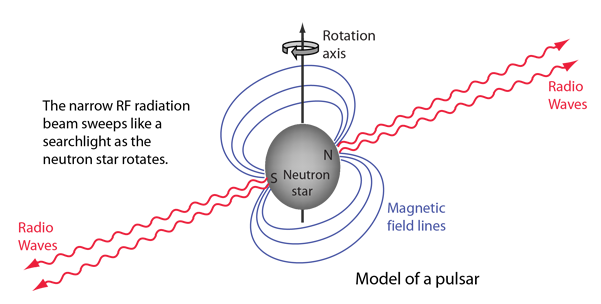
Intriguing, precisely repeated radio pulses from the plane of our galaxy were discovered in the late 1960's and half-seriously attributed to "little green men" and called LGMs. By a process of elimination and modeling, these periodic sources, called pulsars, are attributed to rotating neutron stars which emit lighthouse type sweeping beams as they rotate.

令人着迷的、精确重复的来自银河平面的无线电脉冲于1960年代末被发现,半认真地归因于“小绿人”并被称为LGMs。通过排除法和建模,这些周期性源被归因于旋转的中子星,它们在旋转时发出类似灯塔的扫射束。

Variations in the normal periodic rate are interpreted as energy loss mechanisms or, in one case, taken as evidence of planets around the pulsar.

正常周期性速率的变化被解释为能量损失机制,或者在一种情况下,被当作脉星周围存在行星的证据。
Example of precision
精度的例子
Binary pulsar
二元脉冲星
Index

Pasachoff
p212
索引 Pasachoff p212
 
HyperPhysics***** Astrophysics
HyperPhysics ***** 天体物理学
R Nave
Go Back
返回


Neutron Degeneracy

中子简并

Neutron degeneracy is a stellar application of the Pauli Exclusion Principle, as is electron degeneracy. No two neutrons can occupy identical states, even under the pressure of a collapsing star of several solar masses. For stellar masses less than about 1.44 solar masses (the Chandrasekhar limit), the energy from the gravitational collapse is not sufficient to produce the neutrons of a neutron star, so the collapse is halted by electron degeneracy to form white dwarfs. Above 1.44 solar masses, enough energy is available from the gravitational collapse to force the combination of electrons and protons to form neutrons. As the star contracts further, all the lowest neutron energy levels are filled and the neutrons are forced into higher and higher energy levels, filling the lowest unoccupied energy levels. This creates an effective pressure which prevents further gravitational collapse, forming a neutron star. However, for masses greater than 2 to 3 solar masses, even neutron degeneracy can't prevent further collapse and it continues toward the black hole state.

中子简并是一种泡利不相容原理在恒星中的应用,电子简并也是如此。即使在几倍太阳质量的坍缩星的高压下,两个中子也不能占据相同的量子态。对于小于约1.44个太阳质量(钱德勒极限)的恒星质量,引力坍缩产生的能量不足以产生中子星中的中子,因此坍缩被电子简并所阻止,形成白矮星。在超过1.44个太阳质量的情况下,足够的能量可以从引力坍缩中获得,迫使电子和质子结合形成中子。随着恒星进一步收缩,所有最低的中子能级都被填满,中子被迫进入更高的能级,填满最低的未被占据的能级。这产生了一个有效的压力,阻止进一步的引力坍缩,形成中子星。然而,对于超过2到3个太阳质量的恒星,即使中子简并也无法阻止进一步的坍缩,它将继续向黑洞状态发展。
Index
索引
 
HyperPhysics***** Astrophysics
HyperPhysics ***** 天体物理学
R Nave
Go Back
返回


Pulsar Examples

脉冲星示例

In 1967 a repeating RF pulse was discovered in our galaxy with a period of 1.3373011 seconds, reproducible at 1 part in 108! At first it generated excitement as a possible beacon from an intelligent civilization. At present it is called a pulsar and viewed as a point source of radiation on a spinning neutron star, a rotating beacon.

1967年,天文学家在银河系中发现了一种重复的射频脉冲,其周期为1.3373011秒,可重复性达到10⁸分之一!起初,人们认为这可能是来自智能文明的信号。如今,它被称为脉冲星,被视为来自旋转的中子星的点状辐射源。

A 0.033 sec pulsar was discovered in the Crab Nebula as well as an optical and x-ray counterpart. The discovery of the optical and RF signals from the same source was important in that it gave a probe of the number of free electrons in space between us and the pulsar. The dispersion, or slowing of the RF compared to the visible gave the figure of about 1 electron per 30 cm3, using the distance to the Crab Nebula obtained by other methods. The Crab pulsar is slowing at the rate of about 10-8 sec per day, and the corresponding energy loss agrees well with the energy needed to keep the nebula luminous. "Starquakes" on pulsars, glitches which speed up the pulsar for a short time, may represent settling of the pulsar crust by as small an amount as a mm!

在蟹状星云中发现了一颗0.033秒的脉冲星,同时还发现了光学和X射线的对应信号。光学和射频信号的发现具有重要意义,因为它们提供了我们与脉冲星之间空间中自由电子数量的探测。射频信号相比可见光的减速,给出了大约每30立方厘米有1个电子的数值,这个数值是通过其他方法获得的蟹状星云距离得到的。蟹状星云脉冲星的自转速率正在以每天约10^-8秒的速率减慢,相应的能量损失与维持星云发光所需能量相符。“星震”现象,即使脉冲星短暂加速的glitches,可能代表脉冲星外壳的调整,幅度可能小至毫米级。
Index

Pasachoff
Ch 8
索引 Pasachoff 第8章
 
HyperPhysics***** Astrophysics
HyperPhysics ***** 天体物理学
R Nave
Go Back
返回


Binary Pulsar

二体脉冲星

Hulse and Taylor won the Nobel Prize in 1993 for the discovery of the first binary pulsar in 1974. It has a period of 59 milliseconds but shows an orbital period of 7 hours and 45 minutes. Discovered at Arecibo, it was an important test of general relativity. There have been about 40 binary pulsars discovered to date.

Hulse 和 Taylor 于 1993 年因发现第一个二体脉冲星而获得诺贝尔奖。该脉冲星的周期为 59 毫秒,但其轨道周期为 7 小时 45 分钟。该脉冲星于阿雷西博发现,是广义相对论的重要检验。截至目前,已发现约 40 个二体脉冲星。

An exciting close binary was reported in Nature in December 2003 and in Science in early 2004. With the cumbersome designation PSR J0737-3039A, it is composed of pulsars with an eccentric orbit of period just 2.4 hours! The most active of the pulsars spins 44 times per second and its companion just once in 2.8 seconds. Irion in Science described the pair as "two pulsars in a tight orbital embrace, blasting each other with radiation as they spiral toward a mutual doom." General relativity calculations reportedly suggest a convergence of the two pulsars by about 7 millimeters/day with a projected crash in about 85 million years.

2003年12月,《自然》杂志和2004年初《科学》杂志都报道了一颗有趣的密接双星。它以冗长的名称PSR J0737-3039A被标识,由两颗脉冲星组成,具有很高的轨道偏心率,轨道周期仅为2.4小时!其中一颗脉冲星每秒自转44次,而其伴星则每2.8秒自转一次。Irion在《科学》杂志中描述这对脉冲星为“两颗脉冲星在紧密的轨道拥抱中相互辐射,向彼此的毁灭螺旋靠近”。广义相对论的计算表明,这两颗脉冲星每天会相互接近约7毫米,预计在大约8500万年后发生碰撞。

At just 2000 light years distance, this binary pulsar is relatively close. Its orbit is almost edge-on from the Earth, optimum for viewing. Part of the promise of this dramatic pair is information about relativistic theories of the gravitational interaction. The discovery of this binary pulsar is credited to the 64-meter Parkes radio telescope in New South Wales, Australia. The measurement of the slower period of the companion is credited to Jodrell Bank Observatory in Macclesfield, U.K.

在2000光年之外,这个双星脉冲星相对接近。其轨道几乎是从地球边缘视角观察的,是最适合观测的。这个壮观双星系统的一部分承诺是关于引力相互作用的相对论理论的信息。这一双星脉冲星的发现归功于澳大利亚新南威尔士州的64米帕克斯射电望远镜。对伴星较慢周期的测量归功于英国麦克斯韦尔菲尔德的Jodrell Bank天文台。
Using binary pulsars to test general relativity
利用双星脉冲星检验广义相对论
Index

References
Schwarzschild

Irion
索引参考施瓦茨希尔德伊罗恩
 
HyperPhysics***** Astrophysics
HyperPhysics ***** 天体物理学
R Nave
Go Back
返回


Planets around pulsar?

脉冲星周围的行星?

Radio emissions from the object labeled PSR B1257+12 some 980 light years away in the Virgo constellation classify it as a pulsar with period 6.33 milliseconds. Observations from Arecibo detected variation in the pulsars period which could be modeled in terms of planets orbiting about the pulsar. Current observations indicate three planets and a possible fourth.

距离室女座约980光年的天体PSR B1257+12发出的无线电波将其归类为脉冲星,其周期为6.33毫秒。阿雷西博天文台的观测发现脉冲星周期的变化,这可以解释为行星围绕脉冲星运行。目前的观测结果表明存在三颗行星,可能还有一颗第四颗。

Wiki on PSR B1257+12

关于PSR B1257+12的维基百科
Index

Cowen
Cowen 索引
 
HyperPhysics***** Astrophysics
HyperPhysics ***** 天体物理学
R Nave
Go Back
返回