Supernova 1987A
1987A型超新星
The discovery of Supernova 1987A was a great opportunity for detailed observation of the dynamics of a supernova. This supernova was unusual in that it did not rise abruptly to its maximum brightness, but paused briefly before increasing its luminosity by another factor of ten. It increased for about 85 days and then began a gradual decline which was more characteristic of other observed supernovae.
1987A型超新星的发现为详细观测超新星的动力学提供了绝佳机会。这种超新星与众不同之处在于,它并未突然达到最大亮度,而是在亮度增加十倍之前短暂暂停。它持续增加了约85天,之后开始逐渐下降,这种下降趋势更符合其他观测到的超新星的特点。
Another unique feature about this supernova is that the star which exploded had been observed and named Sk-69202. It was a blue supergiant presumed to have a mass of about 20 solar masses.
这个超新星还有一个独特之处,即爆炸的恒星曾被观测并命名为Sk-69202。它是一颗蓝超巨星,预计质量约为20个太阳质量。
Almost coincident with the observation of the supernova, a burst of neutrinos were observed on the Earth, providing further information for modeling supernovae and providing another test for the mass of the neutrino.
几乎与超新星的观测同时发生的是,地球上观测到了中微子爆发,这为模拟超新星提供了更多信息,并为中微子质量提供了另一个检验。
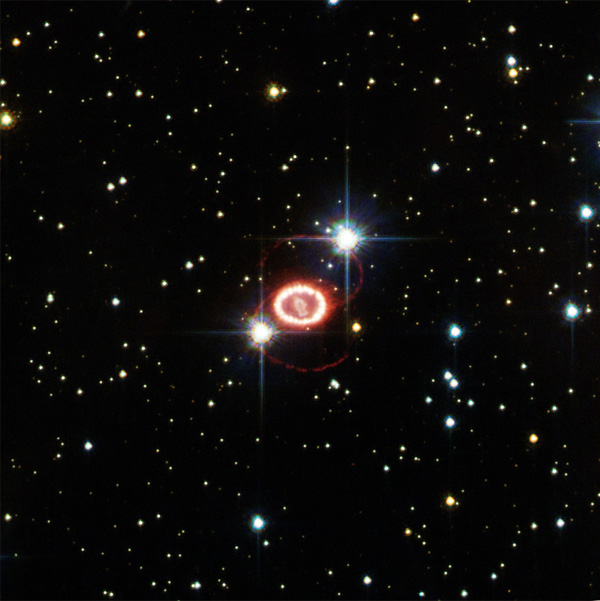
This image of the remnant of Supernova 1987a was taken by the Hubble Space Telescope (Picture credit ESA/Hubble & NASA). The image was taken in December 2006 with Hubble's Advanced Camera for Surveys. The field of view is about 25x25 arcseconds. Note the two glowing loops and the inner circle of glowing material. ESA suggests that the loops and rings are probably material ejected from the star earlier in its history that is now being illuminated by the supernova and its shockwave. A neutron star is expected as a remnant of the supernova, but it has not been detected.
这张是超新星1987a残骸的图像,由哈勃太空望远镜(图片版权:ESA/哈勃与NASA)拍摄。该图像于2006年12月使用哈勃的先进巡天相机拍摄。视场约为25x25角秒。请注意那两个发光的环状结构和内部发光物质环。ESA认为这些环状结构和环可能是该星体在历史早期抛射出的物质,现在正被超新星及其冲击波照亮。中子星是超新星残骸的预期产物,但尚未被探测到。 "The pink object in the centre of the ring is debris from the supernova blast. The glowing debris is being heated by radioactive elements, principally titanium 44, created in the explosion. The debris will continue to glow for many decades."
环中央的粉红色物体是超新星爆发产生的碎片。这些发光的碎片由放射性元素(主要是钛-44)加热。这些碎片将在许多 decades 内继续发光。 Reference: Hubble website
参考:哈勃网站 |