Bilingual edition: English is preserved and Chinese follows each unit. Terminology uses the confirmed v20260916 glossary; automated semantic review remains traceable.
中英双语版:英文原文完整保留,中文紧随对应单元;术语采用 v20260916 确认表,自动语义审校结果可追溯。

Hund's Rules

洪德规则

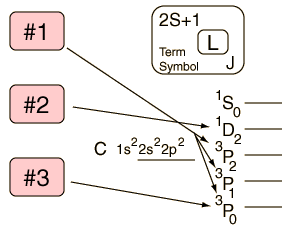
1. The term with maximum multiplicity lies lowest in energy.

乘积最大的项位于能量最低处。
Click on the indicated buttons for more detail.
点击指示的按钮以获取更多细节。
2. For a given multiplicity, the term with the largest value of L lies lowest in energy.
对于给定的简并度,具有最大L值的项能量最低。
3. For atoms with less than half-filled shells, the level with the lowest value of J lies lowest in energy.
对于壳层未填满的原子,具有最低J值的能级能量最低。
Hund's rules assume combination to form S and L, or imply L-S (Russell-Saunders) coupling.
洪德规则假设形成S和L的组合,或暗示L-S(Russell-Saunders)耦合。

Note: Some references, such as Haken & Wolf, use Hund's Rule #1 to apply to the nature of full shells and subshells. Full shells and subshells contribute nothing to the total angular momenta L and S. If you call this Hund'e Rule #1, then the above rules will be bumped up one in number. I don't know which is the more common practice.

注意:一些参考文献,如Haken & Wolf,将Hund规则#1应用于全壳层和亚壳层的性质。全壳层和亚壳层对总角动量L和S的贡献为零。如果将其称为Hund规则#1,那么上述规则的编号将相应增加1。我不确定哪种做法更为常见。
Exceptions to Hund's Rules
洪德规则的例外
Multi-electron energy levels
多电子能级
Index

Atomic structure concepts
索引 原子结构概念
 
HyperPhysics***** Quantum Physics
HyperPhysics ***** 量子物理
R Nave
Go Back
返回


Hund's Rule #1

洪德规则 #1

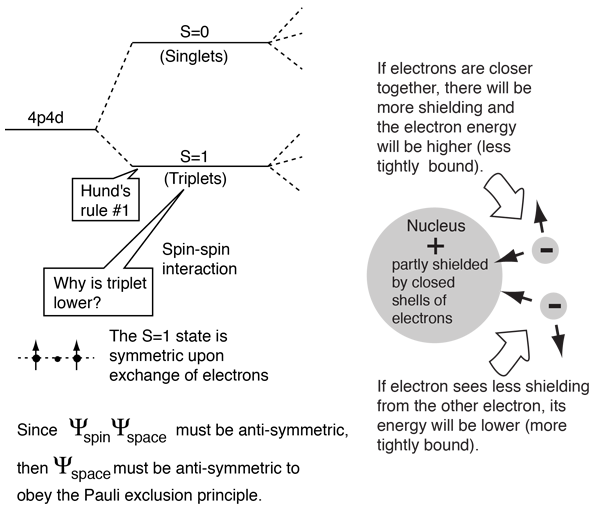
The term with the maximum multiplicity lies lowest in energy.

具有最大简并度的项能量最低。
Example: In the configuration p2 we expect the order 3P < (1D,1S).
在配置p²中,我们预期的顺序为3P < (¹D, ¹S)。

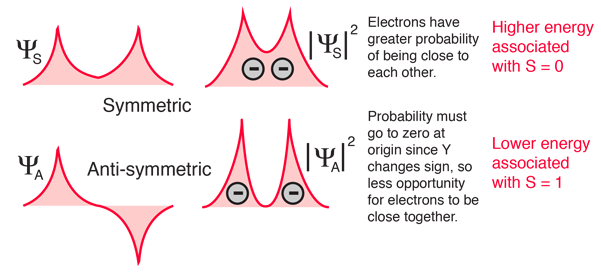
The explanation of the rule lies in the effects of the spin-spin interaction. Though often called by the name spin-spin interaction, the origin of the energy difference is in the coulomb repulsion of the electrons. It's just that a symmetric spin state forces an antisymmetric spatial state where the electrons are on average further apart and provide less shielding for each other, yielding a lower energy. The sketches below attempt to visualize why that is so.

自旋-自旋相互作用的解释在于自旋-自旋相互作用的影响。尽管通常被称为自旋-自旋相互作用,但能量差的起源在于电子的库仑排斥。实际上,对称的自旋态迫使空间态为反对称,使得电子平均更远离彼此,彼此之间的屏蔽作用更弱,从而能量更低。下面的示意图试图说明其中的原因。

These sketches are conceptual only. No attempt has been made to do any realistic scaling.

这些草图仅具有概念性。未尝试进行任何真实的比例缩放。

Note that the energies we are discussing here are electric potential energies, so that a negative electron in the vicinity of a positive nucleus will have a negative energy leading to a bound state. Any force between the electrons will tend to counter that, contributing a positive potential energy which makes the electrons less tightly bound, or higher in potential energy.

需要注意的是,我们在这里讨论的能量是电势能,因此一个位于正核附近带负电的电子将具有负的能量,从而形成束缚态。电子之间的任何力都会试图抵消这一点,贡献出正的势能,使电子的结合更弱,或处于更高的势能状态。
Example of ortho- and parahelium
正氦和para氦的例子
Hund's Rules
洪德规则
Multi-electron energy levels
多电子能级
Index

Atomic structure concepts

Reference
Rohlf
Ch 9
索引 原子结构概念 参考 Rohlf 第9章
 
HyperPhysics***** Quantum Physics
HyperPhysics ***** 量子物理
R Nave
Go Back
返回


Hund's Rule #2

洪德规则 #2

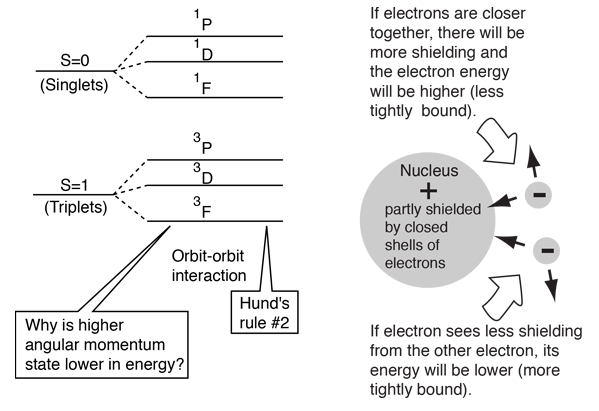
For a given multiplicity, the term with the largest value of L lies lowest in energy.

在给定的可及态数下,具有最大L值的项处于最低能级。

Example: In the configuration p2 we expect the order 3P < 1D < 1S).

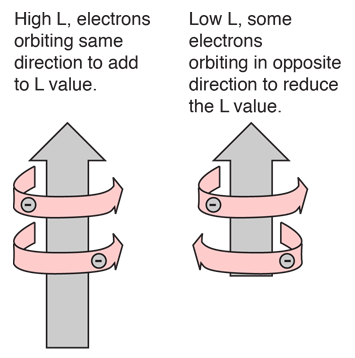
The basis for this rule is essentially that if the electrons are orbiting in the same direction (and so have a large total angular momentum) they meet less often than when they orbit in opposite directions. Hence their repulsion is less on average when L is large.

这条规则的基础在于,如果电子以相同方向运动(因此具有较大的总角动量),它们相遇的次数会比以相反方向运动时更少。因此,当L较大时,它们的排斥作用平均来说会更小。

These influences on the atomic electron energy levels is sometimes called the orbit-orbit interaction. The origin of the energy difference lies with differences in the coulomb repulsive energies between the electrons.

这些对原子电子能级的影响有时被称为轨道-轨道相互作用。能量差异的起源在于电子之间的库仑排斥能差异。

For large L value, some or all of the electrons are orbiting in the same direction. That implies that they can stay a larger distance apart on the average since they could conceivably always be on the opposite side of the nucleus. For low L value, some electrons must orbit in the opposite direction and therefore pass close to each other once per orbit, leading to a smaller average separation of electrons and therefore a higher energy.

对于较大的L值,有些或所有电子可能都在同一方向轨道运动。这表明它们可以平均保持更大的距离,因为它们可能始终处于核的相反侧。对于较小的L值,有些电子必须逆向运动,因此在每个轨道中都会接近彼此,导致电子的平均距离更小,因此能量更高。
Hund's Rules
洪德规则
Multi-electron energy levels
多电子能级
例如:在p²配位中,我们预期的顺序为3P < 1D < 1S。
Index

Atomic structure concepts

Reference
Rohlf
Ch 9
索引 原子结构概念 参考 Rohlf 第9章
 
HyperPhysics***** Quantum Physics
HyperPhysics ***** 量子物理
R Nave
Go Back
返回


Hund's Rule #3

洪德规则第三条

For atoms with less than half-filled shells, the level with the lowest value of J lies lowest in energy.

对于壳层未填满的原子,J值最小的能级能量最低。

Example: Since p2 is less than half-filled, the three levels of 3P are expected to lie in the order 3P0 < 3P1 < 3P2 .

When the shell is more than half full, the opposite rule holds (highest J lies lowest). The basis for the rule is the spin-orbit coupling. The scalar product S·L is negative if the spin and orbital angular momentum are in opposite directions. Since the coefficient of S·L is positive, lower J is lower in energy.

当壳层超过半满时,相反的规则成立(最高J处于最低处)。该规则的基础是自旋-轨道耦合。若自旋和轨道角动量方向相反,则S·L的标量积为负值。由于S·L的系数为正,因此较低的J对应较低的能量。
Hund's Rules
洪德规则
Multi-electron energy levels
多电子能级
例如:由于p²未被填满,预期3P的三个能级将按顺序排列为3P₀ < 3P₁ < 3P₂。
Index

Atomic structure concepts

Reference
Rohlf
Ch 9
索引 原子结构概念 参考 Rohlf 第9章
 
HyperPhysics***** Quantum Physics
HyperPhysics ***** 量子物理
R Nave
Go Back
返回


Exceptions to Hund's Rules

洪德规则的例外

Hund's rules presume L-S coupling and presume that the electrons can be considered to be in a unique configuration. Neither is always true. For heavier elements, the "j-j coupling" scheme often gives better agreement with experiment.

洪德规则假定采用L-S耦合,并假定电子可以被认为处于一个独特的态。但这并不总是成立。对于较重的元素,通常采用“j-j耦合”方案能更好地符合实验结果。
Hund's Rules
洪德规则
Index

Atomic structure concepts

Reference
Rohlf
Ch 9
索引 原子结构概念 参考 Rohlf 第9章
 
HyperPhysics***** Quantum Physics
HyperPhysics ***** 量子物理
R Nave
Go Back
返回