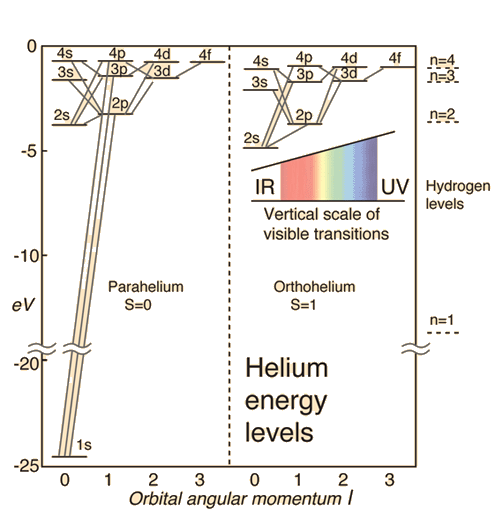
Orthohelium and Parahelium Energy Levels
正氦和正氦能级
In the helium energy level diagram, one electron is presumed to be in the ground state of a helium atom, the 1s state. An electron in an upper state can have spin antiparallel to the ground state electron (S=0, singlet state, parahelium) or parallel to the ground state electron (S=1, triplet state, orthohelium).
在氦的能量级图中,假设有电子处于氦原子的基态(1s态)。处于激发态的电子可以有自旋与基态电子反平行(S=0,单重态,para氦)或平行(S=1,三重态,ortho氦)。
It is observed that the orthohelium states are lower in energy than the parahelium states. The explanation for this is:
观察到正氦态的能级比正氦态的能级更低。其解释是:
- The parallel spins make the spin part of the wavefunction symmetric.
自旋平行使波函数的自旋部分对称。
- The total wavefunction for the electrons must be anti-symmetric since they are fermions and must obey the Pauli exclusion principle.
电子的总波函数必须是反对称的,因为它们是费米子,必须遵守泡利不相容原理。
- This forces the space part of the wavefunction to be anti-symmetric. The wavefunction for the electrons can be written as the product of the space and spin parts of the wavefunction.
这迫使波函数的空间部分必须是反对称的。电子的波函数可以写成空间部分和自旋部分的乘积。
- An anti-symmetric space wavefunction for the two electrons implies a larger average distance between them than a symmetric function of the same type. The probability is the square of the wavefunction, and from a simple functional point of view, the square of an antisymmetric function must go to zero at the origin. So in general, the probability for small separations of the two electrons is smaller than for a symmetric space wavefunction.
一个反对称的空间波函数对于两个电子意味着它们之间的平均距离比相同类型的对称函数更大。概率是波函数的平方,从简单的函数观点来看,反对称函数的平方在原点处必须趋于零。因此,总体而言,两个电子小距离的概率比对称空间波函数的小。
- If the electrons are on the average further apart, then there will be less shielding of the nucleus by the ground state electron, and the excited state electron will therefore be more exposed to the nucleus. This implies that it will be more tightly bound and of lower energy.
如果电子平均更远离核,则地面态电子对核的屏蔽作用会减少,激发态电子因此会更暴露于核。这表明它会更紧密地结合,具有更低的能量。
This effect is sometimes called the "spin-spin interaction" and is addressed by Hund's Rule #1 . It is part of the understanding of the ordering of energy levels in multi-electron atoms.
这种效应有时被称为“自旋-自旋相互作用”,并由洪德规则#1加以解释。它是理解多电子原子中能级排列的理解的一部分。
|
Index
Reference
Rohlf
Ch 9
索引参考Rohlf第9章 |