Bilingual edition: English is preserved and Chinese follows each unit. Terminology uses the confirmed v20260916 glossary; automated semantic review remains traceable.
中英双语版:英文原文完整保留,中文紧随对应单元;术语采用 v20260916 确认表,自动语义审校结果可追溯。

Hydrogen Fine Structure

氢精细结构
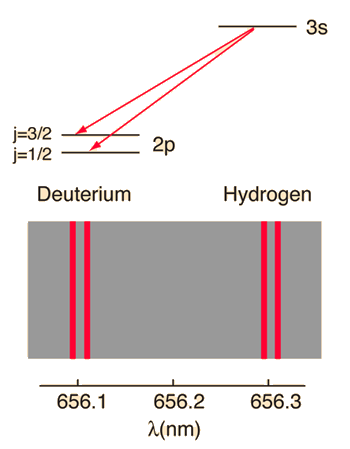
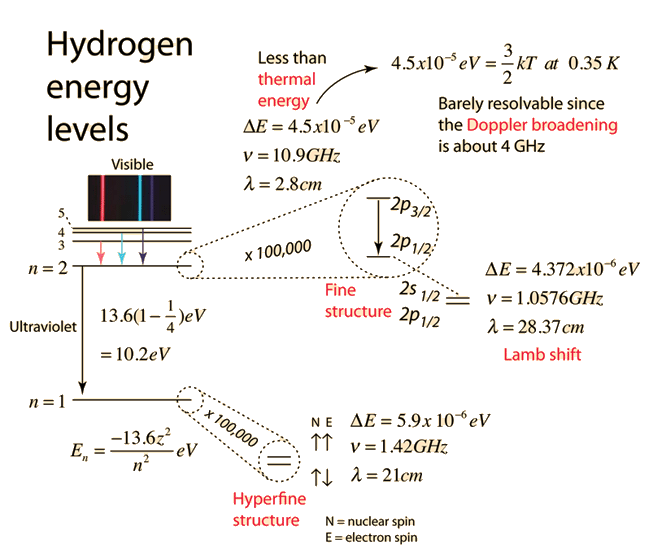
When the familiar red spectral line of the hydrogen spectrum is examined at very high resolution, it is found to be a closely-spaced doublet. This splitting is called fine structure and was one of the first experimental evidences for electron spin.
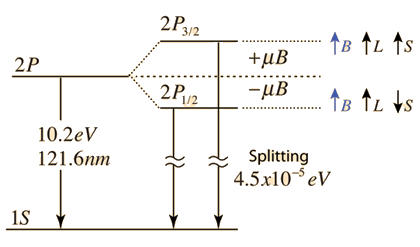
The small splitting of the spectral line is attributed to an interaction between the electron spin S and the orbital angular momentum L. It is called the spin-orbit interaction.
谱线的微小分裂归因于电子自旋S与轨道角动量L之间的相互作用。这种现象称为自旋-轨道相互作用。

The familiar red H-alpha line of hydrogen is a single line according to the Bohr theory. The straight application of the Schrodinger equation to the hydrogen atom gives the same result. If you calculate the wavelength of this line using the energy expression from the Bohr theory, you get 656.11 nm for hydrogen, treating the nucleus as a fixed center. If you use the reduced mass, you get 656.47 nm for hydrogen and 656.29 nm for deuterium. The difference between the hydrogen and deuterium lines is about 0.2 nm and the splitting of each of them is about 0.016 nm, corresponding to an energy difference of about 0.000045 eV. This corresponds to an internal magnetic field on the electron of about 0.4 Tesla.

氢的熟悉红H-α线根据玻尔理论是一个单线。将薛定谔方程直接应用于氢原子得到相同的结果。如果你用玻尔理论中的能量表达式计算这条线的波长,得到氢的波长为656.11纳米,将原子核视为固定中心。如果使用约化质量,得到氢的波长为656.47纳米,氘的波长为656.29纳米。氢和氘的波长差异约为0.2纳米,每条线的分裂约为0.016纳米,对应能量差约为0.000045 eV。这对应于电子内部的磁场约为0.4特斯拉。

Active illustration: click for more detail

Examination of fine structure by saturation spectroscopy
通过饱和光谱法考察精细结构
当氢谱线中熟悉的红色谱线在极高分辨率下被考察时,发现它是一个 closely-spaced doublet。这种分裂被称为精细结构,并是电子自旋的第一个实验证据之一。主动示例:点击查看更多细节
Index

Schrodinger equation concepts

Hydrogen concepts

Atomic structure concepts

Reference
Rohlf
Sec 8.6
索引、薛定谔方程概念、氢原子概念、原子结构概念、参考、Rohlf 第8章第6节
 
HyperPhysics***** Quantum Physics
HyperPhysics ***** 量子物理
R Nave
Go Back
返回


Spin-Orbit Interaction

自旋-轨道相互作用

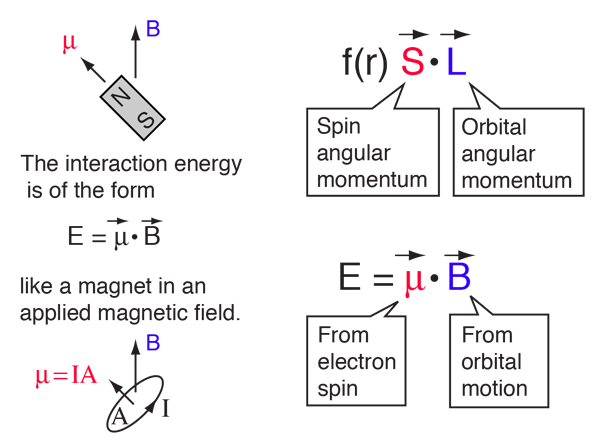
The energy levels of atomic electrons are affected by the interaction between the electron spin magnetic moment and the orbital angular momentum of the electron. It can be visualized as a magnetic field caused by the electron's orbital motion interacting with the spin magnetic moment. This effective magnetic field can be expressed in terms of the electron orbital angular momentum. The interaction energy is that of a magnetic dipole in a magnetic field and takes the form

原子电子的能量级受电子自旋磁矩与电子轨道角动量之间的相互作用影响。可以形象地看作是电子轨道运动产生的磁场与自旋磁矩之间的相互作用。这种有效磁场可以表示为电子轨道角动量的函数。相互作用能量是磁偶极子在磁场中的能量,形式为

When atomic spectral lines are split by the application of an external magnetic field, it is called the Zeeman effect. The spin-orbit interaction is also a magnetic interaction, but with the magnetic field generated by the orbital motion of an electron within the atom itself. It has been described as an "internal Zeeman effect". The standard example is the hydrogen fine structure.

当原子谱线在施加外磁场时发生分裂,这种现象称为塞曼效应。自旋-轨道相互作用也是一种磁相互作用,但其磁场是由电子在原子内部的轨道运动所产生的。它被描述为一种‘内部塞曼效应’。典型的例子是氢的精细结构。
Hydrogen fine structure
氢精细结构
Spin-orbit splitting in sodium
钠的自旋-轨道分裂
Index

Schrodinger equation concepts

Atomic structure concepts
索引薛定谔方程概念 原子结构概念
 
HyperPhysics***** Quantum Physics
HyperPhysics ***** 量子物理
R Nave
Go Back
返回


Effective Magnetic Field of Orbit

轨道的有效磁场

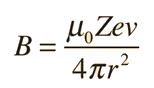
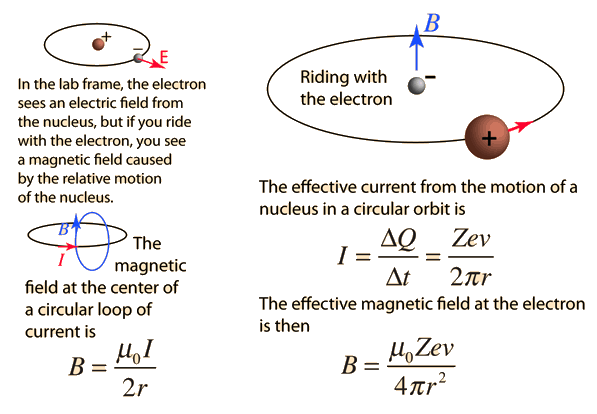
The classical magnetic field in the electron frame of reference arising from the orbital motion is

在电子参考系中由轨道运动产生的经典磁场

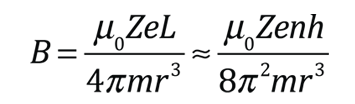
Using classical physics and assuming a circular orbit, the angular momentum is L = mrv, so this field can be expressed in terms of the orbital angular momentum L:

使用经典物理并假设圆轨道时,角动量为 L = mrv,因此该场可以表示为轨道角动量 L 的函数:

This is making use of the Bohr model where L=nh/2π . For a hydrogen electron in a 2p state at a radius of 4x the Bohr radius, this translates to a magnetic field of about 0.03 Tesla.

这利用了玻尔模型,其中L=nh/2π。对于一个处于2p态、半径为4倍玻尔半径的氢电子,这相当于产生约0.03特斯拉的磁场。

The magnetic field exerted on the orbiting electron as a result of the orbit produces an energy by the spin-orbit interaction. This energy contribution depends upon the relative orientation of its orbital and spin angular momentum. The magnetic field at the electron is in the direction of the orbital angular momentum. The energy contribution can be expressed as

由电子轨道产生的磁场作用于电子轨道上,通过自旋-轨道相互作用产生能量。这种能量贡献取决于其轨道角动量和自旋角动量之间的相对取向。电子处的磁场方向与轨道角动量方向一致。这种能量贡献可以表示为

With the two orientations of spin, the energy separation ΔE can be expressed as

具有自旋的两种取向,能量差ΔE可以表示为

where α is the fine structure constant:

其中 α 是精细结构常数:

Considering the example of the fine structure of the n=2 hydrogen level shown above, that substitution with the approximation that the radius = a0n2 yields the value

考虑上文所示的n=2氢原子能级的精细结构例子,用近似值半径= a0 n²进行替换,可以得到
Index

Schrodinger equation concepts

Blatt
Modern Physics Sec 9.3
索引 斯涅尔方程概念 布拉特现代物理 第9.3节
 
HyperPhysics***** Quantum Physics
HyperPhysics ***** 量子物理
R Nave
Go Back
返回


Magnetic Field in Electron Frame

电子参考系中的磁场
Magnetic field of current loop
电流环的磁场
Express in terms of angular momentum
用角动量表示
Index

Schrodinger equation concepts
索引:薛定谔方程概念
 
HyperPhysics***** Quantum Physics
HyperPhysics ***** 量子物理
R Nave
Go Back
返回