Bilingual edition: English is preserved and Chinese follows each unit. Terminology uses the confirmed v20260916 glossary; automated semantic review remains traceable.
中英双语版:英文原文完整保留,中文紧随对应单元;术语采用 v20260916 确认表,自动语义审校结果可追溯。

Monaural and Stereo Signals

单声道和立体声信号

Monaural, or single source sound signals, combine all audio information into a single channel. This is characteristic of older signals, but monaural signals are also currently used in AM radio and in many large auditorium sound systems. Mono is used in AM radio because of bandwidth limitations. For auditorium sound systems, the use of ordinary stereo is problematic because those listeners close to one of the stereo speakers will perceive all of the sound to be coming from that speaker, whereas the real sound source may be center front. The resulting sound image problems are so severe in large auditoriums that a single sound cluster is typically used over the sound source to keep the sound image centered.

单声道,或单源音频信号,将所有音频信息合并到一个通道中。这特征于较旧的信号,但单声道信号目前也用于AM广播和许多大型礼堂音响系统中。在AM广播中使用单声道是因为带宽限制。对于礼堂音响系统,使用普通立体声存在问题,因为靠近其中一个立体声扬声器的听众会感知所有声音都来自该扬声器,而实际声源可能在中前位置。在大型礼堂中,这种声音图像问题非常严重,因此通常会使用一个声音集群来覆盖声源,以保持声音图像居中。

Stereo, or two discrete channel sound, gives a much more realistic sound in a home listening room, allowing you to localize the instruments in an orchestra for example. Discrete stereo with high channel separation is possible from any signal source which can present a left and right channel, and can be broadcast with FM radio. Further enhancements to sound fields can be made with surround sound.

立体声,或两个独立声道的音响,能在家庭聆听室中提供更加真实的音效,例如可以让你定位交响乐团中的各种乐器。只要信号源能够提供左声道和右声道,就可以实现高分离度的独立立体声,并可通过FM广播进行播放。此外,还可以通过环绕声进一步提升音场效果。
Index

Sound reproduction concepts
索引 声学再现概念
 
HyperPhysics***** Sound
HyperPhysics ***** 声音
R Nave
Go Back
返回


Surround Sound

环绕声

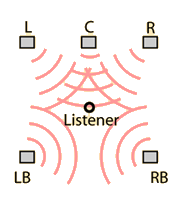
Surround sound is a term applied to five channel sound (regular R & L stereo, center front, plus left and right rear speakers). It typically means Dolby Surround, the home application of Dolby Stereo, which was introduced into movie theaters in the 70's. It is a matrix encoding scheme which puts four channels of information on two recorded channels to be decoded into L, R, Center, and Surround upon playback.

环绕声是指五声道声音(常规的左右立体声,中前声道,加上左右后声道)。它通常指Dolby Surround,即Dolby Stereo在家庭应用中的形式,该技术于70年代被引入电影院。它是一种矩阵编码方案,将四个声道的信息放在两个录制声道中,播放时可解码为左、右、中和环绕声。

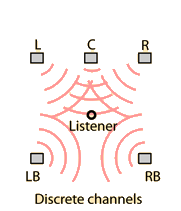
A popular adaptation of surround sound for home sound systems is called Dolby Pro-logic. To obtain five discrete channels of information (including separate signals to LB and RB speakers requires digital surround sound.

一种流行的用于家庭音响系统的环绕声改编技术称为Dolby Pro-logic。要获得五个独立声道的信息(包括分别送往左后声道和右后声道的信号),需要数字环绕声。
Sound synthesis
声音合成
Index

Sound reproduction concepts

Audio signal concepts

Reference
Riggs
索引 声学再现概念 音频信号概念 参考 Riggs
 
HyperPhysics***** Sound
HyperPhysics ***** 声音
R Nave
Go Back
返回


Dolby Pro-Logic

杜比 Pro-Logic

Dolby Pro-Logic refers to a system for decoding Dolby Surround signals and directing them to five speakers. Receivers which are designated as "surround" may passively separate the surround signal and send the center channel signal equally to R and L front channels. Dolby Pro-Logic goes further in that it extracts the center channel signal to send to the front center speaker and actively cancels it from the L & R speakers. It attempts to steer the signal to the correct channels, and in so doing it creates a more realistic sound field, but it cannot overcome the limitations of the matrix encoding scheme. The L to R channel separation is high, but between center and left or right the separation is limited to about 3 dB. The separation between surround and left or right is similarly limited. All surround speakers receive the same signal. Precise sound localization requires 15 to 20 dB of channel separation (Riggs). More precise localization is obtainable from digital surround systems. One such system is called AC-3.

Dolby Pro-Logic 指的是一个用于解码 Dolby Surround 信号并将其发送到五个扬声器的系统。被指定为“环绕声”的接收机可能被动地将环绕声信号分离,并将中置通道信号平均发送到R和L前通道。Dolby Pro-Logic 进一步采取措施,提取中置通道信号并发送到前中置扬声器,同时主动从L和R扬声器中消除该信号。它试图将信号引导到正确的通道,从而创造出更真实的声场,但无法克服矩阵编码方案的局限性。L到R通道的分离度较高,但中置与左或右通道之间的分离度仅限于约3 dB。中置与左或右通道之间的分离度也类似地受到限制。所有环绕声扬声器接收到的信号相同。精确的声源定位需要15到20 dB的通道分离度(Riggs)。更精确的定位可以从数字环绕声系统中获得。其中一种系统称为AC-3。
Impedance of capacitor
电容器的阻抗
Impedance of inductor
电感的阻抗
Index

Sound reproduction concepts

Audio signal concepts

Reference
Riggs
索引 声学再现概念 音频信号概念 参考 Riggs
 
HyperPhysics***** Sound
HyperPhysics ***** 声音
R Nave
Go Back
返回


AC-3 Digital Surround Sound

AC-3数字环绕声

AC-3 is the name given to an encoding scheme for a digital surround system which is called a 5.1 channel system (five discrete channels plus a subwoofer output). The digital approach permits new ways of dealing with the limited available bandwidth. Since most of the bandwidth of video/audio media must go to the video portion, the audio signals must be squeezed into the remaining limited bandwidth. Squeezing the additional discrete channels into the digitally recorded signal is aided by what is called perceptual encoding, making use of the fact that some sounds are inaudible and others are masked by louder ones; these signals can be simply removed by the encoder to make room for more important sounds.

AC-3是一种用于数字环绕声系统的编码方案,也称为5.1声道系统(五个独立声道加一个低音炮输出)。数字方法使得在有限的可用带宽内进行处理成为可能。由于视频/音频媒体的大部分带宽必须用于视频部分,音频信号必须被压缩到剩余的有限带宽中。通过所谓的感知编码,将额外的独立声道压缩到数字记录信号中变得更容易,利用的是某些声音是听不到的,而其他声音会被更响的声音掩盖的事实;这些信号可以被编码器简单地去除,以腾出空间给更重要的声音。

AC-3 also allocates bits between channels of the discrete system to shift signal-handling capability to the channel with the greatest current demand.

AC-3还将比特分配到离散系统的各个通道,以将信号处理能力转移到当前需求最大的通道。

AC-3 was originally developed for HDTV. AC stands for Audio Coding and 3 is the generation of the design. The designation "Dolby digital" is sometimes used as a name for this system.

AC-3最初是为高清电视(HDTV)开发的。AC表示音频编码,3代表设计的版本。这种系统有时也被称为“杜比数字”。“
Index

Sound reproduction concepts

Audio signal concepts

Reference
Riggs
索引 声学再现概念 音频信号概念 参考 Riggs
 
HyperPhysics***** Sound
HyperPhysics ***** 声音
R Nave
Go Back
返回