Bilingual edition: English is preserved and Chinese follows each unit. Terminology uses the confirmed v20260916 glossary; automated semantic review remains traceable.
中英双语版:英文原文完整保留,中文紧随对应单元;术语采用 v20260916 确认表,自动语义审校结果可追溯。

Biasing in Tape Recording

磁带录音中的偏置

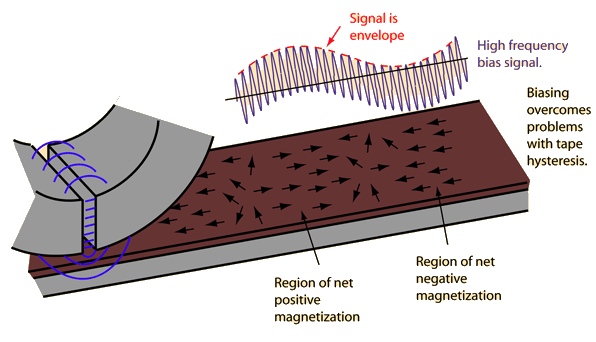
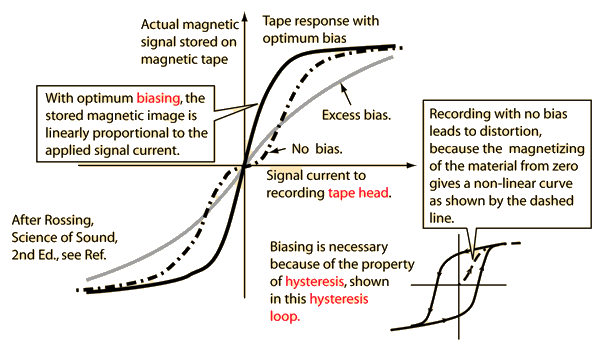
A music signal alone cannot be used to produce a faithful tape recording of a sound because the magnetization of the tape is so sensitive to its previous magnetic history, even the effects of the signal recorded just ahead of it. A high frequency bias signal is typically applied to the tape through the tape head along with the music signal to remove the effects of this magnetic history. This large bias signal (typically 40 to 150 kHz in frequency) keeps "stirring" the magnetization so that each signal to be recorded encounters the same magnetic starting conditions. The necessity for biasing has its origin in the magnetic property called hysteresis - the magnetic material tends to hold onto any magnetization it receives and must be actively driven back to zero to start over. Magnetic emulsions made with chromium dioxide require a larger biasing signal to make use of their wider dynamic range, so modern recorders have different bias settings for iron oxide, chromium dioxide, and metal tapes. With optimum biasing, the recorded magnetic image is proportional to the signal current applied to the record head.

单独的音乐信号无法用来产生忠实的磁带录音,因为磁带的磁化对其之前的磁历史非常敏感,甚至其前面刚刚记录的信号效果也会产生影响。通常,通过磁带头将高频偏置信号与音乐信号一起施加到磁带上,以消除这种磁历史的影响。这个较大的偏置信号(通常频率为40到150 kHz)会“搅动”磁化,使得每个要记录的信号都遇到相同的磁起始条件。偏置的必要性源于一种称为磁滞的磁性特性——磁性材料倾向于保留它所接收的任何磁化,必须主动将其驱动回零以重新开始。使用氧化铬制成的磁性乳液需要更大的偏置信号来利用其更宽的动态范围,因此现代录音机为铁氧化物、氧化铬和金属磁带设有不同的偏置设置。在最佳偏置条件下,记录的磁性图像与施加到录音头的信号电流成正比。

One could become almost philosophical about the process by which one can produce the sound of a beautiful symphony from a "ribbon of rust". Biasing is critical to this process of imposing the design of the symphony upon a medium which would tend to have random variations because of thermal energy and a kind of "inertia" in the form of hysteresis that resists the production of an undistorted image of the music. Biasing plays the role of "scrambling" or "stirring" the medium dynamically so that each element of the musical image you intend to impose will have the same "blank slate" upon which to write. The scrambling process of biasing also increases the sensitivity for the recording of a clean signal, i.e., you can record with a much smaller input signal because the medium is more susceptible to the imposition of the pattern you intend.

人们可以几乎哲学地思考将一首优美的交响乐之声从‘一根锈带’中产生出来的过程。偏置对于这一过程至关重要,因为这一过程是将交响乐的设计施加于一种倾向于因热能而产生随机变化的介质上,而这种介质还有一种‘惯性’形式,即滞回,它会抵抗产生一个未失真的音乐图像。偏置的作用类似于‘搅乱’或‘搅拌’介质,使其动态地变化,使得你想要施加的音乐图像的每一个元素都有一个相同的‘白板’来书写。偏置的搅乱过程也提高了记录清晰信号的灵敏度,即你可以用一个远小的输入信号来记录,因为介质对你想要施加的模式更加敏感。
Illustration of biasing
偏置的示意图
Index

Sound reproduction concepts

Tape recording concepts

Reference
Rossing
Science of Sound
Ch 21
索引 声学再现概念 磁带录音概念 参考 Rossing 声学科学 第21章
 
HyperPhysics***** Sound
HyperPhysics ***** 声音
R Nave
Go Back
返回


Bias During Recording

录音时的偏移

To record a sine wave on tape, you mix it with a high frequency bias signal. The bias keeps the magnetic domains "stirred", with an average magnetization in the direction of the signal voltage you wish to record. As the head passes, a net magnetization proportional to the sine wave signal remains.

为了将正弦波记录在磁带上,你需要将其与一个高频偏置信号混合。偏置信号使磁畴保持‘搅动’,并使磁化方向与你希望记录的信号电压方向一致。当磁头通过时,剩余的净磁化强度与正弦波信号成正比。
Hysteresis and biasing
滞回与偏置
Discussion of biasing
偏置讨论
Index

Sound reproduction concepts

Tape recording concepts

Reference
Rossing
Science of Sound
Ch 21
索引 声学再现概念 磁带录音概念 参考 Rossing 声学科学 第21章
 
HyperPhysics***** Sound
HyperPhysics ***** 声音
R Nave
Go Back
返回


Optimum Biasing

最佳偏置
This is an active graphic. You may click on any of the bold text for further details.
Discussion of biasing
偏置讨论
这是一个动态图形。您可以点击任何加粗的文本以获取更多详情。
Index

Sound reproduction concepts

Tape recording concepts

Reference
Rossing
Science of Sound
Ch 21
索引 声学再现概念 磁带录音概念 参考 Rossing 声学科学 第21章
 
HyperPhysics***** Sound
HyperPhysics ***** 声音
R Nave
Go Back
返回


Hysteresis in Magnetic Recording

磁记录中的滞回

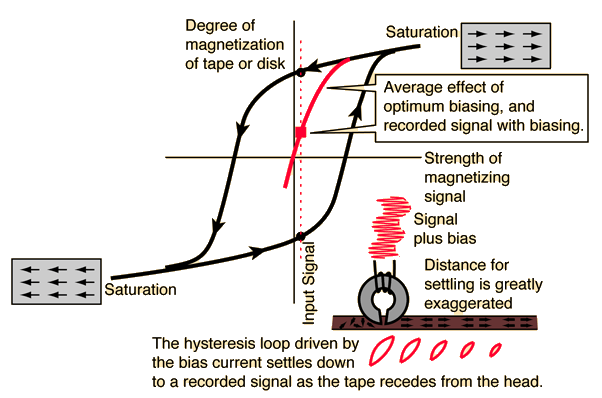
Because of hysteresis, an input signal at the level indicated by the dashed line could give a magnetization anywhere between C and D, depending upon the immediate previous history of the tape (i.e., the signal which preceded it). This clearly unacceptable situation is remedied by the bias current which cycles the oxide grains around their hysteresis loops so quickly that the magetization averages to zero when no signal is applied. The result of the bias signal is like a magnetic eddy which settles down to zero if there is no signal superimposed upon it. If there is a signal, it offsets the bias signal so that it leaves a remnant magnetization proportional to the signal offset.

由于磁滞效应,输入信号在虚线所示的电平上,其磁化强度可能在C和D之间变化,这取决于磁带的先前历史(即其前一个信号)。这种明显不可接受的情况通过偏置电流得到解决,该电流使氧化物颗粒快速绕其磁滞回线循环,使得在无信号输入时磁化强度平均为零。偏置信号的效果类似于一个磁性涡流,如果没有叠加的信号,它会趋于零。如果存在信号,则会抵消偏置信号,从而留下与信号偏移成正比的剩余磁化强度。
Tape recording process
磁带录音过程
Optimum biasing
最佳偏置
Index

Sound reproduction concepts

Tape recording concepts

References
Rossing
Science of Sound
Ch 21

Westmijze
索引 声学再现概念 磁带录音概念 参考文献 Rossing 声学科学 第21章 Westmijze
 
HyperPhysics***** Sound
HyperPhysics ***** 声音
R Nave
Go Back
返回