Adrenal Glands
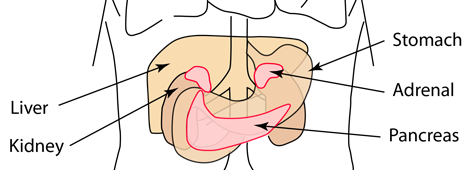 | The adrenal glands are part of the endocrine system which produce a variety of hormones including adrenaline and the steroids aldosterone and cortisol. 肾上腺是内分泌系统的一部分,能够产生多种激素,包括肾上腺素以及甾体激素醛固酮和皮质醇。 |
The anterior pituitary gland interacts with the adrenal gland by producing the adrenocorticotropic hormone (ACTH) to cause it to release its hormones.
"Adrenal" is latin for "on the kidney", and the adrenal glands rest upon each kidney. They are two glands in one, an inner region called the adrenal medulla and an outer region called the adrenal cortex.
The adrenal medulla consists of secretory cells derived during development from nervous tissue, and its hormone secretion process is controlled directly by the nervous system. The adrenal medulla (latin for 'marrow') produces the two hormones adrenaline and noradrenaline (alternatively called epinephrine and norephinephrine respectively) in response to stress. These hormones prepare the body for emergency action by increasing the heart and respiration rates, causing blood glucose levels to rise, and directing blood flow away from the digestive tract and toward the brain and muscles.
The outer layer is the adrenal cortex (latin for 'bark'). It secretes three types of steroid hormones called glucocorticords, synthesized from cholesterol. The process involves 1) releasing hormones provided by the hypothalamus, 2) secretion of ACTH by the anterior pituitary is stimulated, and 3) the glucocorticord synthesis is stimulated by ACTH. The glucocorticords raise blood glucose levels by stimulating glucose production and promoting the use of fats instead of glucose for energy production.
Audesirk and Audesirk note that there is a common pattern here since the hypothalamus supplies the releasing hormones in response to stressful stimuli for the body, like trauma, infection, temperature extremes. They suggest that this pattern in multiple settings protects the brain since the only energy source for the brain is glucose, and therefore systems for protecting the glucose supply are critical for survival.
The adrenal cortex also produces the hormone aldosterone, which regulates the sodium content of the blood. The sodium ion level is critical for cellular processes, and when sodium drops the aldosterone acts to retain sodium in the kidney, sweat glands, salivary glands and colon. The action in the kidney occurs by acting on receptors in the distal tubules and collecting ducts of the nephron. When the sodium level rises, the production of aldosterone stops.
The adrenal cortex also produces testosterone, although not as much as the primary source in the reproductive organs.
| Adrenal Gland Wiki
肾上腺皮质 |
| Aldosterone Wiki
醛固酮维基 |
| This material is part of a brief overview of the topics studied in biology with the intent to highlight the connections to basic ideas in physics and physical science.
这部分内容是对生物学中研究主题的简要概述,旨在突出其与物理学和物理科学基本概念的联系。 |
Reference
Audesirk & Audesirk
Ch 32, 33
Thibodeau & Patton
Ch 16
| HyperPhysics***** Biology
HyperPhysics ***** 生物学 | R Nave |