Cyanobacteria
Cyanobacteria are examples of the prokaryotic cell type. They are photosynthetic and were thought to be examples of bluegreen algae until it was discovered that they had no membrane-bound nucleus and had no chloroplasts. With a size range of 0.5 to 60 micrometers, they are perhaps the largest prokaryotic organisms. (Britannica) Their metabolism utilizes energy from the sun and they release oxygen into the atmosphere. In fact, it is thought that they are some of the oldest forms of life and may have played a major role in giving the Earth an oxygen-containing atmosphere. Along with that, it is proposed that cyanobacteria were actually involved in originating the chloroplasts that enable photosynthesis in plants.
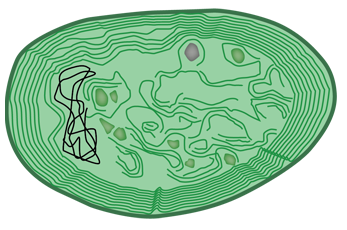 | This is a sketch of a cyanobacteria from an electron micrograph displayed by Karp, Chapter 1.3, showing the multiple internal membranes that participate in photosynthesis. It also shows the lack of a nucleus and the other organelles characteristic of eukaryotic cells. 这是一张由Karp在第1.3章中展示的蓝藻细胞电子显微照片,显示了参与光合作用的多个内部膜。该图还展示了真核细胞中缺乏细胞核和其他细胞器的特征。 |
Unlike most prokaryotes, cyanobacteria have internal membranes in the form of flattened sacs called thylakoids where photosynthesis takes place. The similarity of these thylakoids to the structures in the chloroplasts of plants has led to the proposal that cyanobacteria were the origin of those chloroplasts by a process called endosymbiosis into the developing plant forms.
The great age of cyanobacteria is affirmed by their presence in ancient stromatolites. Strong evidence for the presence of cyanobacteria dates back to 2.1 Ga (1 Ga= 109 years). Their contributions to the stromatolites are viewed as some of the oldest known fossils on the Earth, stretching into the precambrian period. Stromatolites date back to perhaps 3.5 Ga, with evidence for cyanobacteria to 2.7 Ga. Cyanobacteria release oxygen into the atmosphere, and they may have made a major contribution to the rapid rise of atmospheric oxygen about 2.4 Ga which is called the "Great Oxygenation Event". It is also sometimes called "the rusting of the Earth" because the increased oxygen in the sea oxidized the large amount of dissolved iron, producing the extensive "banded iron" mineral deposits of iron oxide. (Wiki ) The rapid rise in atmospheric oxygen followed the oxidizing of most of the dissolved iron in the oceans.
Cyanobacteria are found in almost every terrestrial and aquatic habitat. They contribute significantly to the global ecology. "The tiny marine cyanobacterium Prochlorococcus was discovered in 1986 and accounts for more than half of the photosynthesis in the ocean."(Wiki) Some of the cyanobacteria are nitrogen-fixing, and are abundant in moist soils and waterways.
The photosynthesis in cyanobacteria provides light energy to drive the synthesis of organic compounds from carbon dioxide. They have several carbon concentrating mechanisms for collecting CO2 and optimize the effectiveness of the CO2-fixing enzyme, RuBisCo. They are able to use CO2 as their sole source of carbon. They make use of the PPP cycle in fixing CO2.
Cyanobacteria accomplish both respiration for the cells energy needs alongside the photosynthesis which synthesizes carbohydrates. "They appear to separate these two processes with their plasma membrane containing only components of the respiratory chain, while the thylakoid membrane hosts an interlinked respiratory and photosynthetic electron transport chain. Cyanobacteria only respire during the night (or in the dark) because the facilities used for electron transport are used in reverse for photosynthesis while in the light." (Wiki).
Cyanobacteria can have harmful environmental and health effects (CDC article) when they have large growth events referred to as "blooms". They can use up the oxygen and block sunlight from other organisms, and they can produce toxins called CyanoHABs or cyanotoxins. The rapid growth of cyanobacteria poses human and animal hazards in lakes like Bantam Lake in Connecticut and in lakes and waterways in California.
 | They give a bluegreen color to water, and can survive at high temperatures, producing the beauty of hot springs like the Morning Glory Pool in Yellowstone. (Cyanobacteria, Britannica)
它们使水呈现蓝绿色,能在高温下生存,产生如黄石公园晨光池般的温泉美景。(蓝藻菌, Britannica) |
| Building an oxygen atmosphere
构建氧气大气 |
Reference
Enger & Ross
Cyanobacteria wiki
Karp, Ch 1.3
Cyanosite
| HyperPhysics***** Biology
HyperPhysics ***** 生物学 | R Nave |