Bilingual edition: English is preserved and Chinese follows each unit. Terminology uses the confirmed v20260916 glossary; automated semantic review remains traceable.
中英双语版:英文原文完整保留,中文紧随对应单元;术语采用 v20260916 确认表,自动语义审校结果可追溯。

Chloroplasts

叶绿体

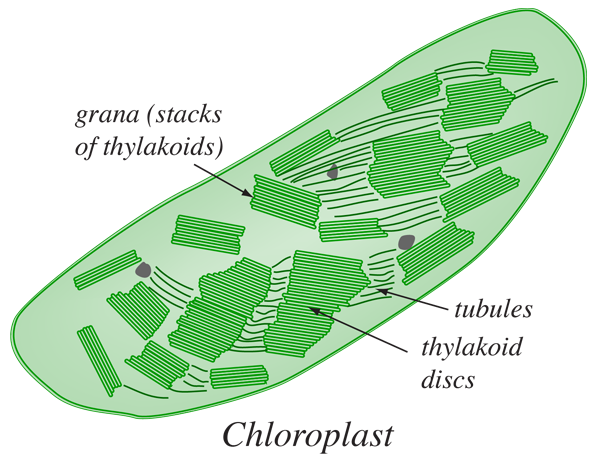
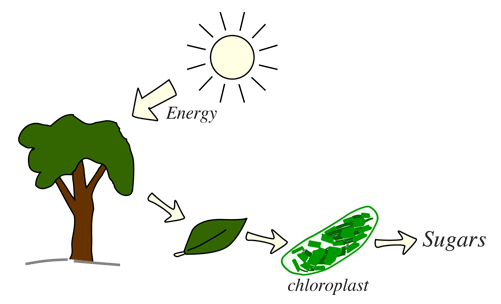
The sketch of the chloroplast above was made from an electron micrograph of a chloroplast from a higher order plant (Levy). Plants use energy from the sun in tiny energy factories called chloroplasts. Using chlorophyll in the process called photosynthesis, they convert the sun's energy into storable form in ordered sugar molecules such as glucose. In this way, carbon dioxide from the air and water from the soil in a more disordered state are combined to form the more ordered sugar molecules.
上图的叶绿体素描是根据一种高等植物的叶绿体电子显微照片(Levy)绘制的。植物利用太阳的能源,在称为叶绿体的微小能量工厂中进行作用。利用叶绿素在称为光合作用的过程中,它们将太阳的能量转化为可以储存的形式,储存在有序的糖分子中,如葡萄糖。这样,来自空气的二氧化碳和来自土壤的水在更无序的状态下结合,形成更有序的糖分子。

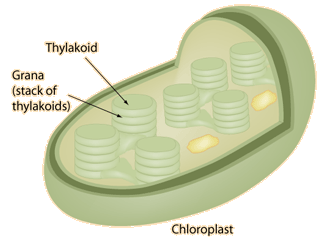
Inside the chloroplasts are stacks of discs called thylakoids. They are compared to stacks of coins within the walls of the chloroplast, and they act to trap the energy from sunlight.

叶绿体内部有称为类囊体的叠盘状结构。它们类似于嵌在叶绿体壁内的硬币叠层,作用是捕获阳光的能量。

The stacks of thylakoids are called grana. They are connected with an extensive sytem of tubules. The thylakoid membranes contain chlorophyll and other pigments arranged in antenna arrays to capture light energy for two photosystems called Photosystem I and Photosystem II. In most plants, both photosystems are used in an electron transport process that yields energy in the form of ATP and reduced coenzymes to the stroma of the chloroplast to be used in the synthesis of carbohydrates. The energy is used in the Calvin cycle to fix carbon from atmospheric CO2 and construct sugars.

类囊体堆叠在一起称为基质。它们通过一个广泛的管状结构连接在一起。类囊体膜含有叶绿素和其他色素,这些色素以天线阵列的形式排列,用于捕获光能,为两个称为光系统I和光系统II的光系统提供能量。在大多数植物中,这两个光系统都用于电子传递过程中,产生以ATP和还原辅酶的形式的能量,将能量输送到叶绿体的基质中,用于碳水化合物的合成。光能用于卡尔文循环中将大气中的CO₂固定并构建糖类。

Order can be produced with an expenditure of energy, and the order associated with life on the earth is produced with the aid of energy from the sun.
秩序可以通过消耗能量来产生,而与地球上的生命相关的秩序则是借助太阳的能量产生的。
Qualitative statements of the Second Law of Thermodynamics
热力学第二定律的定性陈述
Order from disorder in biological systems
生物系统中的有序与无序
Energy cycle in living things
生物体的能量循环
More on chloroplast structure
关于叶绿体结构的更多内容
Index

Photosynthesis Concepts

Second law concepts

Reference
Levy
Ch 4
索引 光合作用概念 第二定律概念 参考 Levy 第4章
 
HyperPhysics***** Thermodynamics ***** Biology
HyperPhysics ***** 热力学 ***** 生物学
R Nave
Go Back
返回


Chloroplast Structure

叶绿体结构

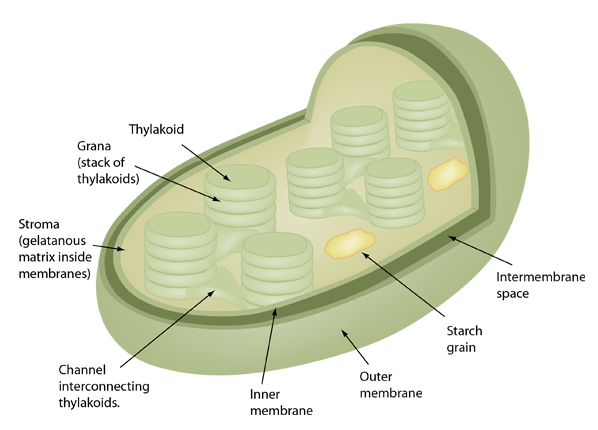
Plants use energy from the sun in tiny energy factories called chloroplasts. The green color of leaves is attributable largely to these chloroplasts because they contain chlorophyll for photosynthesis. Though obviously oversimplified, the illustration depicts the somewhat elongated sausage type shape with large dimension 5-10 μm and smaller dimension 3-4 μm. Moore suggests 40-200 chloroplasts per photosynthetic cell and about 500,000 per square millimeter of leaf area.

植物利用太阳的能,在称为叶绿体的微小能量工厂中进行光合作用。叶子的绿色主要归因于这些叶绿体,因为它们含有叶绿素。尽管显然过于简化,但图示描绘了略呈长条状的形状,其长度为5-10微米,宽度为3-4微米。Moore建议每个光合细胞中有40-200个叶绿体,每平方毫米的叶面积约有500,000个。

There are two membranes, and inside the inner membrane is the gelatanous matrix called the stroma. The stroma contains ribosomes, DNA, and is the location for biochemical synthesis. Membranous sacs called thylakoids are arranged in stacks called grana. The chlorophyll in the thylakoid membranes carries out photosynthesis.

有两个膜,内膜内含有称为基质的胶质矩阵。基质中含有核糖体和DNA,并是生物合成的场所。被称为类囊体的膜囊排列成称为基粒的堆叠。类囊体膜中的叶绿素进行光合作用。

The similarity of the thylakoid structures in the chloroplasts of plants to the photosynthetic structures in ancient cyanobacteria has led to the proposal that cyanobacteria were the origin of those chloroplasts by a process called endosymbiosis into the developing plant forms.

植物细胞质体中的类囊体结构与古代蓝藻的光合作用结构相似,这一相似性促使人们提出一个假说:蓝藻通过一种称为内共生的过程,成为这些质体的起源。
Index

Photosynthesis Concepts

Second law concepts

Reference
Levy
Ch 4

Moore, et al.
Ch 7
索引 光合作用概念 第二定律概念 参考文献 Levy 第四章 Moore 等人 第七章
 
HyperPhysics***** Thermodynamics ***** Biology
HyperPhysics ***** 热力学 ***** 生物学
R Nave
Go Back
返回