Cellular Respiration细胞呼吸
The term cellular respiration refers to the biochemical pathway by which cells release energy from the chemical bonds of food molecules and provide that energy for the essential processes of life. All living cells must carry out cellular respiration. It can be aerobic respiration in the presence of oxygen or anaerobic respiration. Prokaryotic cells carry out cellular respiration within the cytoplasm or on the inner surfaces of the cells. More emphasis here will be placed on eukaryotic cells where the mitochondria are the site of most of the reactions. The energy currency of these cells is ATP, and one way to view the outcome of cellular respiration is as a production process for ATP. 细胞呼吸这一术语指的是细胞通过分解食物分子中的化学键释放能量,并将这种能量用于生命必需过程的生化途径。所有活细胞都必须进行细胞呼吸。它可以在有氧条件下进行(有氧呼吸)或在无氧条件下进行(无氧呼吸)。原核细胞在细胞质或细胞内表面进行细胞呼吸。在这里,更侧重于真核细胞,因为线粒体是大多数反应的场所。这些细胞的能量货币是ATP,将细胞呼吸的结果视为ATP的生产过程之一。
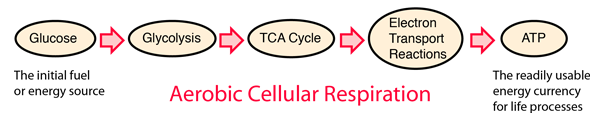
![]() The graphic below can serve as a reminder of some of the processes involved in cellular respiration. 下图可以作为一些细胞呼吸过程中所涉及过程的提醒。
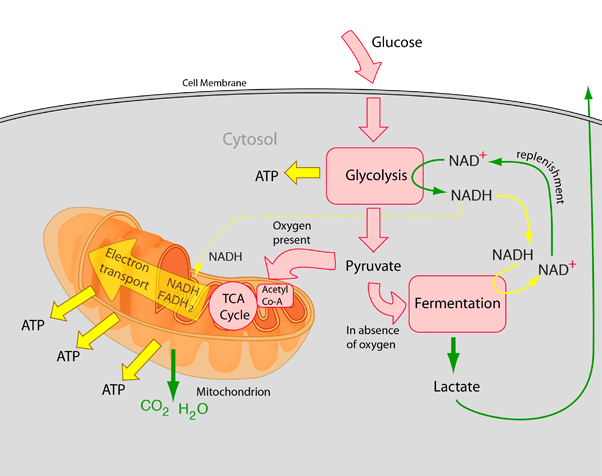
![]() These are active graphics: click anywhere. Cellular respiration produces CO2 as a metabolic waste. This CO2 binds with water to form carbonic acid, helping to maintain the blood's pH. Since too much CO2 would lower the blood's pH too much, the removal of the excess CO2 must be accomplished on an ongoing basis. 细胞呼吸会产生二氧化碳作为代谢废物。这种二氧化碳与水结合形成碳酸,有助于维持血液的pH值。由于过多的二氧化碳会使血液pH值下降过多,因此必须持续不断地去除多余的二氧化碳。
One of the interesting things about cell respiration is that it is part of an essentially universal "toolkit" that characterizes all of life, at least for life involving eukaryotic cells. ![]()
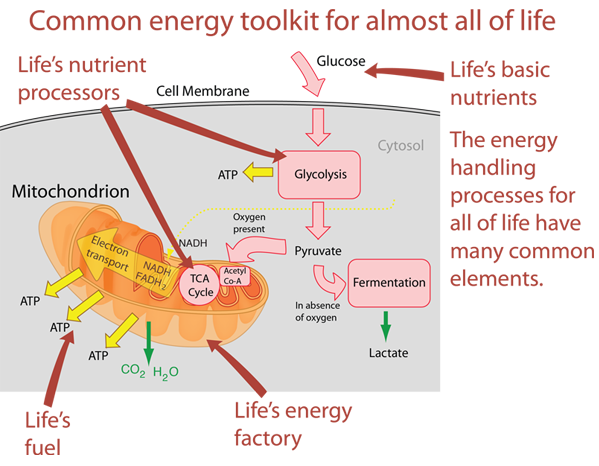
细胞呼吸的一个有趣之处在于,它属于一个本质上普遍的‘工具包’,这一特征贯穿所有生命,至少对于涉及真核细胞的生命而言是如此。
这些是动态图形:点击任意位置。 |
Index Reference Enger & Ross Ch 6 Audesirk & Audesirk Ch 8 Karp Ch 5 索引参考Enger & Ross第6章,Audesirk & Audesirk第8章,Karp第5章 | ||
|
Go Back
返回 |
Aerobic Respiration有氧呼吸
Aerobic respiration, or cell respiration in the presence of oxygen, uses the end product of glycolysis (pyruvate) in the TCA cycle to produce much more energy currency in the form of ATP than can be obtained from any anaerobic pathway. Aerobic respiration is characteristic of eukaryotic cells when they have sufficient oxygen and most of it takes place in the mitochondria. 有氧呼吸,或在有氧条件下进行的细胞呼吸,利用糖酵解的终产物(丙酮酸)在柠檬酸循环中产生比任何无氧途径都能获得的更多能量货币形式的ATP。有氧呼吸是真核细胞在有足够氧气的情况下所具有的特征,大部分过程发生在线粒体中。
|
Index Reference Enger & Ross Ch 6 索引参考Enger & Ross第6章 | ||
|
Go Back
返回 |
Anaerobic Respiration无氧呼吸
The first step in cellular respiration in all living cells is glycolysis, which can take place without the presence of molecular oxygen. If oxygen is present in the cell, then the cell can subsequently take advantage of aerobic respiration via the TCA cycle to produce much more usable energy in the form of ATP than any anaerobic pathway. Nevertheless, the anaerobic pathways are important and are the sole source of ATP for many anaerobic bacteria. Eukaryotic cells also resort to anaerobic pathways if their oxygen supply is low. For example, when muscle cells are working very hard and exhaust their oxygen supply, they utilize the anaerobic pathway to lactic acid to continue to provide ATP for cell function. 所有活细胞进行细胞呼吸的第一个步骤是糖酵解,这一过程可以在没有分子氧的情况下进行。如果细胞中存在氧气,那么细胞可以随后通过三羧酸循环进行有氧呼吸,产生比任何无氧途径都要多的可用能量,以ATP的形式释放。然而,无氧途径仍然很重要,并且是许多厌氧细菌ATP的唯一来源。当真核细胞的氧气供应不足时,它们也会依赖无氧途径。例如,当肌肉细胞非常努力工作并耗尽氧气供应时,它们会利用无氧途径产生乳酸,以继续为细胞功能提供ATP。
Glycolysis itself yields two ATP molecules, so it is the first step of anaerobic respiration. Pyruvate, the product of glycolysis, can be used in fermentation to produce ethanol and NAD+ or for the production of lactate and NAD+. The production of NAD+ is crucial because glycolysis requires it and would cease when its supply was exhausted, resulting in cell death. A general sketch of the anaerobic steps is shown below. It follows Karp's organization. 糖酵解本身会产生两个ATP分子,因此它是无氧呼吸的第一步。糖酵解的产物丙酮酸可以用于发酵产生乙醇和NAD+,或者用于生成乳酸和NAD+。NAD+的生成至关重要,因为糖酵解需要它,当其供应耗尽时,糖酵解会停止,导致细胞死亡。无氧步骤的总体示意图如下。它遵循Karp的组织方式。
![]() Anaerobic respiration (both glycolysis and fermentation) takes place in the fluid portion of the cytoplasm whereas the bulk of the energy yield of aerobic respiration takes place in the mitochondria. Anaerobic respiration leaves a lot of energy in the ethanol or lactate molecules that the muscle cells cannot use and must excrete. A portion of the lactate will reach the liver through the bloodstream and may be converted back to glucose through the Cori cycle. The ethanol can be metabolized by the liver, but is a poor precursor for gluconeogenesis and may lead to hypoglycemia. 无氧呼吸(包括糖酵解和发酵)发生在细胞质的液体部分,而有氧呼吸的大部分能量产生则发生在线粒体中。无氧呼吸会留下大量的能量储存在乙醇或乳酸分子中,这些能量肌肉细胞无法利用,必须排出体外。一部分乳酸会通过血液到达肝脏,并可能通过科里循环转化为葡萄糖。乙醇可以被肝脏代谢,但作为葡萄糖生成的前体效果较差,可能导致低血糖。
|
Index Reference Enger & Ross Ch 6 Karp Ch 3 Matthews, van Holde, & Ahern Ch 16 索引参考Enger & Ross第6章,Karp第3章,Matthews, van Holde, & Ahern第16章 | ||
|
Go Back
返回 |