Golgi Apparatus
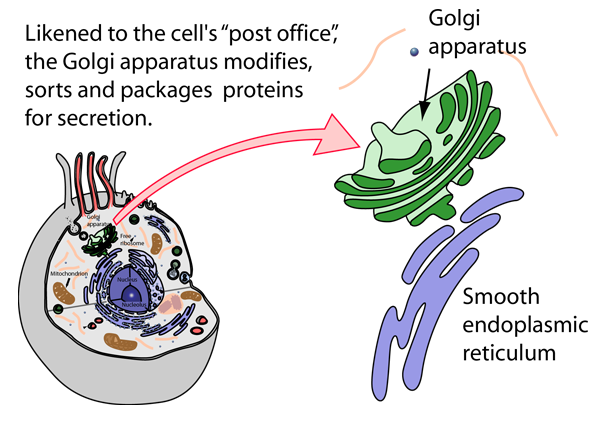
A major organelle in most eukaryotic cells is the structure of membrane-bound sacs called the Golgi apparatus (or Golgi body, Golgi complex, dictyosome). It acts to process and package the macromolecules such as proteins and lipids that are synthesized by the cell. It has been likened to the cell's post office. A major function is the modifying, sorting and packaging of proteins for secretion. It is also involved in the transport of lipids around the cell, and the creation of lysosomes.
The sacs or folds of the Golgi apparatus are called cisternae. Typically there are five to eight cisternae but as many as sixty have been observed. The cisternae stack has five functional regions: the cis-Golgi network, cis-Golgi, medial-Golgi, trans-Golgi, and trans-Golgi network. Vesicles from the endoplasmic reticulum fuse with the cis-Golgi network and subsequently progress through the stack to the trans-Golgi network, where they are packaged and sent to the required destination. Each region contains different enzymes which selectively modify the contents depending on where they are destined to reside.
Reference
Lodish, et al.
| HyperPhysics***** Biology
HyperPhysics ***** 生物学 | R Nave |