Hormones
The term hormone refers to the specific chemical messengers or "signaling molecules" secreted by glands in the endocrine system. Most familiar are the "endocrine hormones" which are released directly into the bloodstream to be carried to the cells which have protein receptors which can respond to them. There are also "exocrine hormones" which are released into a duct. These exocrine hormones may then enter the bloodstream or be conducted from cell to cell by diffusion (paracrine signaling). By these means, hormones are carried to essentially every part of the body and serve various regulatory functions.
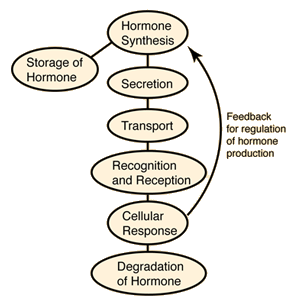 | While the hormonal communication system is too complex to be summarized by a simple model, there are some common overall features. Typically, the glands of the endocrine system have specialized hormone cells. The hormone molecules are synthesized in these cells and exit the cells (exocytosis) via some membrane transport mechanism. When they reach a cell which is sensitive to that hormone, it will have a receptor for the hormone. The receptor will typically be in the cell membrane. The cellular response may be a cascade of reactions to accomplish the purpose of the hormone. There are often feedback mechanisms that serve to regulate the production of the hormone in the gland of origin. 尽管激素通信系统过于复杂,无法用简单的模型来概括,但有一些共同的总体特征。通常,内分泌系统的腺体具有专门的激素细胞。这些细胞合成激素分子,并通过某种膜运输机制将其排出细胞(胞吐)。当这些激素到达对它敏感的细胞时,该细胞将具有相应的受体。受体通常位于细胞膜上。细胞的反应可能是一系列反应,以实现激素的作用。通常存在反馈机制,用于调节原腺体中激素的产生。 |
荷尔蒙 | 源 | 函数 |
| Thyroid stimulating hormone (TSH)
促甲状腺激素(TSH) | Pituitary Gland
垂体 | Stimulates the Thyroid Gland to release its hormones.
刺激甲状腺分泌激素 |
| Thyroxine
甲状腺素 | Thyroid
甲状腺 | Increases metabolic rate and stimulates synthesis of enzymes.
增加代谢率并刺激酶的合成。 |
| Antidiuretic hormone (ADH)
抗利尿激素(ADH) | Pituitary Gland
垂体 | Increases the permeability of the tubules in the nephrons of the kidney to release more water back into the bloodstream.
增加肾小管对水分的通透性,使更多的水分回流入血液。 |
References:
Wiki Hormones
| This material is part of a brief overview of the topics studied in biology with the intent to highlight the connections to basic ideas in physics and physical science.
这部分内容是对生物学中研究主题的简要概述,旨在突出其与物理学和物理科学基本概念的联系。 |
Reference
Audesirk & Audesirk
Ch 32
Thibodeau & Patton
Ch 16
| HyperPhysics***** Biology
HyperPhysics ***** 生物学 | R Nave |