 |
The Cello小提琴
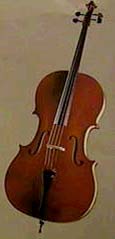
The cello, or violoncello, is the second largest member of the VIOLIN family of musical instruments. It is tuned an octave below the VIOLA and serves both as a melodic and bass instrument in chamber and orchestral music. The body of the cello is approximately 76 cm (30 in) long and is much deeper than those of the violin and viola. The cellist is seated and supports the instrument between his calves, with its lower end raised off the floor by an endpin. The strings are tuned a fifth apart at C2(65.4 Hz), G2(98 Hz), D3(146.8 Hz), A3(220 Hz) if tuned in equal temperament to the A4(440 Hz) standard. 小提琴家族中第二大的乐器是中提琴,或称低音提琴。它的音域比小提琴低一个八度,既可以作为旋律乐器,也可以作为低音乐器,在室内乐和管弦乐中发挥作用。中提琴的长度约为76厘米(30英寸),比小提琴和中提琴更深。演奏者坐着,将乐器放在小腿之间,用末端的支撑杆将乐器下端抬离地面。琴弦按等音律调至A4(440Hz)标准,音程为纯五度,即C2(65.4Hz)、G2(98Hz)、D3(146.8Hz)、A3(220Hz)。
The top plate of the cello is made of spruce or pine because of their good sound radiating qualities. The sides and back plate are made of maple. The neck, pegbox and scroll are made of maple. A thin piece of ebony is glued to the top side of the neck to form the fingerboard. At the end of the neck where the pegboard is attached, a small grooved piece of ebony is attached for holding the strings in position. It is called the "nut". The strings pass over a bridge made of maple which transmits the vibrational energy from the strings to the body of the instrument. The top of the bridge is curved to match the contour of the top plate and to allow one string at a time to be bowed. 小提琴的顶部板通常采用云杉或松木制成,这是因为它们具有良好的声音辐射特性。侧面和背板则采用枫木制成。琴颈、琴头和琴尾板也都是枫木制成的。在琴颈的顶部,会粘贴一片薄的黑胡桃木,形成指板。在琴头与琴头板连接处,会粘贴一小块有凹槽的黑胡桃木,用于固定琴弦的位置,这部分称为“琴钉”。琴弦经过一个由枫木制成的琴桥,将琴弦的振动能量传递到乐器的共鸣箱中。琴桥的顶部形状与顶部板的轮廓相匹配,并允许每次只有一根琴弦被拨奏。
String instruments characteristically produce a fundamental resonance plus all the string harmonics. 弦乐器通常会产生基频共振以及所有弦的泛音。
|
String instruments
Musical instruments
| HyperPhysics***** Sound
HyperPhysics ***** 声音 | R Nave |