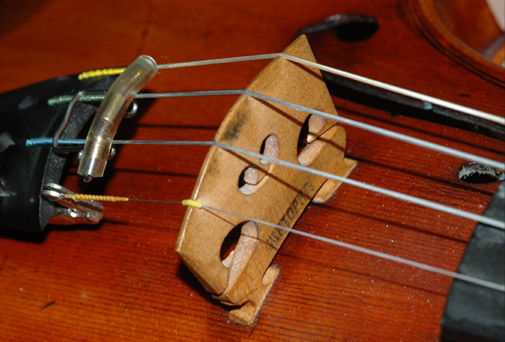
Some Violin Details
一些小提琴细节
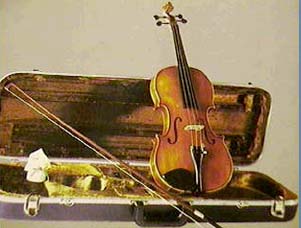
The violin, the most commonly used member of the modern string family, is the highest-sounding instrument of that group. Its four strings are stretched over a high arched bridge that permits the playing of one or two strings at a time, as well as the nearly simultaneous sounding of three or four as chords. The overall length of the violin averages about 60 cm (23.5 in), whereas the sounding length of the strings, from bridge to the nut at the end of the fingerboard, is about 32 cm (12.75 in). The instrument is held on the left side of the body, while the right hand holds the bow. The wider end of the instrument is placed between the player's left shoulder and chin, while the left hand encircles its neck, the fingers stopping the strings to produce the various pitches. Sound is produced by drawing the bow across the strings to make them vibrate, or by plucking the strings (PIZZICATO).
小提琴是现代弦乐器中最常用的成员,是该类乐器中音高最高的乐器。它的四根弦被拉过一个高拱形桥,允许同时演奏一根或两根弦,也可以同时发出三根或四根弦的和弦。小提琴的整体长度平均约为60厘米(23.5英寸),而弦的发音长度,从桥到指板末端的 nut,约为32厘米(12.75英寸)。乐器放在身体的左侧,右手持弓。较宽的一端放置在演奏者的左肩和下巴之间,左手环绕其颈部,手指停止弦线以产生各种音高。声音通过将弓拉过弦使其振动,或拨动弦线(称为Pizzicato)来产生。
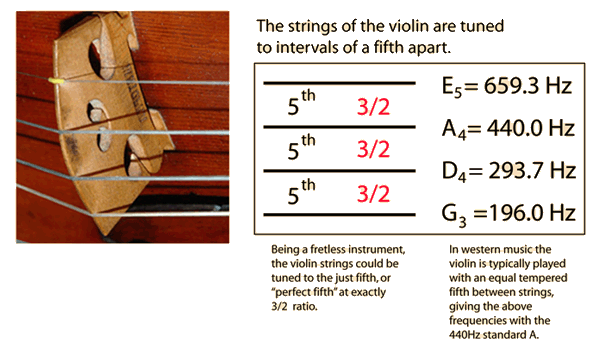
The range of the violin extends from G, the lowest open string, upward nearly four octaves. The strings are tuned a fifth apart at G3(196 Hz), D4(293.7 Hz), A4, E5(659.3 Hz) if tuned in equal temperament with the A4 = 440Hz standard. But there are no frets on the fingerboard as found on the guitar, so the player can continuously tune the intervals to any desired pitch in the string's frequency range and play the intervals in any system of temperament. With an ensemble of such instruments, like a string quartet with cello and string bass, the players can experiment with different tunings of the intervals since they are not constrained by frets.
小提琴的音域从最低的开放弦G音开始,几乎延伸到上方四个八度。如果以A4=440Hz为标准,小提琴的弦按五度关系定音为G3(196 Hz)、D4(293.7 Hz)、A4、E5(659.3 Hz)。但小提琴的指板上没有像吉他那样的品柱,因此演奏者可以在弦的频率范围内连续地调节音调到任何 desired pitch,并在任何调音系统中演奏音程。当使用这样的乐器组合,如弦乐四重奏中的大提琴和低音提琴时,演奏者可以自由尝试不同的音程调音,因为它们不受品柱的限制。
Many consider that violin making reached its pinnacle in the work of Antonio Stradivari and Guiseppe Guarneri in the 18th century. Although the basic construction of the violin has been long established, the subtle variations which make an outstanding violin are the stuff of legend.
许多人认为,小提琴制作在18世纪安东尼奥·斯特拉迪瓦里和朱塞佩·担保里作品中达到了顶峰。尽管小提琴的基本构造早已确立,但使一把优秀小提琴脱颖而出的微妙差异却成了传说。
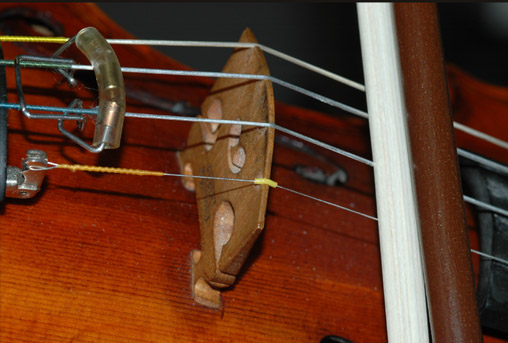
The sound quality can be changed considerably by the place where the string is bowed. If bowed close to the bridge (sul ponticello) then the sound is brighter with more harmonic content. If bowed further from the bridge (sul tasto) then the sound is darker, more mellow with less harmonic content.
琴弦的音色可以根据琴弓靠近琴桥的位置而显著改变。如果琴弓靠近琴桥(sul ponticello),则声音更明亮,谐波成分更多;如果琴弓远离琴桥(sul tasto),则声音更暗淡,更醇厚,谐波成分更少。
|