Varying Flute Pitch
The lower notes of a flute are obtained by opening holes in the side of the instrument to shorten the air column, raising the fundamental frequency of the open air column. To achieve higher notes, one may force the air column to sound its second harmonic, up an octave from the fundamental. This is achieved by a process called "overblowing" the flute, and the notes produced are said to be in the "upper register" of the flute.
Besides those basic ways to vary the pitch of the flute, the player may make "fine tuning" adjustments by control of the air stream from the lips. The pitch can be lowered slightly by aiming the air in a downward direction into the embouchure hole, and raised slightly by aiming the airstream higher so that it crosses over the embouchure hole.
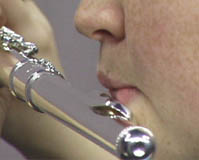 |
The flute is overblown to its second or third harmonic by a combination of increasing the airstream velocity and "rolling in" to decrease the gap between the players lips and the edge. This example demonstrates the tuning range obtainable by rotating the flute relative to the player's lips. 长笛通过增加气流速度和‘向内吹’以减小嘴唇与乐器边缘之间的间隙,使其发出第二或第三谐波。这个例子展示了通过将长笛相对玩家嘴唇旋转所能获得的调谐范围。
|
Thanks to Sara Booker for helping to demonstrate the instrument and to Tim Merritt of GSU's Instructional Resource Center for assistance with the video.
| Flute discussion
长笛讨论 |
Woodwind instruments
Musical instruments
| HyperPhysics***** Sound
HyperPhysics ***** 声音 | R Nave |