Bilingual edition: English is preserved and Chinese follows each unit. Terminology uses the confirmed v20260916 glossary; automated semantic review remains traceable.
中英双语版:英文原文完整保留,中文紧随对应单元;术语采用 v20260916 确认表,自动语义审校结果可追溯。

The Flute

长笛

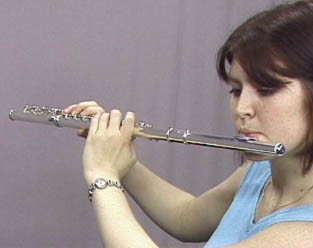
The flute is made in the form of an open cylindrical air column about 66 cm long. Its fundamental pitch is middle C (C4) and it has a range of about three octaves to C7. Sound is produced from a flute by blowing onto a sharp edge, causing air enclosed in a tube to vibrate. The flute as shown above is a transverse or side-blown flute.

长约66厘米的 flute 是一个开放的圆柱形空气柱。其基音音调为中音C(C4),其音域约为三个八度到C7。通过将气流吹向一个锐边,使管内空气振动从而产生声音。如上图所示,这种 flute 是一种横吹或侧吹 flute。

The modern flute was developed by Theobald Boehm who experimented with it from 1832 to 1847, desiring to give it a bigger tone. He finally produced a parabolic (bowl-shaped) head joint attached to a cylindrical body with open-standing keys and finger pads to cover large finger holes. There are typically 16 holes, or four more than the minimum to cover the chromatic notes of an equal-tempered octave. Since then, other minor improvements have been made. The modern flute usually has a range from middle C (C4) upward for about three octaves. In Europe flutes are often constructed of wood; silver is commonly used in the United States.

现代长笛是由Theobald Boehm开发的,他从1832年到1847年对长笛进行了实验,希望赋予它更响亮的音色。他最终制造出一个抛物面(碗形)的头部连接到一个圆柱形主体,配有开放站立的键和指垫,以覆盖较大的指孔。通常有16个孔,或比最小数量多四个,以覆盖一个等音律八度中的所有音。此后,还进行了其他一些小的改进。现代长笛通常的音域从中央C(C4)向上约三个八度。在欧洲,长笛通常由木头制成;在美国,银则被广泛使用。

Thanks to Sara Booker for helping to demonstrate the instrument.

感谢Sara Booker帮助演示仪器
Construction details
构造细节
Waveform examples
波形示例
Overblowing the flute
吹奏长笛时过度吹气
Index

Woodwind instruments

Musical instruments

References
Boehm

Toff

Quantz
索引 木管乐器 音乐乐器 参考文献 Boehm Toff Quantz
 
HyperPhysics***** Sound
HyperPhysics ***** 声音
R Nave
Go Back
返回


Flute Construction

flute 的构造

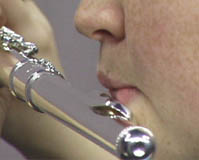
The modern flute is about 26 inches in length with and inside diameter of about 3/4", open at one end . The embouchure at which the edgetone is produced is near one end and constitutes a second open end, making the flute an open cylinder in harmonic content. As with other edgetone instruments, the tone production is made more efficient by the coupling of the slit formed by the players lips, the edge, and the air column. The flute has a series of 16 openings in the tube wall, 11 of which can be closed directly by seven fingers and one by the left thumb. The four additional openings can be opened or closed by means of suitably arranged keys. The external structures on the flute which aid the players access to all the holes total about 150 springs, rollers, levers, etc.

现代 flute 约有 26 英寸长,内径约 3/4 英寸,一端开放。产生边缘音的吹奏口位于近一端,构成第二个开放端,使 flute 像一个开放圆柱体一样在谐波内容上具有特点。与其他边缘音乐器一样,通过玩家嘴唇形成的缝隙、边缘和空气柱之间的耦合,使音色产生更加高效。flute 的管壁上有系列 16 个孔,其中 11 个可以直接由七根手指关闭,一个由左拇指关闭。另外四个孔可通过适当安排的按键打开或关闭。帮助玩家访问所有孔的 flute 外部结构总共有约 150 个弹簧、滚轮、杠杆等。

One advantage of the flute over the recorder is that the player has direct control over the angle at which the air from the lips strikes the embouchure hole. Rolling in or out with the lips relative to the edge gives the player a greater range of volume and expression, and aids the process of overblowing to achieve the higher register. This direct access to the edge also permits the player to make small fine tuning adjustments.

管风琴相比竖笛的一个优势在于,演奏者可以直接控制空气从嘴唇撞击吹口孔的角度。通过嘴唇相对于边缘的前倾或后缩,演奏者可以获得更广泛的音量和表现力,并有助于实现高音区的过度吹奏。这种直接接触边缘的能力也使演奏者能够进行细微的调谐调整。
Sketch of structure
结构草图
Flute discussion
长笛讨论
Index

Woodwind instruments

Musical instruments
索引 长笛类乐器 音乐乐器
 
HyperPhysics***** Sound
HyperPhysics ***** 声音
R Nave
Go Back
返回


Flute Structure

flute 结构

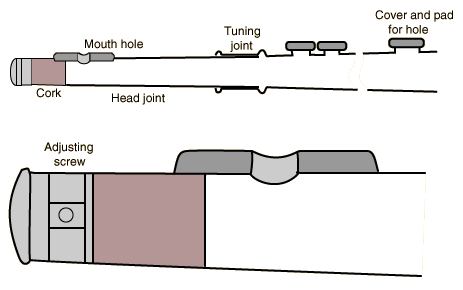
This image shows the form of a U.S. flute up to the tuning joint. In Europe flutes are often constructed of wood; silver is commonly used in the United States.

这张图显示了美国 flute 的形状,直到调谐关节。在欧洲, flute 常常由木材制成;而在美国,银则被广泛使用。
Discussion of structure
结构讨论
Flute discussion
长笛讨论
Index

Woodwind instruments

Musical instruments
索引 长笛类乐器 音乐乐器
 
HyperPhysics***** Sound
HyperPhysics ***** 声音
R Nave
Go Back
返回


Overblowing the Flute

吹管乐器过吹

The lower notes of a flute are obtained by opening holes in the side of the instrument to shorten the air column, raising the fundamental frequency of the open air column. To achieve higher notes, one may force the air column to sound its second harmonic, up an octave from the fundamental. This is achieved by a process called "overblowing" the flute, and the notes produced are said to be in the "upper register" of the flute. The flute is sounded by the edgetone principle: directing air on an edge causes it to oscillate. Increasing the airstream velocity tends to make the pitch go up, and "rolling in" the players lips toward the edge aids that tendency. By rolling in and simultaneously increasing the airstream velocity, the air column can be made to pop cleanly from its fundamental to its second harmonic, raising the pitch by an octave.

通过在乐器侧面开孔来缩短空气柱,可以获得 flute 的低音音调。为了产生高音,可以迫使空气柱发出其第二个泛音,即比基频高一个八度。这一过程称为“过吹”,产生的音调被称为 flute 的“高音区”。flute 是通过边缘振动原理发声的:将空气 directed 到边缘使其振动。增加气流速度会使音高升高,同时将嘴唇向边缘滚动也会增强这种趋势。通过同时滚动嘴唇并增加气流速度,可以使空气柱从基频跃迁到第二个泛音,音高升高一个八度。
Illustration of overblowing
过度吹气示意图
Flute discussion
长笛讨论
Index

Woodwind instruments

Musical instruments
索引 长笛类乐器 音乐乐器
 
HyperPhysics***** Sound
HyperPhysics ***** 声音
R Nave
Go Back
返回


Overblowing the Flute

吹管乐器过吹
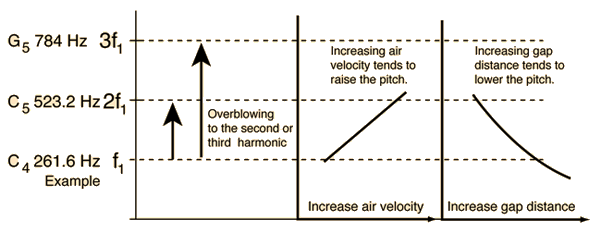
The fundamental and all harmonics are resonances for an open air column.
空气柱的基频和所有谐波都是共振现象。
Increasing airstream velocity raises the edgetone frequency.
增加气流速度会提高边缘音频率。
Decreasing the slit-to-edge distance raises the edgetone frequency.
减小缝到边缘的距离会提高边缘音频率

The flute is overblown to its second or third harmonic by a combination of increasing the airstream velocity and "rolling in" to decrease the gap between the players lips and the edge.

长笛通过增加气流速度和‘压入’来减小嘴唇与管口边缘之间的间隙,从而吹奏出第二或第三泛音。
Discussion of overblowing
过吹讨论
Video example: overblowing to the octave
视频示例:吹奏到八度
Video example: producing higher harmonics
视频示例:产生高 harmonics
Index

Woodwind instruments

Musical instruments
索引 长笛类乐器 音乐乐器
 
HyperPhysics***** Sound
HyperPhysics ***** 声音
R Nave
Go Back
返回


Varying Flute Pitch

变化音调

The lower notes of a flute are obtained by opening holes in the side of the instrument to shorten the air column, raising the fundamental frequency of the open air column. To achieve higher notes, one may force the air column to sound its second harmonic, up an octave from the fundamental. This is achieved by a process called "overblowing" the flute, and the notes produced are said to be in the "upper register" of the flute.

通过在乐器侧面开孔,缩短空气柱长度,可以获得 flute 的低音。为了产生高音,可以迫使空气柱发出其第二泛音,即比基频高一个八度。这一过程称为“过吹”,所产生的音称为 flute 的‘上音域’。

Besides those basic ways to vary the pitch of the flute, the player may make "fine tuning" adjustments by control of the air stream from the lips. The pitch can be lowered slightly by aiming the air in a downward direction into the embouchure hole, and raised slightly by aiming the airstream higher so that it crosses over the embouchure hole.

除了这些基本的改变 flute 音调的方法外,演奏者还可以通过控制嘴唇处的气流进行“微调”。将气流向下吹入嘴唇孔可以使音调略微降低,而将气流向上吹使气流越过嘴唇孔则会使音调略微升高。

The flute is overblown to its second or third harmonic by a combination of increasing the airstream velocity and "rolling in" to decrease the gap between the players lips and the edge.

长笛通过增加气流速度和‘压入’来减小嘴唇与管口边缘之间的间隙,从而吹奏出第二或第三泛音。
Video example: tuning by changing embouchure
视频示例:通过改变嘴唇位置进行调谐
Flute discussion
长笛讨论
Index

Woodwind instruments

Musical instruments
索引 长笛类乐器 音乐乐器
 
HyperPhysics***** Sound
HyperPhysics ***** 声音
R Nave
Go Back
返回


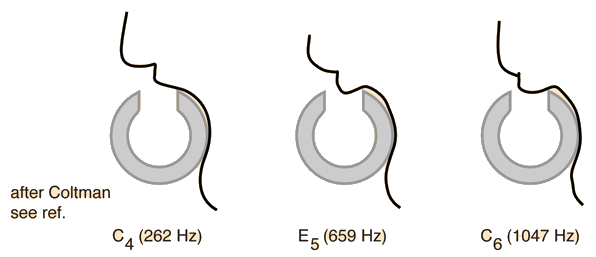
"Rolling In" at Higher Pitches

更高音调上的滚动

In addition to the velocity of the airstream as a determiner of the pitch of an edgetone, the distance between the slit and the edge also influence it.

除了气流速度对边缘音的音调的影响外,缝隙与边缘之间的距离也会影响它。

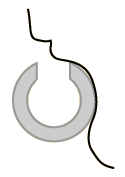
It is common practice in flute playing to "roll in", decreasing the slit-to-edge distance to help produce optimum conditions for higher notes. This helps the process of overblowing to reach the higher registers.

在笛子演奏中,通常会采用“向内缩”(roll in)的做法,通过减小缝隙到边缘的距离,以帮助产生更高音阶的最佳条件。这有助于过吹过程达到更高音区。
Effect of changing slit to edge distance
改变缝到边缘距离的影响
Index

Woodwind instruments

Musical instruments

Reference
Coltman
索引木管乐器 音乐乐器 参考 Coltman
 
HyperPhysics***** Sound
HyperPhysics ***** 声音
R Nave
Go Back
返回