Bilingual edition: English is preserved and Chinese follows each unit. Terminology uses the confirmed v20260916 glossary; automated semantic review remains traceable.
中英双语版:英文原文完整保留,中文紧随对应单元;术语采用 v20260916 确认表,自动语义审校结果可追溯。

Pythagorean Temperament

毕达哥拉斯音律

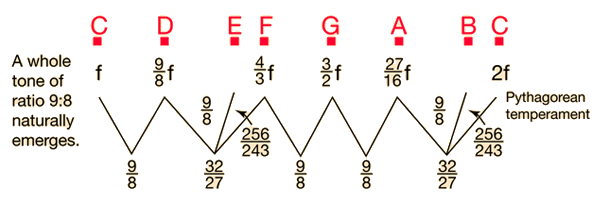
A pentatonic musical scale can be devised with the use of only the octave, fifth and fourth. It produces three intervals with ratio 9/8 and two larger intervals. If a 9/8 (whole tone) interval is carved out of the larger ones, a smaller (semitone) interval is left: B-C and E-F. This creates a Pythagorean diatonic scale. If the semitone thus created is taken from the whole tone, a chromatic semitone of different size is left over. This leads to some of the difficulties of Pythagorean temperament and other temperaments - such difficulties ultimately led to the development of equal temperament.

一个五声音阶可以仅使用八度、五度和四度来构建。它会产生三个比值为9/8的音程和两个较大的音程。如果从较大的音程中取出一个9/8(全音)的音程,剩下的就是一个较小的(半音)音程:B-C和E-F。这会形成一个毕达哥拉斯音阶。如果从全音中取出这个半音,就会留下一个大小不同的半音,这导致了毕达哥拉斯律及其它律制的一些困难。这些困难最终促成了十二平均律的产生。
The use of the octave and the fifth (ratio 3:2) is attributed to Pythagorus in the sixth century BC.

octave 和 fifth(比值为 3:2)的使用可以追溯到公元前六世纪的毕达哥拉斯。
The whole tone
全音
Circle of fifths
五度圆
Index

Musical scales
索引 音阶
 
HyperPhysics***** Sound
HyperPhysics ***** 声音
R Nave
Go Back
返回


Pythagorean Intervals

毕达哥拉斯音程

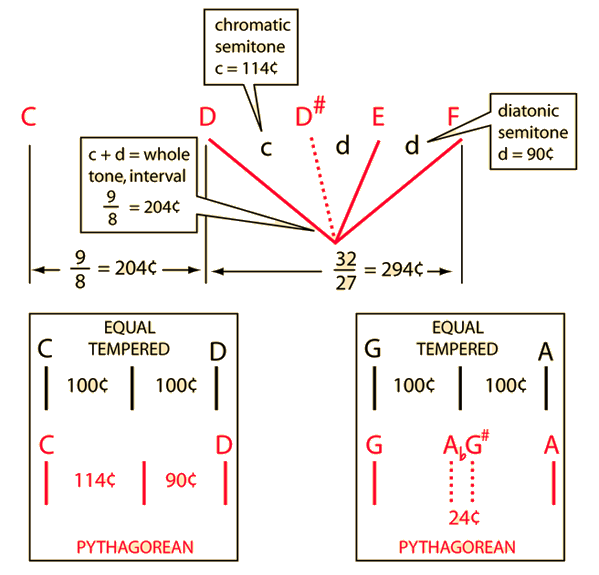
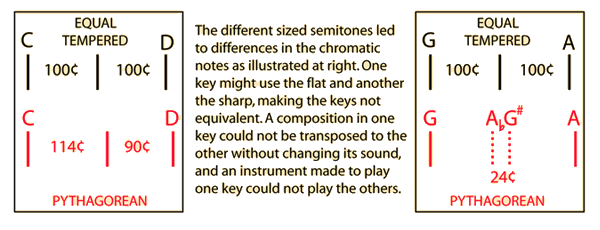
The Pythagorean temperament produces two different semitones. When expressed in cents, it becomes evident that their differences are well above the just noticeable difference in pitch.

毕达哥拉斯音阶会产生两种不同的半音。以音分表示时,可以明显看出它们的差异远高于音高可察觉的差别。

This leads to certain difficulties which ultimately led to the development of equal temperament.

这导致了某些困难,最终促成了十二平均律的形成。
The whole tone
全音
Index

Musical scales
索引 音阶
 
HyperPhysics***** Sound
HyperPhysics ***** 声音
R Nave
Go Back
返回


Temperament Problems

Temperament Problems(专名或术语)

For over two centuries the predominant musical scale used, at least for western music, has been the equal tempered scale. The ability to freely modulate between musical keys and the equivalence of all musical keys were strong enough features to overcome reservations about the compromises made with the small-integer-ratio rule. The kinds of problems which led to this compromise scale were:

在过去两个世纪中,至少在西方音乐中,占主导地位的音阶一直是十二平均律。能够自由地在不同音阶之间转换以及所有音阶之间的等价性,这些特性足以克服对小整数比规则做出的妥协的疑虑。导致这种妥协的种种问题包括:
Comparison with equal-tempered semitone
与等音半音的比较
Index

Musical scales
索引 音阶
 
HyperPhysics***** Sound
HyperPhysics ***** 声音
R Nave
Go Back
返回


The Whole Tone

全音阶

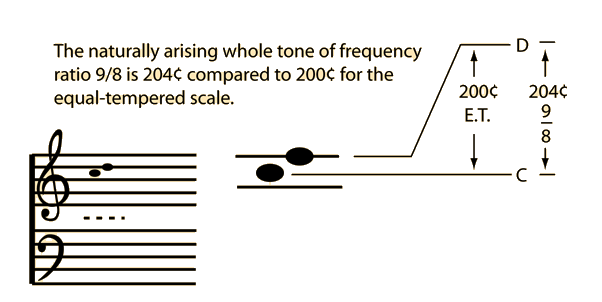
In the buildup of a pentatonic scale using the musical intervals which have been found to be universally consonant ( octave, fifth, and fourth), an interval of ratio 9/8 naturally emerges. This interval satisfies the basic condition for consonance and it occurs in the basic pentatonic scale. This suggests the carving of another such whole tone from the larger interval remaining, leaving the smaller 256/243 interval. This whole tone is used in the Just and Pythagorean temperaments. In devising the equal tempered scale it was important to maintain not only the octave, fifth, and fourth at close to their just values, but also to maintain the whole tone. Expressed in cents notation, the natural whole tone is 204¢, compared to 200¢ for the equal tempered whole tone, just within the accepted 5¢ just noticeable difference.

在使用已被发现普遍和谐的音乐音程(八度、五度和四度)构建五声音阶时,自然会出现一个比值为9/8的音程。这个音程满足基本的和谐条件,并且出现在基本的五声音阶中。这表明可以从剩余的较大音程中再刻出另一个全音,留下较小的256/243音程。这个全音被用于纯律和五度相生律。在构建十二平均律时,不仅需要保持八度、五度和四度接近其纯律值,还需要保持全音。以音分表示,自然全音为204¢,与十二平均律的全音200¢相比,仅相差5¢以内可察觉的音高差。
The natural wholle tone that arises in Pythagorean temperament leads to certain difficulties when compared to equal temperament as shown below.

在毕达哥拉斯调音法中自然产生的全音,在与十二平均律比较时会出现一些困难,如下所示。
Index

Musical scales
索引 音阶
 
HyperPhysics***** Sound
HyperPhysics ***** 声音
R Nave
Go Back
返回