Bilingual edition: English is preserved and Chinese follows each unit. Terminology uses the confirmed v20260916 glossary; automated semantic review remains traceable.
中英双语版:英文原文完整保留,中文紧随对应单元;术语采用 v20260916 确认表,自动语义审校结果可追溯。

Phonation

发声

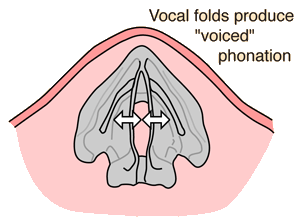
The process of speech production by the human voice may be divided into phonation, resonation, and articulation. Phonation is the process by which energy from the lungs in the form of air pressure is converted into audible vibrations.

人类声音的发声过程可以分为共鸣、共鸣和发音。共鸣是将肺部以气压形式提供的能量转化为可听振动的过程。

One method of phonation involves using the air pressure to set the elastic vocal folds into vibration, a process called voicing.

一种发声方法是利用气压使弹性声带振动,这一过程称为发声。

The other involves allowing air to pass through the larynx in to the vocal tract where modifications of the airstream produce transient or aperiodic sound waves.

另一种情况是让空气通过喉部进入声道,在此过程中气流的改变会产生瞬态或非周期性声波。

Aperiodic sounds can be combined with voiced sounds to create voiced consonants like /d/.

非周期性声音可以与元音声音结合,形成像/d/这样的元音辅音。
Index

Voice concepts

Musical instruments
索引 声学概念 音乐乐器
 
HyperPhysics***** Sound
HyperPhysics ***** 声音
R Nave
Go Back
返回


Aperiodic Phonation

非周期性发声

Aperiodic phonation involves allowing air to pass through the larynx in to the vocal tract where modifications of the airstream produce transient or aperiodic sound waves.

非周期性发声涉及让气流通过喉部进入声道,其中气流的改变产生瞬态或非周期性声波。
Plosive
/t/
爆破音 /t/
Sound produced by blocking the airstream and suddenly releasing the built up air pressure. Such a sound is called a stop or "plosive".
声音是通过阻断气流并突然释放积累的空气压力产生的。这种声音称为闭塞声或‘爆破音’。
Fricative
/sh/
摩擦音 /sh/
A "continuous noise" type sound made by forcing air through a constricted space, like the sound /sh/.
通过狭窄空间迫使空气通过所产生的‘连续噪声’类型声音,例如声音 /sh/。
Africate
/ch/
摩擦音 /ch/
A combination of plosive and fricative, as in the sound /ch/ in "chair" .
一种爆破音和摩擦音的组合,如‘chair’中的声音 /ch/。
Voiced consonant
/d/
Voiced consonant /d/(专名或术语)
A plosive followed by a voiced sound.
一个爆破音后接一个浊音。
Index

Voice concepts

Musical instruments
索引 声学概念 音乐乐器
 
HyperPhysics***** Sound
HyperPhysics ***** 声音
R Nave
Go Back
返回


Voice Vibrato

声音颤音

Included in the distinguishing characteristics of a musical sound which determine its timbre is vibrato/tremolo. The term vibrato for the singing voice is more commonly used to describe the variations in the voice during a sustained note. When analyzed, it is found that both the pitch and amplitude change periodically so that both vibrato and tremolo are present. The presence of vibrato, within limits, adds richness and expression to the voice. It is often the case that the amount of vibrato increases as a given note is sustained, and many singers use variations of vibrato for expression in singing. Excessive vibrato gives an impression of instability to the tone, so control of the amount of vibrato is a matter of practice and musical judgement.

包含在决定音乐声音音色的区分特征中的振动/震颤。对于歌唱声音,'振动'一词更常用来描述在持续音符期间声音的变化。分析发现,音高和振幅都会周期性变化,因此振动和震颤都存在。在一定限度内,振动能增加声音的丰富性和表现力。通常情况下,随着音符的持续,振动的强度会增加,许多歌手会使用不同形式的振动来增强演唱的表现力。过度的振动会使音色显得不稳定,因此振动强度的控制是实践和音乐判断的问题。
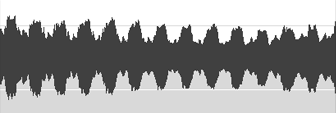
This recording of a sustained vocal sound shows the periodic change in the amplitude of the sound. You could also clearly hear the accompanying periodic pitch change, so both amplitude modulation and frequency modulation were present.

这段持续声音的录音显示了声音幅度的周期性变化。你也可以清楚地听到伴随的周期性音调变化,因此同时存在幅度调制和频率调制。

If the precise harmonic content of a sustained voice sound is reproduced and sounded, the ear can easily distinguish the sound without the vibrato. Stanley suggests that a good vibrato rate for the singing voice is about 6 pulses per second, and that the average pitch variation is about a semitone accompanied by about 3 decibels of intensity variation. The amount of vibrato tends to increase with loudness, reaching about a full tone for very loud vocalization (fortissimo).

如果精确再现持续声音的谐波成分并发出,耳朵可以很容易地分辨该声音而无需泛音。Stanley认为,对于歌唱声音来说,良好的泛音频率约为每秒6次,平均音高变化约为一个半音,同时伴随约3分贝的强度变化。泛音的强度 tends to 增加 with loudness,达到非常大声发声(fortissimo)时约为一个全音。
Musical instrument vibrato
乐器的振动音调
Index

Voice concepts

Musical instruments

Reference
Stanley
索引 声音 概念 音乐乐器 参考 斯坦利
 
HyperPhysics***** Sound
HyperPhysics ***** 声音
R Nave
Go Back
返回


Vibrato with Musical Instruments

乐器的振动

Included in the distinguishing characteristics of the sound of a musical instrument which determine its timbre is vibrato/tremolo. With a violin, almost pure vibrato (periodic pitch variations) can be produced with the finger on the string by a rocking motion which periodically changes the length and therefore the resonant frequency. Likewise a trombone player can produce almost pure vibrato by wiggling the slide in and out to change the pitch. On the other hand when a flute player uses the diaphragm to produce a tone variation, sometimes called "diaphragm vibrato", it is actually almost pure tremolo (periodic amplitude variation). For most tone variations which come under the general term vibrato, such as that produced with instruments employing a reed, the tone variation includes both true vibrato and tremolo since it is hard to produce a pitch variation without producing some amplitude variation as well. Voice vibrato also includes both pitch and amplitude variation.

包含在决定乐器声音特征中的区别特征中,决定其音色的是泛音/震颤。用小提琴时,通过手指在弦上做周期性运动,可以产生几乎纯的震颤(周期性音调变化),这种运动会周期性地改变弦的长度,从而改变共振频率。同样,小号演奏者通过滑动管的进出运动来改变音高,也可以产生几乎纯的震颤。另一方面,当竖笛演奏者使用横膈膜来产生音高变化时,有时称为“横膈膜震颤”,实际上是一种几乎纯的震颤(周期性振幅变化)。对于大多数被称为震颤的音高变化,如使用簧片的乐器所产生的音高变化,这种音高变化包括真正的震颤和震颤,因为很难产生音高变化而不同时产生一些振幅变化。人声震颤也包括音高和振幅的变化。
Index

Voice concepts

Musical instruments
索引 声学概念 音乐乐器
 
HyperPhysics***** Sound
HyperPhysics ***** 声音
R Nave
Go Back
返回