Timbre音色
Sounds may be generally characterized by pitch, loudness, and quality. Sound "quality" or "timbre" describes those characteristics of sound which allow the ear to distinguish sounds which have the same pitch and loudness. Timbre is then a general term for the distinguishable characteristics of a tone. Timbre is mainly determined by the harmonic content of a sound and the dynamic characteristics of the sound such as vibrato and the attack-decay envelope of the sound. 声音通常可以由音调、响度和品质来描述。声音的“品质”或“音色”是指那些使耳朵能够区分具有相同音调和响度的声音的特性。音色则是对音调可区分特性的总称。音色主要由声音的谐波内容以及声音的动态特性(如泛音和声音的起音-衰减包络)决定。
Some investigators report that it takes a duration of about 60 ms to recognize the timbre of a tone, and that any tone shorter than about 4 ms is perceived as an atonal click. It is suggested that it takes about a 4 dB change in mid or high harmonics to be perceived as a change in timbre, whereas about 10 dB of change in one of the lower harmonics is required. 一些研究者报告说,识别一个音调的音色需要约60毫秒的时间,任何短于约4毫秒的音调都会被感知为无调的咔嗒声。建议说,中高频谐波需要约4分贝的变化才能被感知为音色的变化,而低频谐波则需要约10分贝的变化。
|
Index Hearing concepts Reference Winckell 索引听力概念参考Winckell | ||
|
Go Back
返回 |
Harmonic Content谐波成分
The primary contributers to the quality or timbre of the sound of a musical instrument are harmonic content, attack and decay, and vibrato. For sustained tones, the most important of these is the harmonic content, the number and relative intensity of the upper harmonics present in the sound. 决定音乐乐器声音质量或音色的主要因素是谐波内容、攻击和衰减,以及泛音。对于持续音,其中最重要的因素是谐波内容,即声音中存在多少以及各高次谐波的相对强度。
Some musical sound sources have overtones which are not harmonics of the fundamental. While there is some efficiency in characterizing such sources in terms of their overtones, it is always possible to characterize a periodic waveform in terms of harmonics - such an analysis is called Fourier analysis. It is common practice to characterize a sound waveform by the spectrum of harmonics necessary to reproduce the observed waveform.
![]() The recognition of different vowel sounds of the human voice is largely accomplished by analysis of the harmonic content by the inner ear. Their distinctly different quality is attributed to vocal formants, frequency ranges where the harmonics are enhanced. 人类声音的不同元音音色主要通过内耳对谐波内容的分析来识别。其显著不同的音质归因于喉部共振峰,即谐波增强的频率范围。
某些音乐声源的泛音并非基频的谐波。虽然用泛音来描述这类声源在某种程度上是有效的,但始终可以将周期性波形用谐波来描述——这种分析称为傅里叶分析。通常习惯用能再现观察到的波形所需的谐波谱来描述声音波形。 |
Index Loudness concepts Hearing concepts 索引 响度概念 听觉概念 | ||
|
Go Back
返回 |
Attack and Decay攻击与衰减
The primary contributers to the quality or timbre of the sound of a musical instrument are harmonic content, attack and decay, and vibrato/tremolo. 影响乐器声音质量或音色的主要因素包括谐波成分、攻击和衰减,以及震颤(颤音)。
![]() The illustration above shows the attack and decay of a plucked guitar string. The plucking action gives it a sudden attack characterized by a rapid rise to its peak amplitude. The decay is long and gradual by comparison. The ear is sensitive to these attack and decay rates and may be able to use them to identify the instrument producing the sound. 上图展示了拨弦吉他弦的攻击和衰减过程。拨弦动作使其产生一个突然的攻击,表现为迅速达到峰值振幅。相比之下,衰减过程则较长且缓慢。人耳对这些攻击和衰减速率非常敏感,可能能够利用这些特性来识别产生声音的乐器。
![]() This shows the sound envelope of striking a cymbal with a stick. The attack is almost instantaneous, but the decay envelope is very long. The time period shown is about half a second. The interval shown with the guitar string above is also about half a second, but since its frequency is much lower, you can resolve the individual periods in that sound envelope. 这显示了用棒击打镲片时的声波包络线。攻击几乎是瞬间的,但衰减包络线却非常长。所显示的时间周期约为半秒。上面吉他弦的显示区间也是约半秒,但由于其频率低得多,你可以分辨出其中的个体周期。
|
Index Hearing concepts 索引听力概念 | ||
|
Go Back
返回 |
Vibrato/TremoloVibrato/Tremolo(专名或术语)
The primary contributers to the quality or timbre of the sound of a musical instrument are harmonic content, attack and decay, and vibrato/tremolo. The ordinary definition of vibrato is "periodic changes in the pitch of the tone", and the term tremolo is used to indicate periodic changes in the amplitude or loudness of the tone. So vibrato could be called FM (frequency modulation) and tremolo could be called AM (amplitude modulation) of the tone. Actually, in the voice or the sound of a musical instrument both are usually present to some extent. 声音的音色或品质主要由谐波内容、攻击和衰减,以及泛音/震颤决定。振动的普通定义是“音调的周期性变化”,而震颤则用来表示音量或响度的周期性变化。因此,泛音可以称为频率调制(FM),而震颤可以称为幅度调制(AM)。实际上,在声音或乐器的声音中,这两种现象通常都会在一定程度上存在。
Vibrato is considered to be a desirable characteristic of the human voice if it is not excessive. It can be used for expression and adds a richness to the voice. If the harmonic content of a sustained sound from a voice or wind instrument is reproduced precisely, the ear can readily detect the difference in timbre because of the absence of vibrato. More realistic synthesized tones will add some type of vibrato and/or tremolo to produce a more realistic tone. 颤音被认为是人类声音的一个优点,只要它不过度。它可以用于表达,并为声音增添丰富性。如果一个声音或风乐器的持续音的谐波内容被精确地再现,耳朵就能轻易地察觉到音色的差异,因为没有颤音。更加真实的合成音色会加入某种类型的颤音和/或震颤,以产生更加真实的声音。
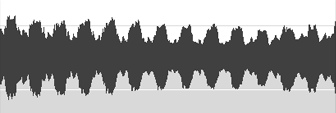
![]() Above is an amplitude plot of a sustained "ee" vowel sound produced by a female voice. The periodic amplitude change would be described as tremolo by the ordinary definition of it. You could also hear pitch variation along with it, so vibrato was present as well. That is commonly the case. The period of the amplitude modulation is about 0.17 seconds, or a modulation frequency of about 5.8 Hz superimposed on a tone of frequency centered at about 395 Hz. Rough frequency measurements gave frequencies of 392 Hz when the amplitude was high and 399 Hz when the amplitude was low. It is not known whether or not this kind of variation is typical. Scaling the amplitude variation gives a range of about 7 dB in intensity associated with the amplitude modulation. 上面是女性声音发出的持续“ee”元音声音的振幅图。这种周期性振幅变化按照普通定义来说可以称为震颤。你也可以同时听到音调的变化,因此存在泛音。这通常是常见的。振幅调制的周期约为0.17秒,或在约395 Hz为中心频率的音调上叠加约5.8 Hz的调制频率。粗略的频率测量显示,振幅高时频率为392 Hz,振幅低时频率为399 Hz。不清楚这种变化是否典型。将振幅变化进行缩放,可以得到与振幅调制相关的强度范围约为7 dB。
In his "The Acoustical Foundations of Music", Ch 11, John Backus comments that voice measurements have shown a pitch variation of a singing voice some six to seven times per second usually accompanied by an amplitude variation at the same rate. He references Sacerdote. 在《音乐的声学基础》第11章中,约翰·巴克斯评论说,声学测量显示,人声的音调变化通常为每秒六到七次,通常伴随相同频率的振幅变化。他引用了萨塞罗特。 The comments of Berg and Stork in their book "The Physics of Sound", 2nd ed, are very close to what I would conclude from my experience and reading. "The vibrato of a singer's voice, for example, aids significantly in distinguishing the voice from other musical sounds. The term 'vibrato' in general use refers not only to periodic changes in pitch, but also to periodic changes in amplitude, which should more correctly be called tremolo. The 'diaphragm vibrato' of a flute player is close to pure tremolo; the vibrato obtained when a trombone player wiggles the slide in and out is almost a pure pitch vibrato. Singing vibrato is actually a mixture of true vibrato and tremolo. Vibrato on a violin or other string instrument is close to pure pitch vibrato." Berg和Stork在他们所著的《声音的物理》(第二版)中的评论,与我根据自己的经验和阅读所得出的结论非常接近。例如,歌手的颤音在区分其声音与其他音乐声音方面起着重要作用。在一般用法中,'颤音'一词不仅指音高周期性变化,也指振幅的周期性变化,后者应更准确地称为'震颤'。小提琴演奏者所称的'腹式颤音'接近纯粹的震颤;当圆号演奏者来回移动滑管时产生的颤音几乎是一种纯粹的音高颤音。歌唱中的颤音实际上是真正颤音和震颤的混合体。小提琴或其他弦乐器上的颤音接近纯粹的音高颤音。 |
Index Hearing concepts References Rossing, Science of Sound Backus Zwicker, et al. Sacerdote 索引 声学概念 参考文献 Rossing, Science of Sound Backus Zwicker, et al. Sacerdote | ||
|
Go Back
返回 |