Stopping Distance for Auto
汽车的停车距离
Assuming proper operation of the brakes, the minimum stopping distance for an automobile is determined by the effective coefficient of friction between the tires and the road. The friction force of the road must do enough work on the car to reduce its kinetic energy to zero (work-energy principle). If the wheels of the car continue to turn while braking, then static friction is operating, while if the wheels are locked and sliding over the road surface, the braking force is a kinetic friction force. 
To reduce the kinetic energy to zero:
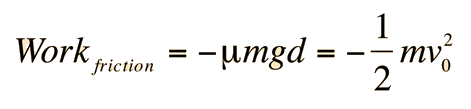
so the stopping distance is
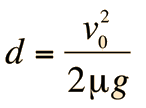 | Show calculation
展示计算 |
 | Even though the stopping distance for a large truck should be the same as that for a car, there are real-world cases where a truck has more difficulty stopping. Runaway truck ramps are placed on long downgrades like this one on Monteagle in Tennessee. Deep, loose gravel provides a stopping force greater than that obtained from just a tire against the road. 尽管大型卡车的停车距离应与汽车相同,但在现实世界中,卡车往往更难停下来。这种情况下,会设置 runaway truck ramps,例如田纳西州蒙特尼格勒的这个坡道。深厚的松散碎石能提供比仅靠轮胎与路面接触所获得的更大的停车阻力。 |
因此,停车距离是 注意到这表明停车距离与车辆质量无关。它还表明,车辆速度加倍时,停车距离会增加四倍。
假定刹车正常工作,汽车的最小停车距离由轮胎与路面之间的有效摩擦系数决定。路面的摩擦力必须对汽车做足够的功,使其动能减少到零(功-能原理)。如果刹车时车轮继续转动,则静摩擦力在起作用;如果车轮锁死并滑动,则制动力是动能摩擦力。为了将动能减少到零:
Work-energy principle
索引 功-能原理
| HyperPhysics***** Mechanics
力学 | R Nave |
返回