Ohm's Law欧姆定律
For many conductors of electricity, the electric current which will flow through them is directly proportional to the voltage applied to them. When a microscopic view of Ohm's law is taken, it is found to depend upon the fact that the drift velocity of charges through the material is proportional to the electric field in the conductor. The ratio of voltage to current is called the resistance, and if the ratio is constant over a wide range of voltages, the material is said to be an "ohmic" material. If the material can be characterized by such a resistance, then the current can be predicted from the relationship: 对于许多导体来说,通过它们的电流与施加的电压成正比。当从微观角度看待欧姆定律时,发现它依赖于这样一个事实:电荷在材料中的漂移速度与导体中的电场成正比。电压与电流的比值称为电阻,如果该比值在较宽的电压范围内保持恒定,则该材料被称为‘欧姆’材料。如果材料可以由这样的电阻来表征,那么电流就可以从以下关系式中预测:
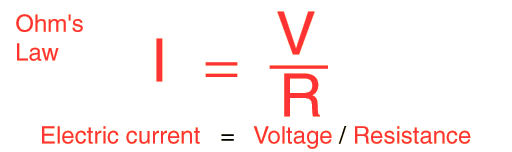
![]() Data can be entered into any of the boxes below. Specifying any two of the quantities determines the third. After you have entered values for two, click on the text representing the third in the active illustration above to calculate its value.
可以将数据输入到下面的任何框中。指定其中两个量即可确定第三个量。在您输入了两个值后,点击上方活动示意图中代表第三个量的文本以计算其值。安培 = 伏特 / 欧姆 中文译文中的待填/计算数值依次对应:1:d1 2:m1 3:v1。实际数值以上方原输入框为准。 |
Index DC Circuits 索引:直流电路 | ||
|
Go Back
返回 |
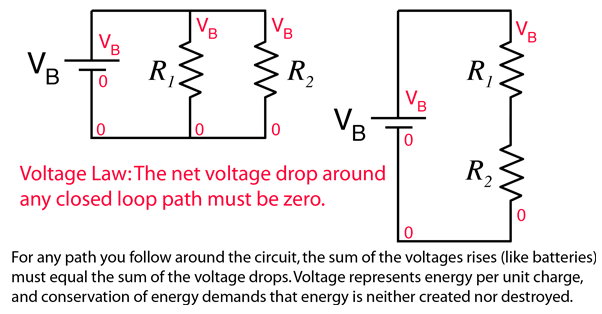
Voltage Law电压定律
The voltage changes around any closed loop must sum to zero. No matter what path you take through an electric circuit, if you return to your starting point you must measure the same voltage, constraining the net change around the loop to be zero. Since voltage is electric potential energy per unit charge, the voltage law can be seen to be a consequence of conservation of energy. 任何闭合回路中的电压变化必须总和为零。不管你通过电路走哪条路径,如果你最终回到起点,必须测量到相同的电压,这限制了回路中的净变化为零。由于电压是单位电荷的电势能,因此电压定律可以被视为能量守恒的结果。
The voltage law has great practical utility in the analysis of electric circuits. It is used in conjunction with the current law in many circuit analysis tasks. 电压定律在电路分析中有重要的实际应用。它常与其他电路定律一起用于许多电路分析任务。
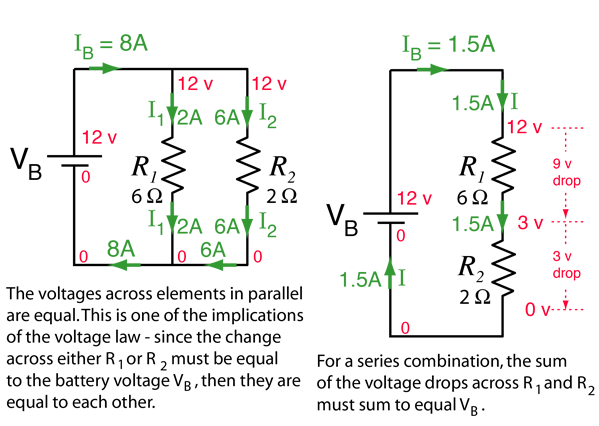
![]() The voltage law is one of the main tools for the analysis of electric circuits, along with Ohm's Law, the current law and the power relationship. Applying the voltage law to the above circuits along with Ohm's law and the rules for combining resistors gives the numbers shown below. The determining of the voltages and currents associated with a particular circuit along with the power allows you to completely describe the electrical state of a direct current circuit. 电压定律是分析电路的主要工具之一,与其他工具如欧姆定律、电流定律和功率关系一起。将电压定律与欧姆定律以及电阻组合规则应用于上述电路,可以得到下面的数值。确定特定电路中的电压和电流以及功率,可以完全描述直流电路的电气状态。
![]()
|
Index DC Circuits 索引:直流电路 | |||
|
Go Back
返回 |
Current Law电流定律
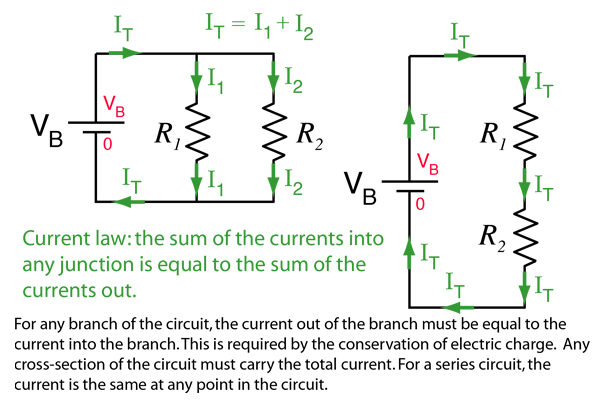
The electric current in amperes that flows into any junction in an electric circuit is equal to the current which flows out. This can be seen to be just a statement of conservation of charge. Since you do not lose any charge during the flow process around the circuit, the total current in any cross-section of the circuit is the same. Along with the voltage law, this law is a powerful tool for the analysis of electric circuits. 在电路中,流入任何节点的电流(单位为安培)等于流出的电流。这可以看作是对电荷守恒的陈述。由于在电路中流动过程中不会损失任何电荷,因此电路中任何横截面上的总电流都是相同的。与电压定律一起,这一定律是分析电路的强大工具。
![]() The current law is one of the main tools for the analysis of electric circuits, along with Ohm's Law, the voltage law and the power relationship. Applying the current law to the above circuits along with Ohm's law and the rules for combining resistors gives the numbers shown below. The determining of the voltages and currents associated with a particular circuit along with the power allows you to completely describe the electrical state of a direct current circuit. 电流定律是分析电路的主要工具之一,与欧姆定律、电压定律和功率关系并列。将电流定律与欧姆定律以及电阻组合规则应用于上述电路,可以得到下面的数值。确定特定电路相关的电压和电流以及功率,可以完全描述直流电路的电气状态。
![]()
|
Index DC Circuits 索引:直流电路 | |||
|
Go Back
返回 |