 |
Ionizing the Air电离空气
Voltages of hundreds of thousands of volts can be generated with a demonstration model Van de Graaff generator. This is sufficient to ionize the air, which has primary constituents nitrogen and oxygen. An applied electric field will polarize air molecules, and if sufficient to force electrons off the molecules, those electrons can collide with other molecules and can start a discharge, or electric arc. The voltage necessary to start an arc depends upon the pressure and gap length, and is modeled in Paschen's law(Wikipedia). For long gaps in air at STP, the threshold for arc discharges is often quoted as 3.4 million volts per meter. 用演示模型的范德格拉夫起电机可以产生数万伏的电压。这足以使空气电离,而空气的主要成分是氮和氧。施加的电场会使空气分子极化,如果电场足够强以将电子从分子中剥离,这些电子可以与其他分子碰撞并引发放电,或电弧。引发电弧所需的电压取决于压力和间隙长度,并在Paschen定律(Wikipedia)中得到建模。对于空气在标准温度和压力下的长间隙,电弧放电的阈值常被引用为每米3.4百万伏。
When an atom is ionized, it will tend to collect a replacement electron which may cascade down though the available atomic energy levels, emitting light quanta characteristic of those level separations. The characteristic spectra of Nitrogen and Oxygen would be observed in a visible arc in air. 当原子被电离时,它会倾向于收集一个替代电子,该电子可能通过可用的原子能级 cascade 下降,发射出特征于这些能级分离的光子。在空气中可见的弧光中可以观察到氮和氧的特征光谱。 |
A spherical metal shell is brought close to the van de Graaf generator, and a spark about 10cm long jumps to that sphere. The voltage required to produce an electric arc across a centimeter of air is in the neighborhood of 30,000 volts, so this arc may represent about 300,000 volts produced by the van de Graaf. 一个球形金属壳被靠近范德格拉夫发电机,一个约10厘米长的火花跳到该球体上。产生跨1厘米空气的电弧所需的电压大约为30,000伏特,因此这个电弧可能代表范德格拉夫发电机产生的约300,000伏特。 |  |
 | The van de Graaf can also be used to excite spectral tubes with specific gases in them and will display the characteristic colors for those gases. This gas is neon, and if the colors were separated by a diffraction grating, they would show the spectrum for neon gas. 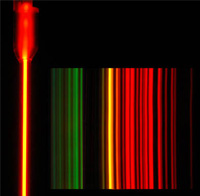 范德格拉夫机也可以用来激发含有特定气体的光谱管,并会显示出这些气体的特征颜色。这种气体是氖气,如果用衍射光栅将这些颜色分开,就会显示出氖气的光谱。 |
A cereal like puffed wheat or Cheerios provides a playful example of the mutual repulsion of objects that are given an electric charge of the same polarity. 像爆米花或Cheerios这样的食物提供了一个有趣的例子,说明带有相同极性电荷的物体之间会发生相互排斥。 |  |
Voltage concepts
| HyperPhysics***** Electricity and Magnetism
HyperPhysics ***** 电学和磁学 | J Nave, R Nave
J Nave, R Nave(专名或术语) |