Batteries and Bulbs as DC Circuit Example
An experiment which uses batteries to power a light bulb and then two light bulbs in parallel provides an exercise in parallel circuits which requires an evaluation of the internal resistance of the battery.
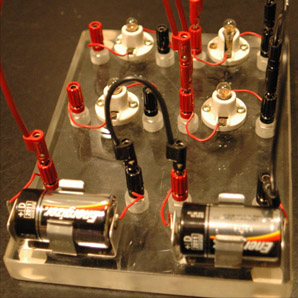 | D-cell batteries (alkaline dry cells) mounted on a plexiglass board supply power to bulb sockets, two of which are wired in parallel here. D型电池(碱性干电池)安装在有机玻璃板上,为灯座供电,其中两个灯座并联连接。
For an ideal voltage source, one bulb could be unscrewed without affecting the brightness of the other. But in practice it is found that the single bulb is noticeably brighter than the two bulbs when they are supplied with voltage in parallel by the batteries. 对于理想电压源,如果拔掉一个灯泡,另一个灯泡的亮度不会受到影响。但实际情况是,当电池通过并联供电时,单个灯泡的亮度明显比两个灯泡时更亮。 |
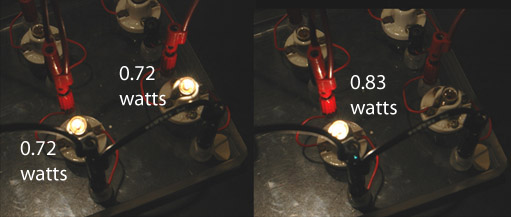
When one bulb was unscrewed, the remaining bulb noticeably brightened, contrary to the expectation for a parallel circuit where the two voltages were presumed to be equal. You should be able to unscrew one without affecting the other. But that presumes an ideal voltage source, and any real battery has some internal resistance which must be taken into account.
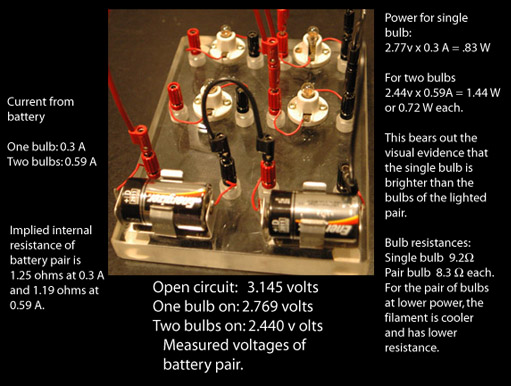
Making measurements of the external voltage of the battery pair and the current flow for an open circuit, with one bulb, and with two bulbs provides the data for analyzing the observed behavior. Applying Ohm's law and the power relationship allows us to determine the internal resistance of the battery and the power used in the bulbs.
| DC circuit examples
直流电路示例 | Resistor combinations
电阻组合 |
| Bulbs in series and parallel
串联和并联的灯泡 |
| Batteries
电池 |
| HyperPhysics*****Electricity and magnetism
HyperPhysics ***** 电磁学 | R Nave |