Bilingual edition: English is preserved and Chinese follows each unit. Terminology uses the confirmed v20260916 glossary; automated semantic review remains traceable.
中英双语版:英文原文完整保留,中文紧随对应单元;术语采用 v20260916 确认表,自动语义审校结果可追溯。

Resistance

电阻

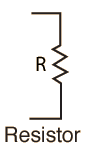
The electrical resistance of a circuit component or device is defined as the ratio of the voltage applied to the electric current which flows through it:

电路元件或器件的电阻定义为施加在其上的电压与通过它的电流之比:

If the resistance is constant over a considerable range of voltage, then Ohm's law, I = V/R, can be used to predict the behavior of the material. Although the definition above involves DC current and voltage, the same definition holds for the AC application of resistors.
如果电阻在相当大的电压范围内保持恒定,那么欧姆定律,I = V/R,可以用来预测材料的行为。尽管上述定义涉及直流电流和电压,但该定义同样适用于电阻器的交流应用。

Whether or not a material obeys Ohm's law, its resistance can be described in terms of its bulk resistivity. The resistivity, and thus the resistance, is temperature dependent. Over sizable ranges of temperature, this temperature dependence can be predicted from a temperature coefficient of resistance.

无论材料是否遵循欧姆定律,其电阻都可以用其体积电阻率来描述。电阻率,因此电阻,是温度依赖的。在较大的温度范围内,这种温度依赖性可以从电阻温度系数来预测。
Conductors and insulators
导体和绝缘体
Resistor combinations
电阻组合
Non-ohmic resistance: the electric pickle
非欧姆电阻:电容器
AC behavior of resistor
电阻的交流行为
Common carbon resistors
常用碳电阻
Index

DC Circuits
索引:直流电路
 
HyperPhysics*****Electricity and magnetism
HyperPhysics ***** 电磁学
R Nave
Go Back
返回


Resistivity and Conductivity

电阻率与导电性

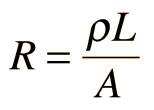
The electrical resistance of a wire would be expected to be greater for a longer wire, less for a wire of larger cross sectional area, and would be expected to depend upon the material out of which the wire is made. Experimentally, the dependence upon these properties is a straightforward one for a wide range of conditions, and the resistance of a wire can be expressed as

导线的电阻应预期随着导线长度的增加而增大,随着横截面积的增大而减小,并且取决于导线所用材料。实验上,这种依赖性在广泛的条件下都是直接的,导线的电阻可以表示为

The factor in the resistance which takes into account the nature of the material is the resistivity . Although it is temperature dependent, it can be used at a given temperature to calculate the resistance of a wire of given geometry.

决定电阻的材料性质的因子是电阻率。尽管它受温度影响,但可以在给定温度下用来计算具有给定几何形状的导线的电阻。

It should be noted that it is being presumed that the current is uniform across the cross-section of the wire, which is true only for Direct Current. For Alternating Current there is the phenomenon of "skin effect" in which the current density is maximum at the maximum radius of the wire and drops for smaller radii within the wire. At radio frequencies, this becomes a major factor in design because the outer part of a wire or cable carries most of the current.

The inverse of resistivity is called conductivity. There are contexts where the use of conductivity is more convenient.

电阻率的倒数称为电导率。在某些情况下,使用电导率会更加方便。

Electrical conductivity = σ = 1/ρ

电导率 = σ = 1/ρ
Calculation
计算
Table of resistivities
电阻率表
Common wire gauges
常用导线规格
Microscopic view of resistivity
电阻率的微观视图
应注意的是,这里假设电流在导线的横截面上是均匀的,这仅适用于直流电。对于交流电,存在‘皮肤效应’现象,即电流密度在导线的最大半径处最大,而在导线内部较小的半径处则减小。在无线电频率下,这种效应成为设计中的重要因素,因为导线或电缆的外部分主要承载大部分电流。
Index
索引
 
HyperPhysics*****Electricity and magnetism
HyperPhysics ***** 电磁学
R Nave
Go Back
返回


Resistor Combinations

电阻组合

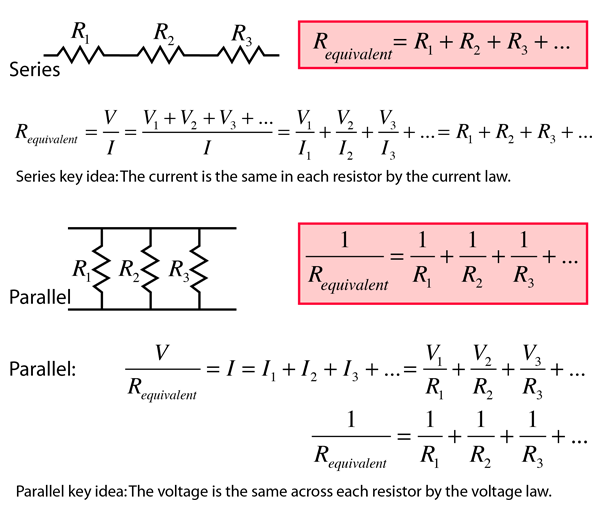
The combination rules for any number of resistors in series or parallel can be derived with the use of Ohm's Law, the voltage law, and the current law.

任何数量的电阻器串联或并联的组合规则,可以通过欧姆定律、电压定律和电流定律推导出来。

Comparison example
比较示例
Index

DC Circuits
索引:直流电路
 
HyperPhysics*****Electricity and magnetism
HyperPhysics ***** 电磁学
R Nave
Go Back
返回


Resistivity Calculation

电阻率计算

The electrical resistance of a wire would be expected to be greater for a longer wire, less for a wire of larger cross sectional area, and would be expected to depend upon the material out of which the wire is made (resistivity). Experimentally, the dependence upon these properties is a straightforward one for a wide range of conditions, and the resistance of a wire can be expressed as

导线的电阻应预期随着导线长度增加而增大,随着横截面积增大而减小,并且取决于导线所用材料(电阻率)。实验上,这种依赖性在广泛的条件下都是直接的,导线的电阻可以表示为

Resistance = resistivity x length/area
For a wire of length L = m = ft
and area A = cm2
corresponding to radius r = cm
and diameter inches for common wire gauge comparison
with resistivity = ρ = x 10^ ohm meters
will have resistance R = ohms.

Enter data and then click on the quantity you wish to calculate in the active formula above. Unspecified parameters will default to values typical of 10 meters of #12 copper wire. Upon changes, the values will not be forced to be consistent until you click on the quantity you wish to calculate.

输入数据,然后点击上方交互式公式中您希望计算的量。未指定的参数将默认设置为典型10米直径为#12的铜线的值。在更改后,这些值不会被强制保持一致,直到您点击您希望计算的量。
Commonly used U.S. wire gauges
for copper wire.
常用的铜线美国线规
AWG
Diameter
(inches)
直径(英寸)
Typical use
典型应用
10
0.1019
Electric range
电烤炉
12
0.0808
Household circuit
家庭电路
14
0.0640
Switch leads
开关电路
Standard wire gauges
标准线缆规格
Resistivities of some metals
in ohm-m(x 10-8) at 20°C.
某些金属在20°C时的电阻率(单位:欧姆·米×10^-8)
Aluminum
铝
2.65
Gold
黄金
2.24
Copper
铜
1.724
Silver
银
1.59
Iron
铁
9.71
Platinum
铂
10.6
Nichrome
尼铬
100
Tungsten
钨
5.65
Table of resistivities
电阻率表

The factor in the resistance which takes into account the nature of the material is the resistivity. Although it is temperature dependent, it can be used at a given temperature to calculate the resistance of a wire of given geometry.

决定电阻的性质因素是电阻率。尽管它随温度变化,但可以在给定温度下用来计算具有给定几何形状的导线的电阻。
Discussion
讨论
Table of resistivities
电阻率表
Common wire gauges
常用导线规格
电阻 = 电阻率 × 长度 / 面积。对于长度 L = m = ft 和面积 A = cm² 对应的半径 r = cm 和直径 inches 的常见导线标称规格,电阻率 ρ = ρ × 10^ ohm meters 的电阻 R = ohms。
中文译文中的待填/计算数值依次对应:1:l 2:lc 3:a 4:r 5:rc 6:rb 7:rp 8:res。实际数值以上方原输入框为准。
Index
索引
 
HyperPhysics*****Electricity and magnetism
HyperPhysics ***** 电磁学
R Nave
Go Back
返回