Electric Force Example
电力示例

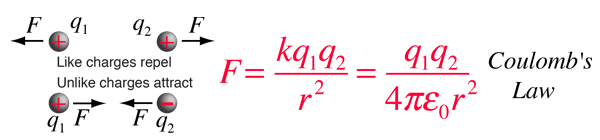
The electric force between charges may be calculated using Coulomb's law.
带电体之间的电力可以用库仑定律计算。
Normal household circuits in the U.S. operate on an AC voltage of about V =120 volts. Connected to such a ciruit, the electric power relationship P = IV tells us that to use power at the rate of P = 120 watts on a 120 volt circuit would require an electric current of I = 1 ampere. One ampere of current transports one Coulomb of charge per second through the conductor. So one Coulomb of charge represents the charge transported through a 120 watt lightbulb in one second.
美国普通家庭电路通常使用约120伏的交流电压。连接到这样的电路,电功率关系P = IV告诉我们,要在120伏的电路上以120瓦的功率使用电力,需要的电流为I = 1安培。1安培的电流每秒通过导体传输1库仑的电荷。因此,1库仑的电荷代表通过120瓦灯泡在1秒内传输的电荷量。
If two one-second collections of 1 Coulomb each were concentrated at points one meter apart, the force between them could be calculated from Coulomb's Law. For this particular case, that calculation becomes
如果两个一库仑的电荷分别集中在相距一米的两点上,那么它们之间的力可以通过库仑定律计算。对于这种特定情况,该计算结果为

If two such charges could indeed be concentrated at two points a meter apart, they would move away from each other under the influence of this enormous force, even if they had to rip themselves out of solid steel to do so!
如果两个这样的电荷真的能被集中到相距一米的两点,它们将在这种巨大力的作用下相互远离,即使它们必须撕裂钢铁才能做到这一点!
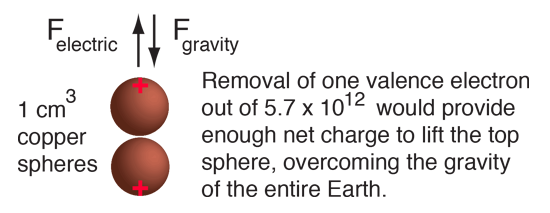
If such enormous forces would result from our hypothetical charge arrangement, then why don't we see more dramatic displays of electrical force? The general answer is that at a given point in a wire, there is never very much departure from electrical neutrality. Nature never collects a Coulomb of charge at one point. It might be instructive to examine the amount of charge in a sphere of copper of volume one cubic centimeter. Copper has one valence electron outside of closed shells in its atom, and that electron is fairly free to move about in solid copper material (that's what makes copper a good electrical conductor). The density of metallic copper is about 9 grams/cm3 and one mole of copper is 63.5 grams so the cubic centimeter of copper contains about 1/7th of a mole or about 8.5 x 10²² copper atoms. With one mobile electron per atom, and with the electron charge of 1.6 x 10⁻¹⁹ Coulombs, this means there are about 13,600 Coulombs of potentially mobile charge in one cm3 of copper. Suppose we remove enough of the electrons from two spheres of copper so that there is enough net positive charge on them to suspend one of them over the other. What fraction of the electron charge must we remove? The force to lift one of the spheres of copper would be its weight, 0.088 Newtons. Assuming that the net charge resides at the points of the spheres most distant from each other because of the charge repulsion, we can set the force of repulsion equal to the weight of a sphere. The radius of a one cm3 sphere is 0.62 cm, so we will treat the force as that between two point charges 2.48 cm apart (i.e., twice the sphere diameter apart). Using Coulomb's law, this requires a charge of 7.8 x 10⁻⁸ Coulombs. Compared to the total mobile charge of 13,600 Coulombs, this amounts to removing just one valence electron out of every 5.7 trillion (5.7 x 10¹²) from each copper sphere. The final result is that the removal of just one out of roughly six trillion of the free electrons from each copper sphere would cause enough electric repulsion on the top sphere to lift it, overcoming the gravitational pull of the entire Earth!
如果这种巨大的力会来自我们的假想电荷安排,那么为什么我们看不到更壮观的电力现象呢?一般答案是,在导体中的任何一点,很少有偏离电中性的现象。自然从不会在一个点上积累一库仑的电荷。或许有启发性的是,检查一下一立方厘米铜球中的电荷量。铜原子中有一个价电子位于闭壳层之外,这个电子在固体铜中可以自由移动(这就是铜成为良好导体的原因)。金属铜的密度约为9克/立方厘米,一摩尔铜为63.5克,因此一立方厘米的铜中含有约1/7摩尔或约8.5×10²²个铜原子。每个原子有一个自由电子,且电子电荷为1.6×10⁻¹⁹库仑,这意味着一立方厘米的铜中潜在的可移动电荷约为13,600库仑。假设我们从两个铜球中移除足够多的电子,使它们之间有足够的净正电荷,使其中一个球悬停在另一个球上方。我们必须移除多少比例的电子电荷?将一个铜球提起所需的力就是它的重量,0.088牛顿。假设净电荷位于两个球最远的点上,因为电荷排斥,我们可以将排斥力设为一个球的重量。一立方厘米球的半径为0.62厘米,因此我们将力视为两个点电荷之间2.48厘米的距离(即两倍球直径的距离)。根据库仑定律,这需要7.8×10⁻⁸库仑的电荷。与总可移动电荷13,600库仑相比,这相当于从每个铜球中移除每个自由电子的1/5.7万亿分之一(5.7×10¹²)。最终结果是,从每个铜球中移除大约六万亿分之一的自由电子,就能产生足够的电排斥力,使上面的球被提起,克服地球的引力!
|