Bilingual edition: English is preserved and Chinese follows each unit. Terminology uses the confirmed v20260916 glossary; automated semantic review remains traceable.
中英双语版:英文原文完整保留,中文紧随对应单元;术语采用 v20260916 确认表,自动语义审校结果可追溯。

Resistance: Temperature Coefficient

电阻:温度系数

Since the electrical resistance of a conductor such as a copper wire is dependent upon collisional proccesses within the wire, the resistance could be expected to increase with temperature since there will be more collisions, and that is borne out by experiment. An intuitive approach to temperature dependence leads one to expect a fractional change in resistance which is proportional to the temperature change:

由于导体(如铜线)的电阻依赖于其中的碰撞过程,因此可以预期电阻会随温度升高而增加,因为碰撞会更多,这一点由实验得到证实。一种直观的温度依赖性方法会导致预期电阻的分数变化与温度变化成正比:

Or, expressed in terms of the resistance at some standard temperature from a reference table:

或者,用某个标准温度下的电阻值从参考表中表达为:

Calculation
计算
Low temperature resistivity
低温电阻率
Superconductivity
超导性
Index

DC Circuits
索引:直流电路
 
HyperPhysics***** Electricity and Magnetism  
HyperPhysics ***** 电学和磁学
R Nave
Go Back
返回


Low Temperature Resistivity

低温电阻率

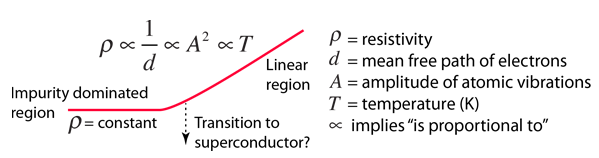
The temperature dependence of resistivity at temperatures around room temperature is characterized by a linear increase with temperature. Microscopic examination of the conductivity shows it to be proportional to the mean free path between collisions (d), and for temperatures above about 15 K, d is limited by thermal vibrations of the atoms. The general dependence is summarized in the proportionalities:

在室温附近,电阻率对温度的依赖性表现为温度的线性增加。微观考察显示,导电性与碰撞之间平均自由程(d)成正比,而在约15 K以上的温度,d受到原子热振动的限制。这种一般依赖性可总结为以下比例关系:

At extremely low temperatures, the mean free path is dominated by impurities or defects in the material and becomes almost constant with temperature. With sufficient purity, some metals exhibit a transition to a superconducting state.

在极低温度下,平均自由程主要由材料中的杂质或缺陷决定,并几乎与温度无关。当纯度足够时,某些金属会过渡到超导状态。
Index

Reference
Rohlf
Ch 15
索引参考Rohlf第15章
 
HyperPhysics***** Electricity and Magnetism  
HyperPhysics ***** 电学和磁学
R Nave
Go Back
返回


Resistor Temperature Dependence

电阻温度依赖性

Resistance = R(initial)[1+ alpha (T(final) - T(initial)]
If a resistor of initial value
如果一个电阻的初始值
R0 = ohms
欧姆
中文译文中的待填/计算数值依次对应:1:r0。实际数值以上方原输入框为准。
at initial temperature
初始温度
T0 = C
is heated to temperature
被加热至温度
T = C
and has a temperature coefficient
并且具有温度系数
α = x 10^ / C
then the resistance will be
然后电阻将
R= ohms
欧姆
中文译文中的待填/计算数值依次对应:1:r。实际数值以上方原输入框为准。
Enter data and then click on the quantity you wish to calculate in the active formula above. Unspecified parameters will default to values typical of copper at 20 C with initial resistance 100 ohms. Upon changes, the values will not be forced to be consistent until you click on the quantity you wish to calculate.
Temperature coefficients of resistance or
resistivity of some metals (10-3/°C)
电阻或电阻率的温度系数(10⁻³/°C)
Silver
银
3.8Copper
铜
3.9
Gold
黄金
3.4Aluminum
铝
3.9
Iron
铁
5.0Tungsten
钨
4.5
Nichrome
尼铬
0.4Platinum
铂
3.92
Table of temperature coefficients
温度系数表
Discussion
讨论
电阻 = R(initial) [1+ alpha ( T(final) - T(initial) ] 请输入数据,然后点击上方的交互式公式中您希望计算的量。未指定的参数将默认为20°C时铜的典型值,初始电阻为100欧姆。在更改后,值不会被强制保持一致,直到您点击您希望计算的量。
中文译文中的待填/计算数值依次对应:1:t0 2:t 3:alp 4:alpp。实际数值以上方原输入框为准。
Index

DC Circuits
索引:直流电路
 
HyperPhysics***** Electricity and Magnetism  
HyperPhysics ***** 电学和磁学
R Nave
Go Back
返回