The Discovery of Superconductivity
超导体的发现
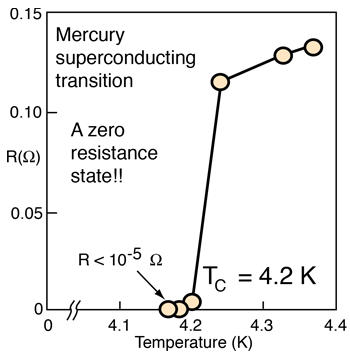 H. K. Onnes, Commun. Phys. Lab.12,120, (1911)(专名或术语) |
H. Kamerlingh Onnes, after having successfully liquified helium in 1908, investigated the low temperature resistivity of mercury in 1911. The mercury could be made very pure by distillation, and this was important because the resistivity at low temperatures tends to be dominated by impurity effects. He found that the resistivity suddenly dropped to zero at 4.2K, a phase transition to a zero resistance state. This phenomenon was called superconductivity, and the temperature at which it occurred is called its critical temperature.
H. Kamerlingh Onnes 在1908年成功液化氦之后,于1911年研究了汞在低温下的电阻率。汞可以通过蒸馏使其非常纯净,这一点很重要,因为低温下的电阻率往往主要由杂质效应决定。他发现汞的电阻率在4.2K时突然降为零,这标志着一种零电阻状态的相变。这种现象被称为超导性,发生这种现象的温度称为临界温度。 |
Superconductivity concepts
Reference Rohlf,Ch 15
索引 超导概念 参考 Rohlf,第15章
| HyperPhysics***** Condensed Matter
HyperPhysics ***** 凝聚态物理 | R Nave |
返回