Microscopic View of Copper Wire
铜导线的微观视图
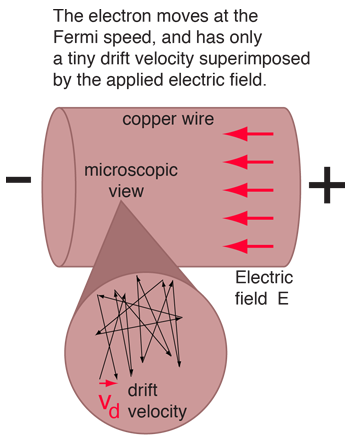
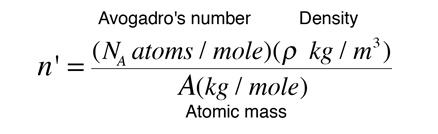
As an example of the microscopic view of Ohm's law, the parameters for copper will be examined. With one free electron per atom in its metallic state, the electron density of copper can be calculated from its bulk density and its atomic mass.
作为欧姆定律微观观点的一个例子,将考察铜的参数。在金属状态下,每个原子有一个自由电子,铜的电子密度可以从其体积密度和原子质量计算得出。

The Fermi energy for copper is about 7 eV, so the Fermi speed is
铜的费米能约为7 eV,因此费米速率是

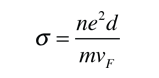
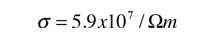
The measured conductivity of copper at 20°C is
在20°C时,铜的测得导电率是
The mean free path of an electron in copper under these conditions can be calculated from
在这些条件下,铜中电子的平均自由程可以计算得到

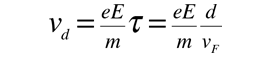
The drift speed depends upon the electric field applied. For example, a copper wire of diameter 1mm and length 1 meter which has one volt applied to it yields the following results.
漂移速率取决于所施加的电场。例如,一根直径为1毫米、长度为1米的铜线,当其两端加1伏特电压时,会产生以下结果。

For 1 volt applied this gives a current of 46.3 Amperes and a current density
当施加1伏特时,这给出了46.3安培的电流和电流密度
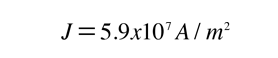
This corresponds to a drift speed of only millimeters per second, in contrast to the high Fermi speed of the electrons.
这对应于电子仅以每秒毫米量级的漂移速度运动,与电子的高费米速度形成对比。

Caution! Do not try this at home! Dr. Beihai Ma of Argonne National Laboratory wrote to point out that the current density of 5900 A/cm2 in this example is over ten times the current density of 500 A/cm2 that copper can normally withstand at 40°F. So doing this in the laboratory might be too exciting. Thanks for the sanity check Dr. Ma.
注意!不要在家尝试!Argonne国家实验室的Beihai Ma博士指出,本例中的电流密度为5900 A/cm²,是铜在40华氏度下通常能承受的500 A/cm²的十倍多。因此在实验室中进行此类操作可能过于刺激。感谢Ma博士的 sanity check。
(If you scale down the voltage applied so that the current is just 3 Amperes, current density 382 A/cm2, so that the copper wire will remain intact, the calculated drift velocity is just 0.00028 m/s. This would be more typical for working conditions in this wire. )
(如果你将施加的电压降低,使电流仅为3安培,电流密度为382 A/cm²,这样铜线将保持完整,计算出的漂移速度仅为0.00028 m/s。这在该电线的正常工作条件下更为典型。)
What about quantum effects and Fermi-Dirac statistics?
量子效应和费米-狄拉克统计呢?
The treatment of the microscopic Ohm's Law and drift velocity above is basically a classical treatment. But we know that the electrons in a metal obey Fermi-Dirac statistics, and that at low temperatures, all the available electron energy levels are filled up to the Fermi Level. We also know that this Fermi level (about 7 eV in copper) is very high compared to room temperature thermal energy. Then how do we justify using the whole free electron population above in the calculation of drift velocity when for thermal interactions, only those electrons within about kT of the Fermi Level are accessible to the interaction?
上述微观欧姆定律和漂移速度的处理基本上是经典处理。但我们知道,金属中的电子服从费米-狄拉克统计,并且在低温下,所有可用的电子能级都被填充到费米能级。我们还知道,这个费米能级(约7 eV在铜中)比室温热能高很多。那么,当考虑热相互作用时,只有那些接近费米能级的电子才能参与相互作用,那么为什么我们还能在计算漂移速度时使用整个自由电子群体呢? One place where this situation is discussed is in the classic Solid State Physics book by Charles Kittel. He points out that because of the full population of conduction electrons up to the Fermi level, these electrons in the copper wire have a very high velocity, on the order of 1.6 x 106 cm/sec for copper. An externally applied electric field in a copper wire will exert a continuous force on the electrons and would continue to accelerate them if that acceleration were not randomized by the multiple collisions and interaction with the lattice. The observation of Ohm's Law experimentally shows us that an equilibrium current is achieved, and that the presumption that all the conduction electrons are participating allows us to project an effective drift velocity for these electrons under the influence of the applied electric field. It is noted that this is an entirely classical presumption.
这种情形在查尔斯·基特尔的经典固体物理教材中也有讨论。他指出,由于导带电子填满费米能级,铜导线中的这些电子具有非常高的速度,约为每秒1.6×10⁶厘米。当在铜导线中施加外电场时,电场会对电子施加持续的力,如果这种加速未被多次碰撞和与晶格的相互作用所随机化,这些电子将继续加速。实验观察欧姆定律表明,达到平衡电流,而假设所有导电电子都参与其中的假设允许我们在这类电场作用下,为这些电子投影出一个有效的漂移速度。需要注意的是,这完全是经典假设。 As Kittel further examines electrical conductivity from the point of view of Fermi-Dirac statistics, he makes the following comment: "It is a somewhat surprising fact that the introduction of the Fermi-Dirac distribution in place of the classical Maxwell-Boltzmann distribution usually has little influence on the electrical conductivity, often only changing the kind of average used in the specification of the relaxation time. One might have expected at first sight to find a more drastic change because with the Fermi-Dirac distribution only those electrons near the Fermi surface can participate in collision processes. "
Kittel 从费米-狄拉克统计的角度进一步考察电导率时,做出如下评论:"令人有些意外的是,将费米-狄拉克分布代替经典麦克斯韦-玻尔兹曼分布通常对电导率影响不大,往往只是改变了弛豫时间指定中所用的平均方式。乍看之下,人们可能会预期会有更剧烈的变化,因为费米-狄拉克分布只允许靠近费米面的电子参与碰撞过程。" Kittel argues that the exclusion principle does not prevent the electric field intervention since it acts on each electron in the distribution to produce the same velocity change. There is always a vacant state ready to receive the electron which is changing its state under the action of the electric field, the vacancy being produced by the simultaneous change of the state of another electron. In contrast to a random thermal collision process, the single direction electric force produces electron excess states A and electron deficiency states B which allow the specific collisions required to restore equilibrium. The exclusion principle does prevent many collisions, but does allow those collisions needed to restore equilibrium. The bottom line is, except for the detailed nature of the relaxation time, the situation is essentially the same as in the classical situation, and leads to the same conductivity expression and average drift velocity.
Kittel认为,排斥原理并不阻止电场作用,因为它对分布中的每个电子产生相同的速度变化。总有一个空态可以接收电子,该电子在电场作用下改变其状态,这个空态是由另一个电子状态同时变化产生的。与随机的热碰撞过程不同,单方向的电场力会产生电子过剩态A和电子缺态B,这些状态允许恢复平衡所需的特定碰撞。排斥原理确实阻止了许多碰撞,但允许恢复平衡所需的那些碰撞。总之,除了弛豫时间的详细性质外,情况基本上与经典情况相同,导致相同的导电性表达式和平均漂移速度。 |