Bilingual edition: English is preserved and Chinese follows each unit. Terminology uses the confirmed v20260916 glossary; automated semantic review remains traceable.
中英双语版:英文原文完整保留,中文紧随对应单元;术语采用 v20260916 确认表,自动语义审校结果可追溯。

Resonance

共振

Resonance in AC circuits implies a special frequency determined by the values of the resistance , capacitance , and inductance . For series resonance the condition of resonance is straightforward and it is characterized by minimum impedance and zero phase. Parallel resonance , which is more common in electronic practice, requires a more careful definition.

交流电路中的共振意味着由电阻、电容和电感的值决定的特殊频率。对于串联共振,共振条件很明确,其特点是阻抗最小且相位为零。而并联共振,这在电子实践中更为常见,需要更仔细的定义。
This is an active graphic. Click on either for more detail.
这是一个动态图形。点击任一查看更多细节。
Index

AC Circuits
索引 AC 电路
 
HyperPhysics***** Electricity and Magnetism
HyperPhysics ***** 电学和磁学
R Nave
Go Back
返回


Series Resonance

串联共振

The resonance of a series RLC circuit occurs when the inductive and capacitive reactances are equal in magnitude but cancel each other because they are 180 degrees apart in phase. The sharp minimum in impedance which occurs is useful in tuning applications. The sharpness of the minimum depends on the value of R and is characterized by the "Q" of the circuit.

在串联RLC电路中,当感抗和容抗的大小相等但因相位相差180度而相互抵消时会发生共振。此时出现的阻抗尖锐最小值在调谐应用中非常有用。最小值的尖锐程度取决于电阻R的值,并由电路的'Q'因子来表征。
Detailed expressions
详细表达式
Calculation
计算
Index

AC Circuits
索引 AC 电路
 
HyperPhysics***** Electricity and Magnetism
HyperPhysics ***** 电学和磁学
R Nave
Go Back
返回


Selectivity and Q of a Circuit

选择性和电路的Q值

Resonant circuits are used to respond selectively to signals of a given frequency while discriminating against signals of different frequencies. If the response of the circuit is more narrowly peaked around the chosen frequency, we say that the circuit has higher "selectivity". A "quality factor" Q, as described below, is a measure of that selectivity, and we speak of a circuit having a "high Q" if it is more narrowly selective.

谐振电路用于对特定频率的信号做出选择性响应,同时抑制其他频率的信号。如果电路的响应在选定频率附近更尖锐,我们说该电路具有更高的“选择性”。如下面所述,一个“品质因数”Q是衡量这种选择性的量,如果电路更具有选择性,我们称其为“高Q”。
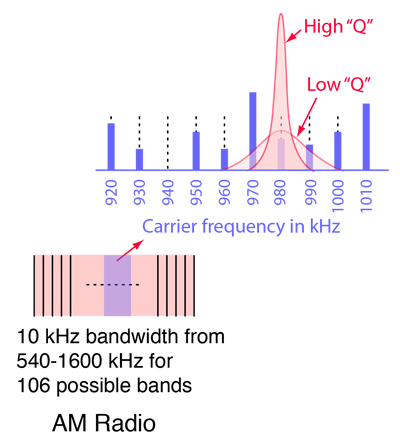
An example of the application of resonant circuits is the selection of AM radio stations by the radio receiver. The selectivity of the tuning must be high enough to discriminate strongly against stations above and below in carrier frequency, but not so high as to discriminate against the "sidebands" created by the imposition of the signal by amplitude modulation.

共振电路的一个应用例子是收音机接收AM电台时的选择性调谐。调谐的选性必须足够高,以强烈地排斥载波频率上下两侧的其他电台,但又不能高到排斥由幅度调制产生的“边带”。

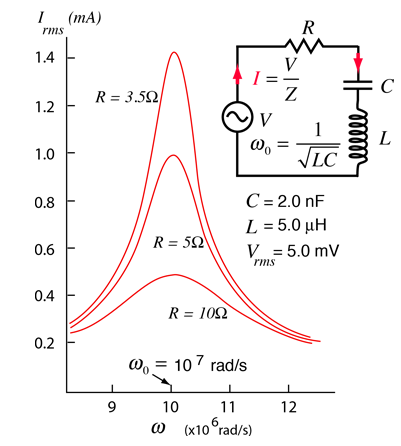
The selectivity of a circuit is dependent upon the amount of resistance in the circuit. The variations on a series resonant circuit at right follow an example in Serway & Beichner. The smaller the resistance, the higher the "Q" for given values of L and C. The parallel resonant circuit is more commonly used in electronics, but the algebra necessary to characterize the resonance is much more involved.

电路的选择性取决于电路中的电阻大小。系列共振电路的波动情况如Serway & Beichner中的例子所示。电阻越小,对于给定的L和C值,其“Q”值越高。虽然并联共振电路在电子学中更为常见,但用来描述共振的代数运算更为复杂。

Using the same circuit parameters, the illustration at left shows the power dissipated in the circuit as a function of frequency. Since this power depends upon the square of the current, these resonant curves appear steeper and narrower than the resonance peaks for current above.

使用相同的电路参数,左边的示意图显示了电路中功率随频率的变化情况。由于该功率与电流的平方成正比,因此这些共振曲线比电流高于共振峰时的曲线更加陡峭和狭窄。

The quality factor Q is defined by


品质因数 Q 定义为

where Δω is the width of the resonant power curve at half maximum.

其中Δω是共振功率曲线在半高处的宽度。

Since that width turns out to be Δω =R/L, the value of Q can also be expressed as

由于这个宽度被确定为Δω = R/L,因此Q的值也可以表示为
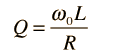
The Q is a commonly used parameter in electronics, with values usually in the range of Q=10 to 100 for circuit applications.

Q 是电子学中常用的参数,其值通常在电路应用中处于 Q=10 到 100 的范围内。
Index

AC Circuits

Reference
Serway & Beichner
Ch 33
索引 AC 电路参考 Serway & Beichner 第33章
 
HyperPhysics***** Electricity and Magnetism
HyperPhysics ***** 电学和磁学
R Nave
Go Back
返回


Power in a Series Resonant Circuit

串联谐振电路中的功率

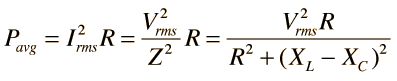
The average power dissipated in a series resonant circuit can be expressed in terms of the rms voltage and current as follows:

在串联谐振电路中,平均耗散功率可以表示为均方根电压和电流之间的函数,如下所示:

Using the forms of the inductive reactance and capacitive reactance, the term involving them can be expressed in terms of the frequency.

利用感抗和容抗的形式,涉及它们的项可以表示为频率的函数。
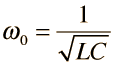
where use has been made of the resonant frequency expression
Substitution now gives the expression for average power as a function of frequency.

This power distribution is plotted at left using the same circuit parameters as were used in the example on the Q factor of the series resonant circuit

这种功率分布如左图所示,使用了与串联谐振电路品质因数示例中相同的电路参数

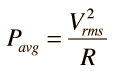
The average power at resonance is just


共振时的平均功率只是

since at the resonant frequency ω0 the reactive parts cancel so that the circuit appears as just the resistance R.

在共振频率ω₀时,电抗部分相互抵消,因此电路表现为仅有的电阻R。
其中已使用共振频率的表达式。代入后得到平均功率关于频率的表达式。
Index

AC Circuits

Reference
Serway & Beichner
Ch 33
索引 AC 电路参考 Serway & Beichner 第33章
 
HyperPhysics***** Electricity and Magnetism
HyperPhysics ***** 电学和磁学
R Nave
Go Back
返回