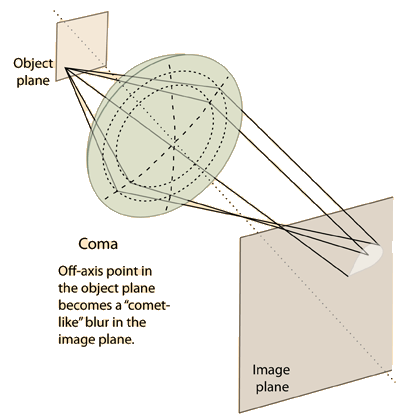
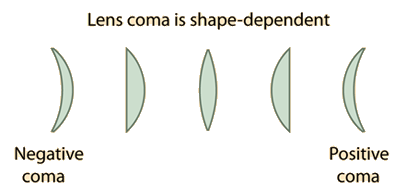
Coma彗星
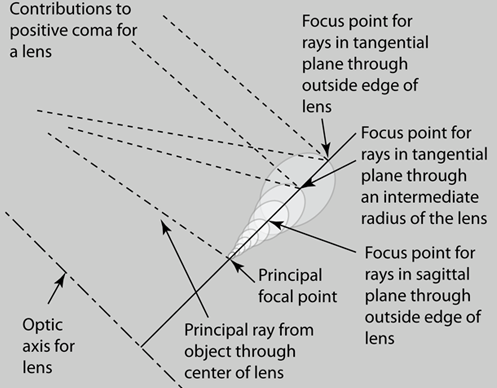
Hecht notes that a little more than half of the light in the image is in the roughly triangular region inside the large oval above, so the image fades as it expands away from the central focus. That encourages the picturing of this image as comet-like.
Hecht指出,图像中超过一半的光位于上方较大的椭圆内部的大三角形区域,因此图像在远离中心焦点时逐渐变暗。这鼓励人们将此图像想象成彗星状。 For more versatile correction of coma, one can use a combination of two lenses, both of which are corrected for zero coma at infinite object distance. The appropriate separation of these two lenses can correct for coma at various object distances. Coma can also be corrected by an appropriately placed stop, but the placement and size of an optimum stop also depends upon the other aberrations.
为了更有效地校正彗差,可以使用两个都校正了无限远物距下零彗差的透镜组合。这两个透镜适当分离可以校正不同物距下的彗差。彗差也可以通过适当放置的孔径光阑来校正,但最优孔径光阑的位置和大小也取决于其他像差。 |
Index Lens concepts Reference Optics References Hecht, 2nd Ed. Sec 6.3 索引透镜概念 参考光学 参考Hecht,第二版 第6.3节 | |||||||
|
Go Back
返回 |
Astigmatism散光
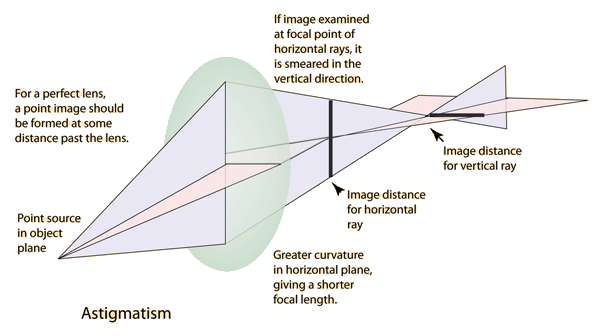
The kind of astigmatism commonly encountered as a vision defect is a result of different lens curvatures in different planes. If the behavior of light from a point source object is examined, then for a perfect lens it should form a focused bright spot on the opposite side of the lens. But if the focal length of the lens is different for different planes of incident light, there will be no point where all the rays from the object reach a sharp focus. 常见的视力缺陷中的散光是由于不同平面中的透镜曲率不同所导致的。如果考察从点光源物体发出的光的行为,那么对于理想的透镜来说,应该在透镜的另一侧形成一个明亮的焦点。但如果透镜在不同平面中对入射光的焦距不同,就不可能存在所有光线从物体发出后都聚焦到一个清晰点的位置。
![]()
一种更一般的散光类型,发生在通过任何接地透镜的偏轴光线中,称为斜向散光。 |
Index Lens concepts Reference Jenkins & White p 156 ff 索引透镜概念 参考 Jenkins & White p 156 ff | ||
|
Go Back
返回 |
Oblique Astigmatism斜向散光
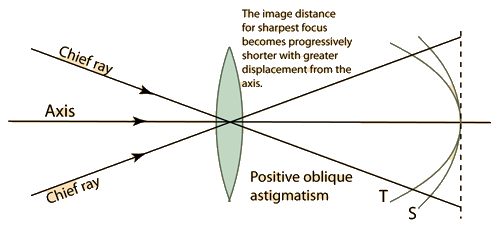
The kind of astigmatism commonly encountered as a vision defect is a result of different lens curvatures in different planes. But even spherical lenses that are perfectly symmetrical exhibit a type of astigmatism for light which approaches the lens from a point off the optic axis. Oblique astigmatism is an aberration of off-axis rays that causes radial and tangential lines in the object plane to focus sharply at different distances in the image space. 像差中常见的那种因不同平面的透镜曲率差异而引起的视力缺陷,是由于光线从光学轴外的点入射时,即使球面透镜完全对称,也会产生一种光行差。光行差是偏轴光线的像差,导致物体平面上的径向和切向线在像空间中聚焦于不同的距离。
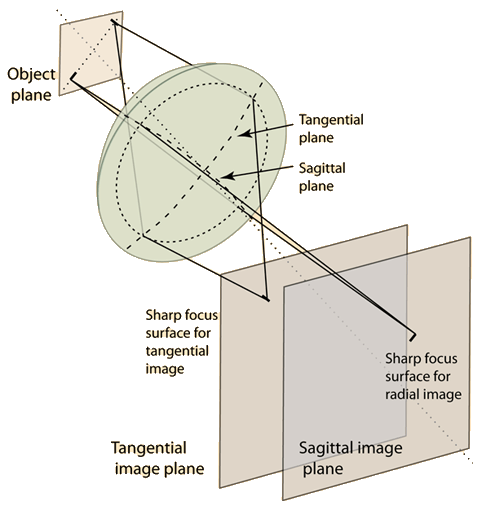
![]() This visualization of oblique astigmatism follows the treatment of Jenkins and White in their text "Fundamentals of Optics", 4th. Ed., Sec. 9.9 . Similar treatments can be found in Pedrotti & Pedrotti, Sec 5-5 and Hecht, 2nd Ed Sec 6.3 . Oblique astigmatism arises not from any asymmetry of the lens, but an asymmetry in the nature of the optical paths followed by rays in the tangential and sagittal planes. For the sagittal plane, the extreme rays are symmetric with respect to the central ray. For the tangential plane however, the pathlengths and angles of incidence on the lens surface are different for the top and bottom rays. (Some texts use the term "meridional plane" instead of tangential plane and "radial plane" instead of sagittal plane.)
这种斜向散光的可视化处理遵循Jenkins和White在《光学基础》第四版第九章第九节中的论述。类似处理也可在Pedrotti & Pedrotti的第五章第五节以及Hecht第二版第六章第三节中找到。斜向散光并非源于透镜的任何不对称性,而是源于在切向平面和视向平面中,光线所遵循的光学路径的性质存在不对称性。对于视向平面,极端光线相对于中心光线是对称的。然而,对于切向平面,顶部和底部光线在透镜表面的路径长度和入射角是不同的。(某些文献使用“meridional plane”代替切向平面,使用“radial plane”代替视向平面。) |
Index Lens concepts Reference Optics references 索引 透镜概念 参考 指南 | ||||
|
Go Back
返回 |
Oblique Astigmatism Examples斜向散光示例
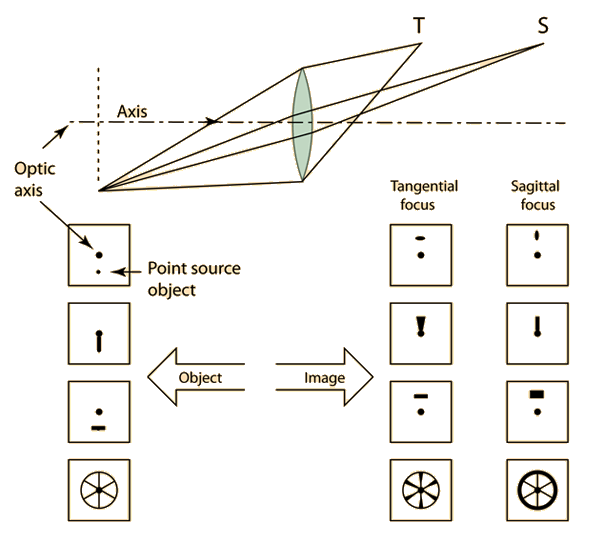
Meyer-Arendt's text does a careful job of trying to visualize the effects of oblique astigmatism in Ch 1.6. If an object consists of a short line segment perpendicular to the radial line from the optic axis (like a segment tangential to a circle centered at the optic axis in the object plane), then that line segment will image sharply in the tangential image plane. If an object consists of a short segment in the sagittal plane, like a short radial segment in the object plane, it will image sharply in the sagittal image plane.
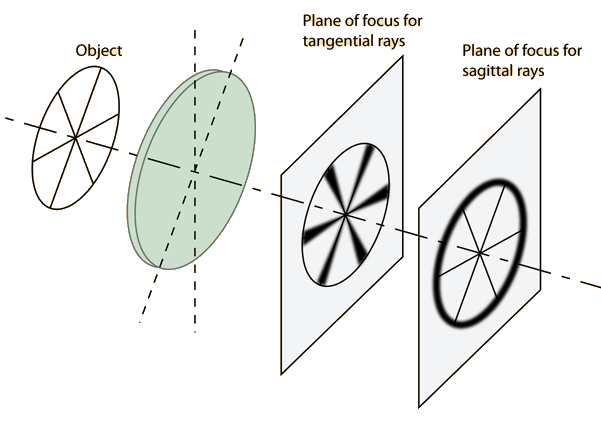
![]() Meyer-Arendt在第1.6章中仔细地尝试可视化斜向散光的影响。如果一个物体由一条垂直于光轴径向线的短线段组成(例如,在物体平面中,该线段与以光轴为中心的圆相切),那么该线段将在切向像平面中清晰成像。如果物体由一个位于切向平面中的短段组成,例如在物体平面中是一个径向段,那么它将在切向像平面中清晰成像。 This illustration follows Meyer-Arendt's approach to showing the different types of distortion of the image by oblique astigmatism when viewed in the tangential and sagittal focus planes. ![]() 这张图展示了Meyer-Arendt的方法,通过斜向散光在切线焦点和切线焦点平面中显示图像的不同扭曲类型。 Another approach to visualizing the effects of oblique astigmatism on the image is employed by Moller, Chapter 13. For an object like the spoked wheel shown, the circumference is imaged sharply in the tangential focus plane and the radial features are imaged sharply in the sagittal focus plane. At some point in between, each image point can be represented by a "circle of least confusion" and the overall best focus for the object is obtained at that point.
另一种可视化斜向散光对图像影响的方法见于Moller,第13章。对于像图中所示的辐条轮这样的物体,其圆周在切向焦点平面中成像清晰,而径向特征在视向焦点平面中成像清晰。在两者之间某个点,每个像点都可以用“最小模糊圈”来表示,而该物体的最佳聚焦点即在该点取得。 |
Index Lens concepts Reference Meyer-Arendt Ch 1.6 . 索引透镜概念 参考 Meyer-Arendt 第1.6章 | |||
|
Go Back
返回 |