Spherical Aberration球面像差
For lenses made with spherical surfaces, rays which are parallel to the optic axis but at different distances from the optic axis fail to converge to the same point. For a single lens, spherical aberration can be minimized by bending the lens into its best form. For multiple lenses, spherical aberrations can be canceled by overcorrecting some elements. The use of symmetric doublets like the orthoscopic doublet greatly reduces spherical aberration. 对于由球面构成的透镜,那些与光轴平行但距离光轴不同距离的光线无法汇聚到同一点。对于单个透镜,可以通过将其弯曲成最佳形式来最小化球差。对于多个透镜,可以通过过矫正某些元件来抵消球差。使用对称的双透镜,如正像双透镜,可以显著减少球差。
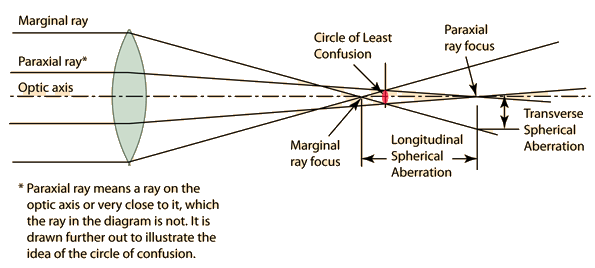
![]() When the concept of principal focal length is used, the presumption is that all parallel rays focus at the same distance, which is of course true only if there are no aberrations. The use of the lens equation likewise presumes an ideal lens, and that equation is practically true only for the rays close to the optic axis, the so-called paraxial rays. For a lens with spherical aberration, the best approximation to use for the focal length is the distance at which the difference between the paraxial and marginal rays is the smallest. It is not perfect, but the departure from perfect focus forms what is called the "circle of least confusion". Spherical aberration is one of the reasons why a smaller aperture (larger f-number) on a camera lens will give a sharper image and greater depth of field since the difference between the paraxial and marginal rays is less.
当使用主焦点距离的概念时,假定所有平行光束都聚焦于同一距离,这当然只有在没有像差的情况下才成立。使用透镜方程同样假定是一个理想的透镜,而该方程仅在近轴光束(即所谓的近轴光束)附近近似成立。对于存在球面像差的透镜,用于焦距的最好近似值是使近轴光束与边缘光束之间的差异最小的那一点。这并非完美,但偏离完美聚焦的区域形成了所谓的“最小混淆圆”。球面像差是为什么相机镜头使用较小的孔径(较大的f数)会得到更清晰的图像和更大的景深的一个原因,因为近轴光束与边缘光束之间的差异更小。 |
Index Lens concepts Thick lens concepts 索引透镜概念 厚透镜概念 | ||
|
Go Back
返回 |
Meniscus Lenses弯月透镜
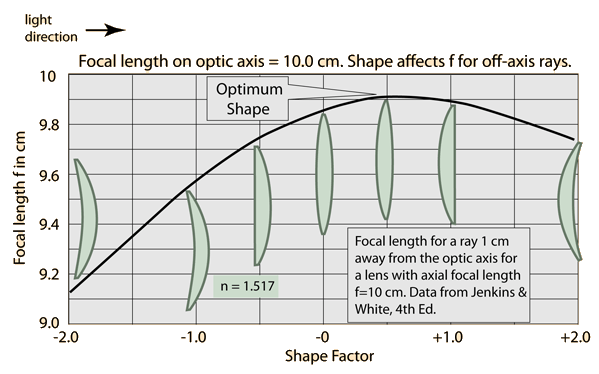
The amount of spherical aberration in a lens made from spherical surfaces depends upon its shape. Bending the lens can also give partial correction of coma aberration. 由球面表面制成的透镜的像差取决于其形状。弯曲透镜也可以部分校正彗差。
![]()
|
Index Lens concepts "Reference Jenkins & White p 156 ff 索引透镜概念 "参考Jenkins & White p 156 ff" | ||
|
Go Back
返回 |
Coddington Shape FactorCoddington 形状因子
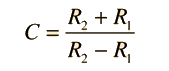
Although spherical aberration cannot be eliminated for a single lens, it can be minimized by the appropriate bending of the lens into its best form. The degree of bending can be characterized by the Coddington shape factor: 尽管对于单个透镜来说,球面像差无法完全消除,但可以通过适当弯曲透镜使其达到最佳形式来减小这种像差。这种弯曲的程度可以用Coddington形状因子来表征:
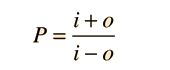
R1 and R2 are the surface radii of the spherical lens surfaces. The minimum spherical aberration also depends on the object and image distances, so another factor enters, called the Coddington position factor: 最小的球面像差也取决于物体和像距,因此又一个因素被引入,称为Coddington位置因子:
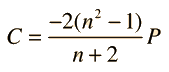
R₁和R₂是球形透镜表面的曲率半径。 i and o are the image and object distances for the lens as in the lens equation. The minimum spherical aberration occurs when 最小的球面像差发生在
The higher the index of refraction n, the smaller the aberration for the optimum shape. 折射率n越高,最优形状的像差越小。
i 和 o 是透镜的像距和物距,如透镜方程所示。 |
Index Lens concepts "Reference Meyer-Arendt Ch 5 索引透镜概念 '参考Meyer-Arendt第5章 | |||||||
|
Go Back
返回 |