Bilingual edition: English is preserved and Chinese follows each unit. Terminology uses the confirmed v20260916 glossary; automated semantic review remains traceable.
中英双语版:英文原文完整保留,中文紧随对应单元;术语采用 v20260916 确认表,自动语义审校结果可追溯。

Lens in Different Media

不同介质中的透镜

Tracing the vergence is a convenient way to locate the image formed by a thick lens in media of different indices of refraction. The Cartesian sign convention is used.
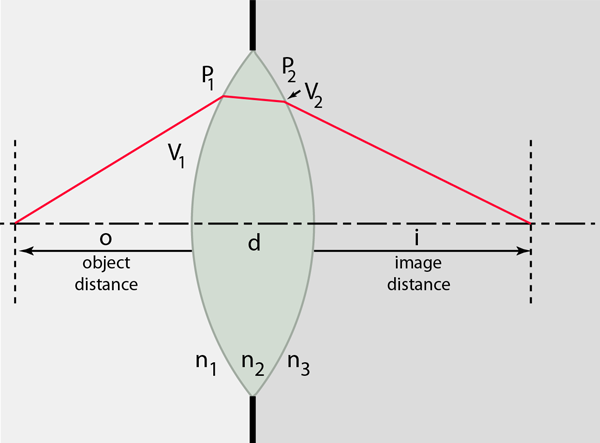
追踪光束的会聚情况是确定厚透镜在不同折射率介质中所成像的位置的一种方便方法。采用笛卡尔符号约定。

Thick lenses can be analyzed in terms of vergence. The vergence can be traced by noting its change at each surface.

厚透镜可以利用 vergence 进行分析。可以通过观察其在每个表面的变化来追踪 vergence。

For this case of a thick lens in different media, the system can be characterized by its radii of curvature, its indices of refraction, and its thickness.

对于处于不同介质中的厚透镜情况,该系统可由其曲率半径、折射率和厚度来表征。

A set of default parameters has been set up so that when you enter a value for one of the parameters, those default values will be assigned to the other parameters and the calculation will proceed with those values. Any of the physical parameters can be changed and the change of any entry will initiate the program operation again.

一组默认参数已被设置,这样当您为其中一个参数输入值时,这些默认值将被分配给其他参数,计算将使用这些值进行。可以更改任何物理参数,任何输入的更改都将触发程序再次运行。

Recommendation: Enter the value nlens = 1.5 and lens thickness d=1 cm to be consistent with the default set of physical parameters. The calculation will fill in the default physical parameters and calculate the resultant values. Any of the physical parameters can then be changed and the change of any entry will initiate the program operation again.

This glass lens with index
nlens = n2 = is embedded in a
front medium of index n1 =
and a back medium with index n3 =

这个索引为n的透镜嵌入前介质索引为n₁的介质中,并且后介质的索引为n₃。
中文译文中的待填/计算数值依次对应:1:n 2:n1 3:n3。实际数值以上方原输入框为准。

the front surface power for lens radius
R1 = m is given by P1= (n2 - n1)/R1
P1 = m-1

透镜半径 R 1 的前表面功率为 m 时,给定由 P 1 = (n 2 - n 1 )/R 1 ,其中 P 1 = m - 1。
中文译文中的待填/计算数值依次对应:1:r1 2:p1。实际数值以上方原输入框为准。

and the back surface power for lens radius
R2 = m is given by P2 = (n3 - n2)/R2
P2 = m-1

透镜半径 R₂ = m 时,其后表面的功率由 P₂ = (n₃ - n₂)/R₂ 给出,即 P₂ = m - 1
中文译文中的待填/计算数值依次对应:1:r2 2:p2。实际数值以上方原输入框为准。

Lens thickness d = cm = m

透镜厚度 d = cm = m
中文译文中的待填/计算数值依次对应:1:dcm 2:d。实际数值以上方原输入框为准。

(Note that for a double convex lens, the front surface radius R1 is positive and the back surface radius R2 is negative according to the Cartesian sign convention.)

(注意,对于双凸透镜,根据笛卡尔符号约定,前表面半径R1为正,后表面半径R2为负。)

The vergences can be calculated from the lens parameters and the object distance.The change in vergence when the light encounters a refracting surface is equal to the power of the surface:

透镜的 vergence 可以通过透镜参数和物体距离计算得出。当光遇到折射面时,其 vergence 的变化等于该表面的 power :

Using the Cartesian sign convention, the object distance is typically a negative number since it points opposite to the direction of light travel.

根据笛卡尔符号约定,物距通常为负数,因为它方向与光的传播方向相反。

Object distance o = m.

物体距离 o = m。
中文译文中的待填/计算数值依次对应:1:o。实际数值以上方原输入框为准。

The vergences can then be calculated.

则可以计算出 vergences。

V1 = n1/o = m-1

V2 = V1 + P1 = n2/i1 =m-1

V3 = n2/(i1 - d) = m-1

V4 = V3 + P2 = n3/i =m-1

The value i1 calculated as an intermediate value above would be the image distance inside the glass with just the front surface power acting. This calculation presumes that this image distance is greater than the thickness of the lens. It is also presumed that the medium is air so that n0 = 1.

上面计算出的i 1作为中间值,将是仅由前表面功率作用时玻璃内部的像距。该计算假定这个像距大于透镜的厚度。同时假定介质是空气,因此n 0 = 1。

The exit vergence from the final surface determines the image distance with respect to that surface.

最终表面的出射发散率决定了该表面相对于像距的大小。

Image distance i = n3/V4 = m.

像距 i = n 3 /V 4 = m。
中文译文中的待填/计算数值依次对应:1:i。实际数值以上方原输入框为准。

This can be compared with the image distance for a thin lens with the same surface powers:

这可以与具有相同表面屈光力的薄透镜的像距进行比较:

Image distance ithin = m.

薄透镜的像距 i = m。
中文译文中的待填/计算数值依次对应:1:ith。实际数值以上方原输入框为准。

The power of a thin lens is just the sum of the surface powers:

薄透镜的功率就是两个表面功率之和:

Pthin = P1 + P2 = m-1.

P thin = P 1 + P 2 = m -1 .(专名或术语)
中文译文中的待填/计算数值依次对应:1:pthin。实际数值以上方原输入框为准。

The equivalent power for the thick lens can be calculated from Gullstrand's equation:

厚透镜的等效功率可通过Gullstrand方程计算:

Pthick = P1 + P2 - P1P2d/n2 = m-1.

P thick = P 1 + P 2 - P 1 P 2 d / n 2 = m -1 .(专名或术语)
中文译文中的待填/计算数值依次对应:1:pthick。实际数值以上方原输入框为准。

Note that the calculation does not take into account the change in lens thickness with the angle of the incoming ray. It is typical to do the calculation only for the paraxial rays where the departure from full thickness is negligible. That is why the full thickness d is used in the calculations above. The exaggerated vertical scale of the lens drawing is hopefully helpful visually, but the calculations are not valid except for very small angles for the light paths.

需要注意的是,该计算未考虑入射光线角度变化时透镜厚度的变化。通常只对近轴光线进行计算,因为偏离完整厚度的情况可以忽略不计。这就是上述计算中使用完整厚度d的原因。图中夸张的垂直比例尺希望有助于视觉理解,但计算结果仅在非常小的角度下有效。
Vergence Example
汇聚示例
建议:输入 n 透镜 = 1.5 和透镜厚度 d=1 cm,以与默认的物理参数集保持一致。计算将填充默认的物理参数并计算出结果值。之后可以更改任何物理参数,任何一项的更改都将再次启动程序运行。
中文译文中的待填/计算数值依次对应:1:v1 2:v2 3:v3 4:v4。实际数值以上方原输入框为准。
Index

Lens concepts

Thick lens concepts

Meyer-Arendt
Ch 1.1
索引透镜概念 厚透镜概念 Meyer-Arendt 第1章1节
 
HyperPhysics***** Light and Vision
HyperPhysics ***** 光与视觉
R Nave
Go Back
返回