Bilingual edition: English is preserved and Chinese follows each unit. Terminology uses the confirmed v20260916 glossary; automated semantic review remains traceable.
中英双语版:英文原文完整保留,中文紧随对应单元;术语采用 v20260916 确认表,自动语义审校结果可追溯。

The Astronomical Telescope

天文学望远镜

The astronomical telescope makes use of two positive lenses: the objective, which forms the image of a distant object at its focal length, and the eyepiece, which acts as a simple magnifier with which to view the image formed by the objective. Its length is equal to the sum of the focal lengths of the objective and eyepiece, and its angular magnification is -fo /fe , giving an inverted image.
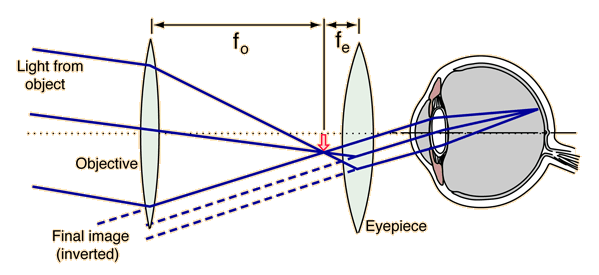
天文望远镜利用两个凸透镜:物镜,它将远处物体的像形成在它的焦距处;目镜,它作为简单的放大镜,用来观察物镜形成的像。其长度等于物镜和目镜焦距之和,其角放大率是 -f_o / f_e ,形成倒立的像。

The astronomical telescope can be used for terrestrial viewing, but seeing the image upside down is a definite inconvenience. Viewing stars upside down is no problem. Another inconvenience for terrestrial viewing is the length of the astronomical telescope, equal to the sum of the focal lengths of the objective and eyepiece lenses. A shorter telescope with upright viewing is the Galilean telescope.

天文望远镜可用于地面观测,但图像倒置是一个明显的不便。观看星星时倒置没有问题。另一个不便之处是天文望远镜的长度,等于物镜和目镜焦距之和。具有直立观测的更短望远镜是伽利略望远镜。
Calculation for finite object distance
有限物体距离的计算
Index

Lens concepts

Optical instruments
索引透镜概念光学仪器
 
HyperPhysics***** Light and Vision
HyperPhysics ***** 光与视觉
R Nave
Go Back
返回


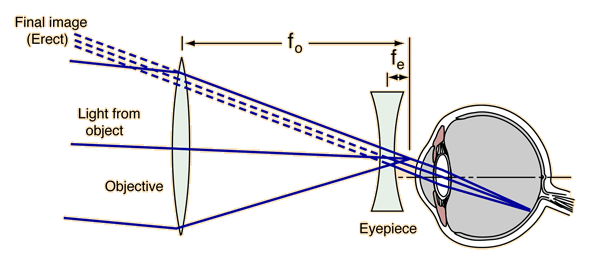
Galilean Telescope

伽利略望远镜

The Galilean or terrestrial telescope uses a positive objective and a negative eyepiece. It gives erect images and is shorter than the astronomical telescope with the same power. It's angular magnification is -fo/fe .

伽利略或地基望远镜使用一个正透镜作为物镜和一个负透镜作为目镜。它能产生直立的像,并且其长度比具有相同放大率的天文望远镜更短。其角放大率是 -f_o / f_e。

The image below shows parallel rays from two helium-neon lasers passing through a Galilean telescope made from an objective with f=30cm and an eyepiece with f=-10cm.

下图显示了两束氦-氖激光的平行光通过一个由焦距为30cm的物镜和焦距为-10cm的目镜组成的伽利略望远镜时的情况。

With the lenses placed 20 cm = fo+fe apart, the parallel input rays are rendered parallel again by the eyepiece lens, giving an image at infinity. This shows one of the uses of Galilean telescopes. It is useful as a collimator that takes a large beam of parallel light and reduces the size of the beam, keeping the rays parallel. The angular magnification of this Galilean telescope is 3. The beams of the helium-neon lasers were made visible with a spray can of artificial smoke.

当两个透镜相距20厘米(等于f_o + f_e)时,平行入射光束经目镜透镜再次变为平行光束,形成无穷远处的像。这展示了伽利略望远镜的一种用途。它作为一种光束扩展器,可以将大束平行光缩小,同时保持光束的平行性。这种伽利略望远镜的角放大率是3。氦-氖激光的光束通过喷雾罐人工烟雾使其可视化。
Index

Lens concepts

Optical instruments
索引透镜概念光学仪器
 
HyperPhysics***** Light and Vision
HyperPhysics ***** 光与视觉
R Nave
Go Back
返回