The Dietary Calorie
饮食热量
The calorie is a unit used in the definition of specific heat, the specific heat of water being assigned the value 1 calorie/gram °C. That is, a calorie is the amount of heat necessary to raise the temperature of one gram of water by 1 degree Celsius. The unit which is commonly used for the measurement of the energy content of foods is the kilocalorie, but it is commonly called a Calorie with an upper case "C" to distinguish it from the smaller physical calorie. It is also referred to as a "dietary Calorie".
卡路里是一个用于定义比热的单位,水的比热被赋予1卡/克·摄氏度的值。也就是说,卡路里是将1克水温度升高1摄氏度所需的热量量。用于测量食物能量含量的常用单位是千卡路里,但通常称为“大写C的卡路里”以区别于较小的物理卡路里。它也被称为“饮食卡路里”。
dietary Calorie = 1 kilocalorie = 1000 calories
饮食热量=1千卡=1000卡路里
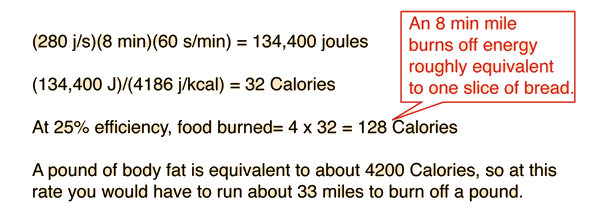
A common example to give perspective on food energy is the amount of energy in a single peanut. That energy is commonly quoted as 5 Calories. If so, it can heat a liter of water 5 degrees Celsius, an impressive amount of energy. Another example is that of the energy to run a mile; it is perhaps dismaying to hear that to burn off the energy of a candy bar, you might have to run two miles!
一个常见的例子是用来理解食物能量的,即一粒花生所含的能量。这种能量通常被引用为5千卡。如果如此,它可以使一升水升温5摄氏度,这是一个相当可观的能量。另一个例子是跑步一英里的能量;听到要燃烧掉一块巧克力的能量,可能需要跑两英里,这听起来似乎令人沮丧!
The energy required for the work done by the body is obtained by the process of metabolism, which is ultimately similar in outcome to the burning of the food. The Calorie content of foods is typically measured by burning them in a pure oxygen atmosphere inside a calorimeter so that the energy release can be measured in terms of the temperature change of the calorimeter. The metabolic process makes energy available to the muscles and other systems in the form of adenosine triphosphate (ATP). The ATP is manufactured in the mitochondria of the cells.
身体所做的功所需的能量是通过代谢过程获得的,这最终与食物燃烧的后果相似。食物的热量通常是在纯氧氛围中在热量计内燃烧来测定的,这样就可以根据热量计温度的变化来测量能量释放。代谢过程使能量以腺苷三磷酸(ATP)的形式可供肌肉和其他系统使用。ATP是在细胞的线粒体中制造的。
|