Diamond
Diamond is a crystalline form of carbon which has a density of has a density of 3.51 gm/cm3 compared to 2.26 gm/cm3 in the graphite form. Imperfectly formed crystalline forms of diamond are called bort and black diamond. They are slightly less dense than diamond and are somewhat tougher and harder. They are used for diamond drills and abrasives.
While diamond is the hardest substance, rating a 10 on the hardness scale, several carbon compounds called carbides rival its hardness. Boron carbide, B4C, is the hardest next to diamond but several of the metal carbides are extremely hard and find application as cutting edges on high speed tools.
The extraordinary "fire" of a diamond gem is partly attributable to it's high index of refraction, which at n=2.417 is higher than any common mineral except zircon.
后Kittel |
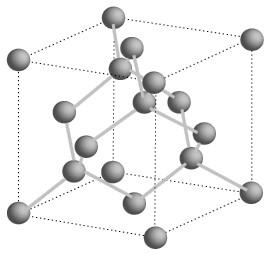
This crystalline form is called the "diamond lattice", and it occurs in other substances (e.g., silicon). It is a structure which Ashcroft and Mermin call "two interpenetrating face-centered cubic" primitive lattices. The lines between carbon atoms in the lattice illustration indicate nearest-neighbor bonds. 这种晶体结构称为‘金刚石结构’,也出现在其他物质(例如硅)中。Ashcroft 和 Mermin 称这种结构为‘两个相互穿插的面心立方原始晶格’。晶格示意图中碳原子之间的线表示最近邻键。
|
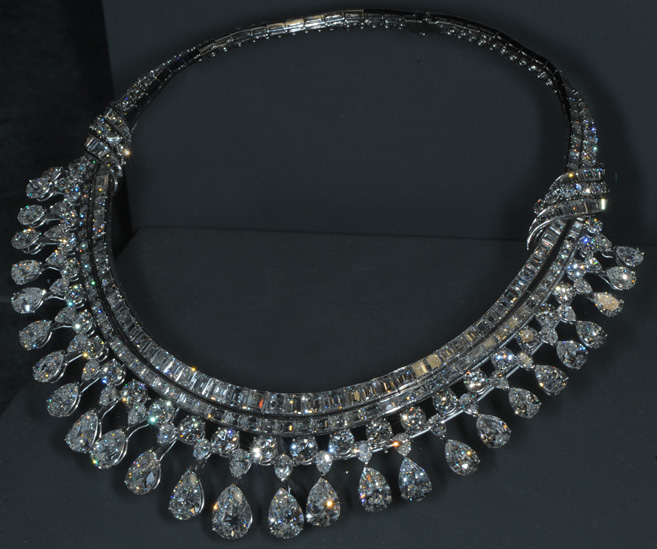
This is the Hazen Diamond Necklace. The 325 diamonds in this platinum necklace weigh a total of 131.4 carats. It was designed by Harry Winston, Inc. and a gift to the Smithsonian in 1979 by Lita Annenberg Hazen. All these diamonds are on display in the Smithsonian Museum of Natural History. 所有这些钻石都在自然历史博物馆展出。
The major sources of diamonds are the Republic of South Africa and Tanzania. Most diamonds are found in a type of volcanic rock called kimberlite, and in particular in structures called "kimberlite pipes". 钻石的主要来源是南非共和国和坦桑尼亚。大多数钻石发现于一种称为 Kimberlite 的火山岩中,特别是称为 'Kimberlite pipes' 的地质结构中。
这是Hazen钻石项链。这条铂金项链共包含325颗钻石,总重131.4克拉。该项链由Harry Winston公司设计,并于1979年由Lita Annenberg Hazen赠送给史密森尼机构。 |
 |
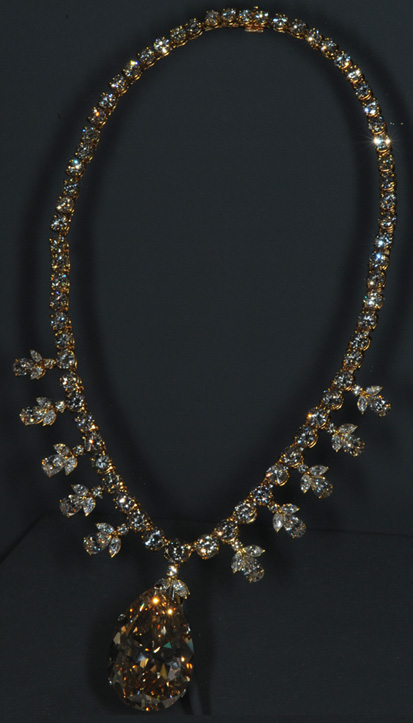 |
Necklace with the Victoria-Transvaal Diamond at 67.89 carats. 镶嵌着维多利亚-特瓦尔钻石的项链,该钻石重67.89克拉。
"The Victoria-Transvaal is a 67.89-carat, brownish-yellow pear shaped stone. It was cut from a 240-carat crystal that was found in the Transvaal, South Africa. The first cutting produced a 75-carat 116-facet stone that measured 1 x 1?/8 inches; a recutting retained the same length and width, but reduced the depth to better proportions, making it more brilliant. The diamond has been featured in several Hollywood films, including a Tarzan episode from 1952 titled Tarzan's Savage Fury, and in leading exhibitions in the United States and Canada. The necklace was designed by Baumgold Brothers, Inc, and consists of a yellow gold chain with 66 round brilliant-cut diamonds, fringed with ten drop motifs, each set with two marquise-cut diamonds, a pear-shaped diamond, and a small round brilliant-cut diamond (the total weight of the 106 diamonds is about 45 carats). "
维多利亚-特瓦拉尔石是一颗重67.89克拉、呈淡黄色的梨形宝石。它最初是从在南非特瓦拉尔发现的重240克拉的晶体中切割而成。第一次切割得到一颗重75克拉、有116个切面的宝石,尺寸为1 x 1?/8英寸;再次切割保留了相同的长度和宽度,但减少了深度以达到更好的比例,使其更加璀璨。这颗钻石曾被用在多部好莱坞电影中,包括1952年的《塔纳洛斯的狂怒》一集,以及在美国和加拿大的主要展览中。项链由Baumgold兄弟公司设计,由一条黄金链和66颗圆 brilliant 切割的钻石组成,饰有十个滴形饰物,每个饰物镶嵌两颗马奎斯切割的钻石、一颗梨形钻石和一颗小的圆 brilliant 切割钻石(106颗钻石的总重量约为45克拉)。 |
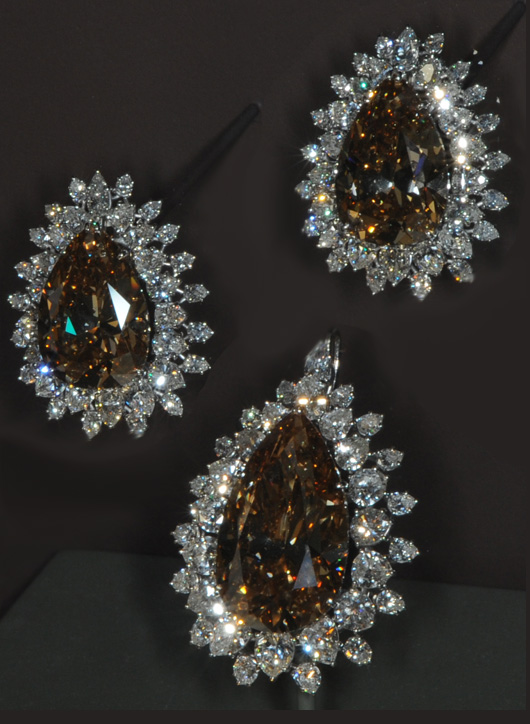
Thompson Diamonds汤普森钻石 The brooch is 36.73 carats and the earclips are 39.58 carats. The three cognac-colored, pear-shaped diamonds wer cut in 1956 from a single 264-carat crystal. Nearly 20 carats of pear-shaped white diamonds accentuate the matching set. 这款胸针重36.73克拉,耳夹重39.58克拉。三种呈琥珀色、梨形的钻石于1956年从单一的264克拉晶体中切割而成。近20克拉的梨形白色钻石增强了整体的匹配效果。
|
 |
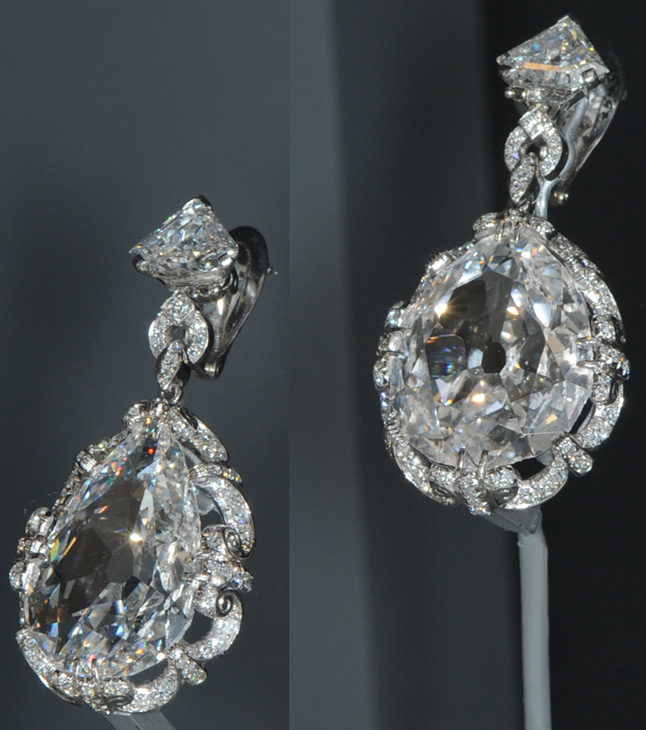 |
The Marie Antoinette diamonds玛丽·安托瓦内特的钻石
The large diamonds in these modern earrings were once set in a much older pair. According to sworn documents, the original earrings were owned by Marie Antoinette, the queen of France who was guillootined in 1793 during the French Revolution. 这些现代耳环中的大钻石曾镶嵌在一对更古老的耳环上。据证人证词所述,原耳环曾属于1793年法国大革命期间被处决的法国王后玛丽·安托瓦内特。
The earrings were said to be a gift from her husband, King Louis XVI. According to one legend, she had them with her when she was arrested fleeing the French Revolution in 1791. Grand Duchess Tatiana Yousupoff of Russia later acquired the earrings. They stayed within her family until 1928. 耳环据说来自她的丈夫,路易十六国王。根据一个传说,她在1791年逃离法国大革命时带着这些耳环。后来,俄罗斯的格鲁迪亚斯塔蒂亚娜·尤苏波娃大公夫人获得了这些耳环。它们一直保留在她的家族中,直到1928年。
|
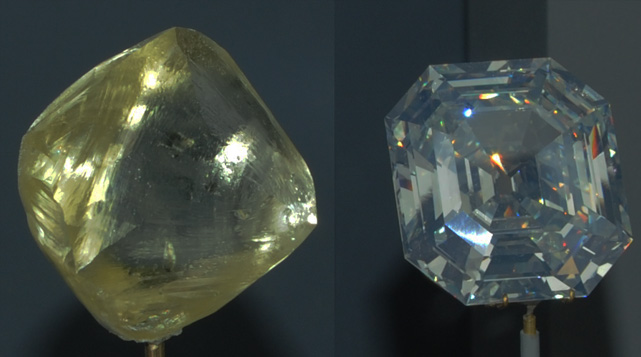
The diamond immediately right is the Oppenheimer Diamond from Dutoitspan mine, Kimberley, South Africa. It is remarkable not only for its size, 253.7 carats, but also because it has survived uncut. Its double pyramid or octahedral shap is typical of many diamond crystals. 右侧的钻石来自多图斯潘矿,位于南非金伯利。它不仅因其253.7克拉的尺寸而引人注目,还因为它未经切割仍得以保存。其双金字塔或八面体形状是许多钻石晶体的典型特征。
|
 |
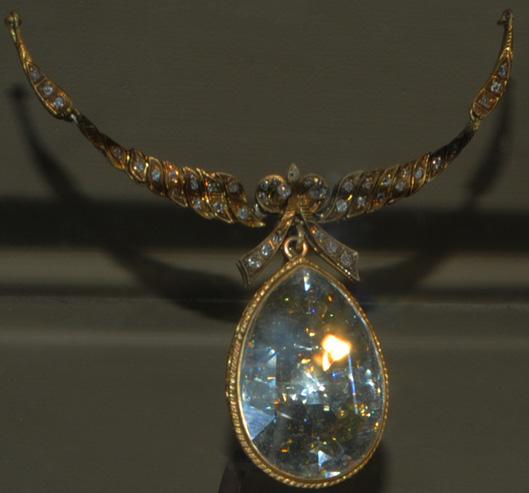 |
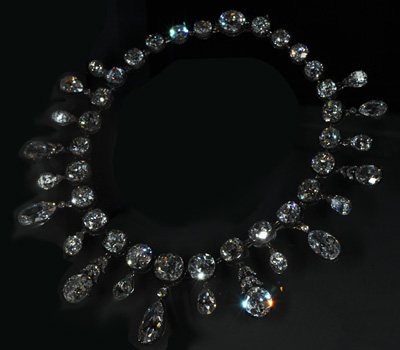
This is called the "Mystery Diamond Necklace". The mystery is not only that the origin of the necklace is unknown, but the fact that the 10-15 carat diamond looks much larger. The cleverly designed setting creates the illusion that this wafer-thin diamond is five or six times heavier than it is. It was a gift to the Smithsonian by Lillian Turner in 1998. 这被称为“谜样钻石项链”。谜团不仅在于项链的来源不明,还在于这颗10至15克拉的钻石看起来大很多。巧妙设计的戒面创造出一种错觉,使这颗超薄的钻石看起来比实际重五到六倍。它于1998年由莉莉安·特纳赠送给史密森尼。
|
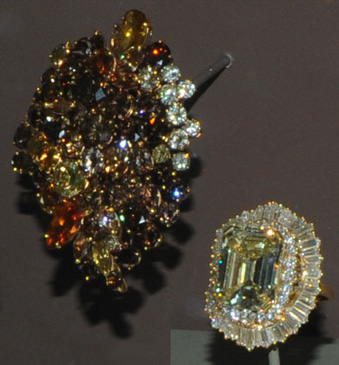 |
This 61.3 carat diamond brooch and the 22 carat ringdent are of unknown origin. The brooch is of 18-carat gold and contains 71 diamonds ranging in weight from 0.3 to 2.5 carats. The colors are natural. The yellow emerald-cut diamond is set in a ringdent designed to be worn as a pendant or ring. 这个61.3克拉的钻石胸针和22克拉的戒指都来自未知的起源。胸针是18克拉金制成的,包含71颗钻石,重量从0.3到2.5克拉不等。颜色均为天然。黄色的椭圆切割钻石镶嵌在戒指设计中,可作为吊坠或戒指佩戴。
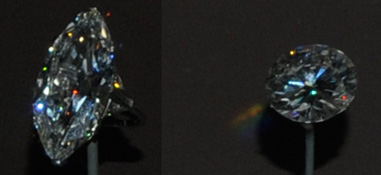 左侧是一枚28.3克拉的马眼形切割钻石戒指。右侧是来自南非的16.72克拉佩恩钻石。圆形明亮切割增强了这颗几乎无色、完美无瑕钻石的卓越品质。 |
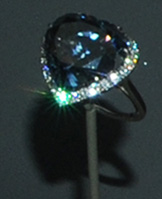 | Blue Diamond蓝宝石
The Blue Heart Diamond Ring has an extraordinary 30.62 carat blue diamond from South Africa. It is two thirds the size of the Hope Diamond. 蓝心蓝宝石戒指镶嵌着一颗来自南非的非凡蓝宝石,重量为30.62克拉,其大小是希望蓝宝石的两倍。
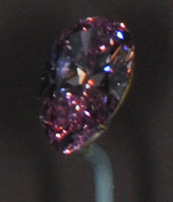
Pink Diamond粉红钻石
This is a 2.9 carat pink diamond, among the rarest of diamond colors. The cause of the pink color is not known. 这是一颗2.9克拉的粉红色钻石,是稀有的钻石颜色之一。粉红色的原因尚不清楚。
|  |
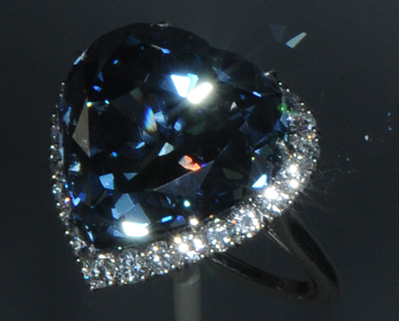 | 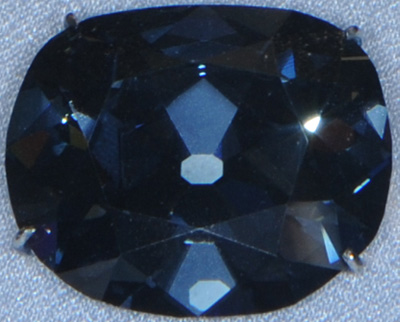 |
This is a larger view of the Blue Heart Diamond Ring compared to the famous Hope Diamond. It was interesting to note that the Hope Diamond is displayed unmounted in this 2010 image compared to 2003 when it was displayed in a necklace. The history of the Hope diamond may be found on the Smithsonian website. The Hope Diamond is 45.52 carats and perhaps the most famous diamond in the world. 与著名的希望之珠相比,这是一幅更大规模的蓝心脏钻石戒指的视图。有趣的是,这张2010年的图片中,希望之珠未镶嵌在首饰上,而2003年时它则镶嵌在一条项链上。希望之珠的历史可以在史密森尼网站上找到。希望之珠重45.52克拉,可能是世界上最著名的钻石。 | 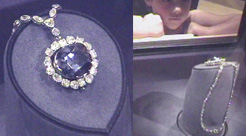 |
 | 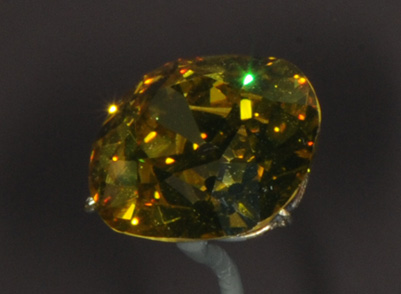 一颗黄色钻石与几乎无色的宝石项链的比较 |
Mindat: Diamond
| Minerals
矿物 |
| Measuring in carats
以克拉为单位的测量 |
References
Kittel
Ashcroft & Mermin
| HyperPhysics*****Geophysics
HyperPhysics ***** 地球物理学 | R Nave |