Molecular Spectra
分子光谱
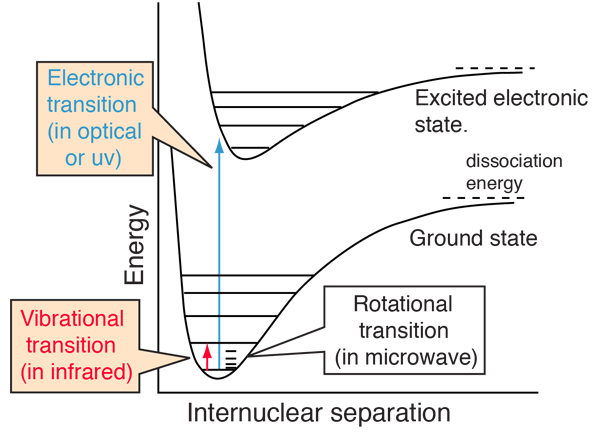 The most commonly observed molecular spectra involve electronic, vibrational, or rotational transitions. For a diatomic molecule, the electronic states can be represented by plots of potential energy as a function of internuclear distance. Electronic transitions are vertical or almost vertical lines on such a plot since the electronic transition occurs so rapidly that the internuclear distance can't change much in the process. Vibrational transitions occur between different vibrational levels of the same electronic state. Rotational transitions occur mostly between rotational levels of the same vibrational state, although there are many examples of combination vibration-rotation transitions for light molecules.
最常观察到的分子光谱涉及电子、振动或转动跃迁。对于双原子分子,电子态可以表示为核间距函数的势能图。在这样的图中,电子跃迁表现为垂直或几乎垂直的线,因为电子跃迁发生得如此迅速,以至于核间距在过程中几乎不会改变。振动跃迁发生在同一电子态的不同振动能级之间。转动跃迁主要发生在同一振动态的转动能级之间,尽管对于轻分子有许多振动-转动跃迁的实例。 |
Index
Molecular spectra concepts
索引 分子光谱概念 |