Bilingual edition: English is preserved and Chinese follows each unit. Terminology uses the confirmed v20260916 glossary; automated semantic review remains traceable.
中英双语版:英文原文完整保留,中文紧随对应单元;术语采用 v20260916 确认表,自动语义审校结果可追溯。

Rotational Spectra

旋转光谱

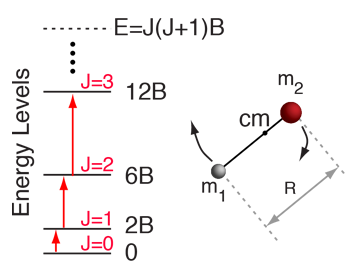
Incident electromagnetic waves can excite the rotational levels of molecules provided they have an electric dipole moment. The electromagnetic field exerts a torque on the molecule. The spectra for rotational transitions of molecules is typically in the microwave region of the electromagnetic spectrum. The rotational energies for rigid molecules can be found with the aid of the Shrodinger equation. The diatomic molecule can serve as an example of how the determined moments of inertia can be used to calculate bond lengths.
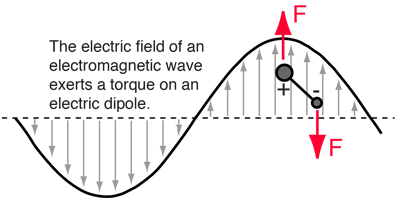
入射的电磁波可以在分子具有电偶极矩的情况下激发其旋转能级。电磁场会对分子施加力矩。分子的旋转跃迁谱通常位于电磁波谱的微波区域。刚性分子的旋转能量可通过薛定谔方程求得。双原子分子可以作为如何利用确定的转动惯量来计算键长的例子。

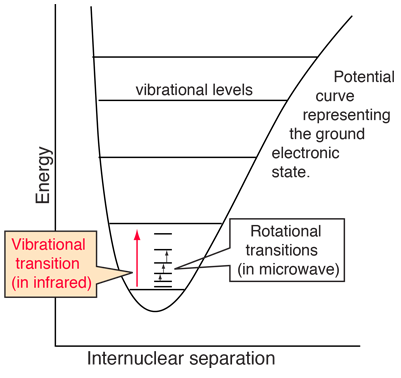
The illustration at left shows some perspective about the nature of rotational transitions. The diagram shows a portion of the potential diagram for a stable electronic state of a diatomic molecule. That electronic state will have several vibrational states associated with it, so that vibrational spectra can be observed. Most commonly, rotational transitions which are associated with the ground vibrational state are observed.

左边的示意图展示了旋转跃迁的某些特性。该图显示了双原子分子稳定电子态的一部分势能图。该电子态将与多个振动态相关联,因此可以观察到振动光谱。通常,与基态振动态相关的旋转跃迁会被观察到。
Diatomic molecules
双原子分子
Determining the structure of a diatomic molecule
确定双原子分子的结构
Determining the structure of a linear molecule
确定线性分子的结构
Example of the structure of a polyatomic molecule
多原子分子的结构示例
Index

Molecular spectra concepts
索引 分子光谱概念
 
HyperPhysics***** Quantum Physics
HyperPhysics ***** 量子物理
R Nave
Go Back
返回


Rotational Energies

旋转能

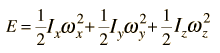
The classical energy of a freely rotating molecule can be expressed as rotational kinetic energy

自由旋转分子的经典能量可以表示为旋转动能

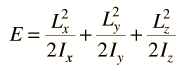
where x, y, and z are the principal axes of rotation and Ix represents the moment of inertia about the x-axis, etc. In terms of the angular momenta about the principal axes, the expression becomes

其中,x、y 和 z 是转动轴的主轴,I<sub>x</sub> 表示关于 x 轴的转动惯量,等等。以关于主轴的角动量表示,表达式变为

The formation of the Hamiltonian for a freely rotating molecule is accomplished by simply replacing the angular momenta with the corresponding quantum mechanical operators.

Diatomic molecules
双原子分子
自由旋转分子的哈密顿量的形成 simply 是通过将角动量替换为相应的量子力学算符来实现的。
Index

Molecular spectra concepts
索引 分子光谱概念
 
HyperPhysics***** Quantum Physics
HyperPhysics ***** 量子物理
R Nave
Go Back
返回


Diatomic Molecules

双原子分子

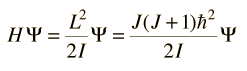
For a diatomic molecule the rotational energy is obtained from the Schrodinger equation with the Hamiltonian expressed in terms of the angular momentum operator.

对于双原子分子,其旋转能量是通过施瓦茨曼方程得到的,该方程中的哈密顿量以角动量算符表示。
More detail
更多内容

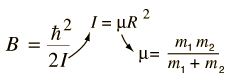
where J is the rotational angular momentum quantum number and I is the moment of inertia.

其中J是转动角动量量子数,I是转动惯量。
Rotational transitions
旋转跃迁

Determining the rotational constant B

确定旋转常数B

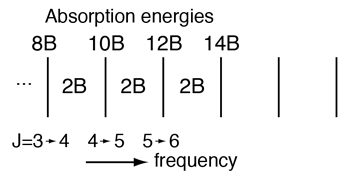
enables you to calculate the bond length R. The allowed transitions for the diatomic molecule are regularly spaced at interval 2B. The measurement and identification of one spectral line allows one to calculate the moment of inertia and then the bond length.

这使你能计算键长R。双原子分子的允许跃迁在间隔2B处规律地分布。测量和识别一条光谱线允许你计算转动惯量,从而得到键长。
Examples
示例
HCl CN CH
章
Table of diatomic molecule parameters
双原子分子参数表
Index

Molecular spectra concepts
索引 分子光谱概念
 
HyperPhysics***** Quantum Physics
HyperPhysics ***** 量子物理
R Nave
Go Back
返回


Rotational Transitions, Diatomic

旋转跃迁,双原子

For a rigid rotor diatomic molecule, the selection rules for rotational transitions are ΔJ = +/-1, ΔMJ = 0 .

对于刚性转子双原子分子,旋转跃迁的选取定则为ΔJ = ±1,ΔM_J = 0。
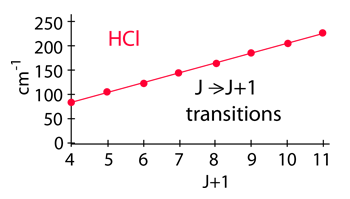
The rotational spectrum of a diatomic molecule consists of a series of equally spaced absorption lines, typically in the microwave region of the electromagnetic spectrum. The energies of the spectral lines are 2(J+1)B for the transitions J -> J+1.
双原子分子的旋转光谱由一系列等间距的吸收线组成,通常位于电磁波谱的微波区域。谱线的能量为2(J+1)B,对应于J到J+1的跃迁。
For real molecules like the example of HCl , the successive transitions are a bit lower than predicted because centrifugal distortion lengthens the molecule, increasing its moment of inertia.
对于像HCl这样的真实分子,连续的跃迁略低于预测值,因为离心畸变使分子变长,从而增加了其转动惯量。
Moment of inertia for diatomic molecule
双原子分子的转动惯量
Vibration/rotation transitions in HCl
HCl中的振动/旋转跃迁
Index

Molecular spectra concepts
索引 分子光谱概念
 
HyperPhysics***** Quantum Physics
HyperPhysics ***** 量子物理
R Nave
Go Back
返回


Moment of Inertia, Diatomic

转动惯量,双原子

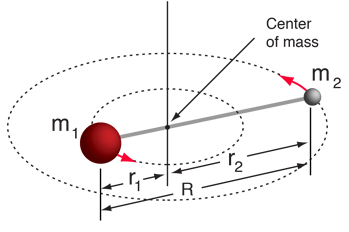
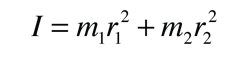
The moment of inertia about the center of mass is

关于质心的转动惯量是

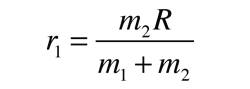
From the center of mass definition

从质心定义出发
and
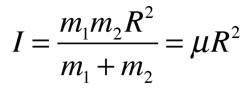
substituting to eliminate r1 and r2 gives
where μ is called the "reduced mass."
并将 r₁ 和 r₂ 代入以消去它们,得到其中 μ 称为‘约化质量’。
Diatomic molecule
双原子分子
Reduced mass
约化质量
Index

Molecular spectra concepts
索引 分子光谱概念
 
HyperPhysics***** Quantum Physics
HyperPhysics ***** 量子物理
R Nave
Go Back
返回