Bilingual edition: English is preserved and Chinese follows each unit. Terminology uses the confirmed v20260916 glossary; automated semantic review remains traceable.
中英双语版:英文原文完整保留,中文紧随对应单元;术语采用 v20260916 确认表,自动语义审校结果可追溯。

Electronic Spectra of Molecules
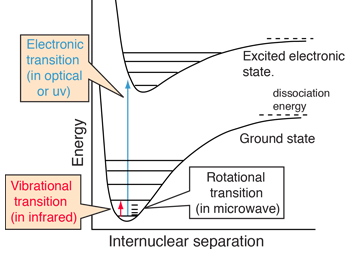
分子电子光谱

Molecules exhibit electronic spectra from transitions between electron energy levels. These spectra are more complex than those of atomic spectra which involve transitions between electron energy levels which typically produce sharp line spectra. The energies associated with molecular electronic spectra (typically in the optical or uv region) are typically much larger than those associated with vibrational spectra (typically in the infrared) and rotational spectra (typically in the microwave region). This contributes to the complexity of the electronic spectra since the transitions from a multitude of vibrational and rotational levels produce many spectral lines, a "band" of frequencies.

分子表现出电子光谱,这是电子能级之间的跃迁所导致的。这些光谱比原子光谱更复杂,后者涉及电子能级之间的跃迁,通常产生尖锐的线状光谱。与分子电子光谱(通常在可见光或紫外区)相关的能量通常比振动光谱(通常在红外区)和旋转光谱(通常在微波区)所关联的能量要大得多。这导致电子光谱的复杂性,因为从众多振动和旋转能级的跃迁会产生许多谱线,形成一个“带”状的频率范围。

Electronic transitions are essentially instantaneous, so there is no time for appreciable motion of the nuclei. So the transitions appear as vertical lines with no change in internuclear distance. This is referred to as the Franck-Condon principle.

电子跃迁本质上是瞬时的,因此核的显著运动没有时间发生。因此,跃迁表现为垂直的线条,核间距没有变化。这被称为弗兰克-康登原理。

The spectra are strongly affected by the probability that an electron is at a location to contribute to such a "vertical" transition. That probability is the wavefunction squared, and at least the lowest vibrational states are approximated by the quantum harmonic oscillator.

光谱强烈地受到电子处于某一位置参与此类'垂直'跃迁的概率的影响。该概率是波函数的平方,最低的振动态可近似由量子谐振子来描述。

The energy level diagrams contain much information about the molecule. The v=0 ground ground vibrational state has the highest probability at the center of the potential well, but the higher vibrational states have the highest probabilty at maximum displacement from that center. The transition above demonstrates one result of those facts: the center of the ground state is at the same internuclear distance as the v=1 state of the first electronic excited state. So that transition is highly probably and produces a strong spectral line. Transitions involving other vibrational states are observed, but significantly weaker.

能级图包含关于分子的大量信息。v=0的基态振动态在势阱中心有最高的概率,但更高振动态的最高概率出现在该中心的最大位移处。上述跃迁展示了一个结果:基态的中心位于第一电子激发态的v=1态的相同核间距处。因此,该跃迁高度可能,并产生强的谱线。涉及其他振动态的跃迁也被观察到,但强度显著较弱。

The illustration of the v=0 to v=1 transition above shows it as being broader, which is partly due to its greater intensity, but also because there can be many molecular rotational states associated with the vibrational states, giving a band of many transitions close to the same frequency. The higher inherent intensity makes more of those transitions visible and broadens the line.
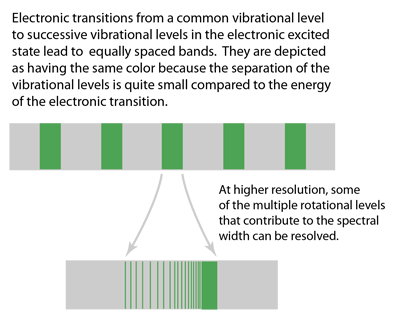
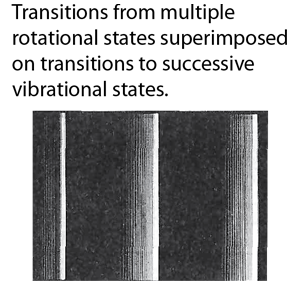
This is a depiction of multiple electronic transitions from a common vibrational state in the ground electronic state to successive vibrational levels in an excited electronic state. There are no limiting selection rules, so transitions between many pairs of levels can occur. The lines are broadened because of the multiple rotation states associated with the vibrational levels.

这是一幅展示从共同的振动态在基态电子态中进行多个电子跃迁到激发态中连续振动能级的示意图。没有限制的选择规则,因此许多能级对之间的跃迁都可以发生。这些线被展宽,是因为与振动能级相关的多个旋转态。

The representation above was patterned after Taylor, Zafiritos and Dubson's treatment. The section of an actual photographic record of such a spectrum at right is from Blatt and attributed to J. A. Marquisce. It is a portion of the emission spectrum of N2.

上述表示方法是模仿Taylor、Zafiritos和Dubson的处理方式。右图中实际光谱照片的截面部分来自Blatt,并归因于J. A. Marquisce。这是N₂的发射光谱的一部分。

上图中v=0到v=1的跃迁显示得更宽,这在一定程度上是由于其更大的强度,也因为每个振动态可以关联到多个分子旋转态,导致许多接近相同频率的跃迁形成一个带状。更高的强度使这些跃迁更明显,从而拓宽了谱线。

The Franck-Condon principle is an important part of the understanding of molecular electronic spectra. The relevant internuclear separations in an electronic excited state may be essentially the same as in the ground state, but if they are different, it has major effects on the nature of the electronic spectrum. Such differences may lead to the phenomenon of fluorescence in some molecules, and phosphorescence in others.

Chemical bonds
化学键
弗兰克-康登原理是理解分子电子光谱的重要部分。电子激发态中的相关核间距可能基本上与基态中的相同,但如果不同,会对电子光谱的性质产生重大影响。这种差异可能导致某些分子出现荧光现象,而其他分子则可能出现磷光现象。
Index

Molecular spectra concepts

Beiser, Perspectives of Modern Physics
Sec 14.8

Taylor, et al
Ch 12

Blatt
Ch 10
索引 分子光谱概念 Beiser, 《现代物理观点》第14章第8节 Taylor 等, 《物理学原理》第12章 Blatt 第10章
 
HyperPhysics***** Quantum Physics
HyperPhysics ***** 量子物理
R Nave
Go Back
返回


Molecular Fluorescence

分子荧光

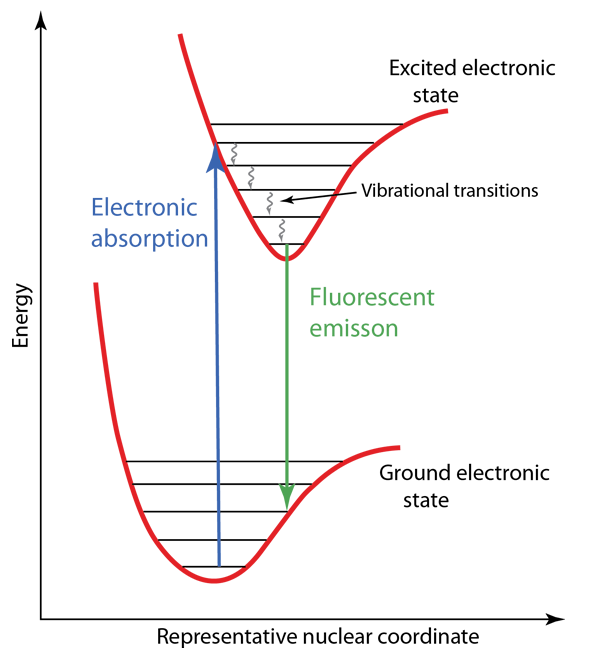
A qualitative understanding of many molecular electronic spectral phenomena can be obtained from the molecular potential diagrams with the application of the Franck-Condon principle and the nature of the quantum harmonic oscillator energy levels. The diagram above follows the suggestion of Beiser to explain how molecular fluorescence can occur. The electronic absorption shown follows the Franck-Condon principle in making the vertical transition from the highest probability location of the ground vibrational state to a high probability location of the v=4 vibrational state of the excited electronic state. Vibrational transitions can bring the electron down to the ground vibrational state where it has a high probability of transition to the v=2 vibrational level of the ground electronic state. This process can occur rapidly, so the molecule can absorb a high energy photon and quickly emit a photon of lower quantum energy, a process which is called fluorescence.

Electronic Spectra
电子光谱
Rotational Spectra
旋转光谱
Vibrational spectra
振动光谱
许多分子电子光谱现象的定性理解可以从分子势能图结合弗兰克-康登原理和量子谐振子能级的性质来获得。上面的图遵循Beiser的建议,解释了分子荧光如何发生。电子吸收过程遵循弗兰克-康登原理,在基态振动态最高概率位置垂直跃迁到激发态中v=4振动态的高概率位置。振动跃迁可以使电子下降到基态振动态,其中电子有较高的概率跃迁到基态电子态的v=2振动能级。这一过程可以迅速发生,因此分子可以吸收高能光子并迅速发射能量较低的光子,这一过程称为荧光。
Index

Molecular spectra concepts

Beiser, Perspectives of Modern Physics
Sec 14.8
索引 分子光谱概念 Beiser, 《现代物理观点》第14章第8节
 
HyperPhysics***** Quantum Physics
HyperPhysics ***** 量子物理
R Nave
Go Back
返回


Molecular Phosphorescence

分子磷光

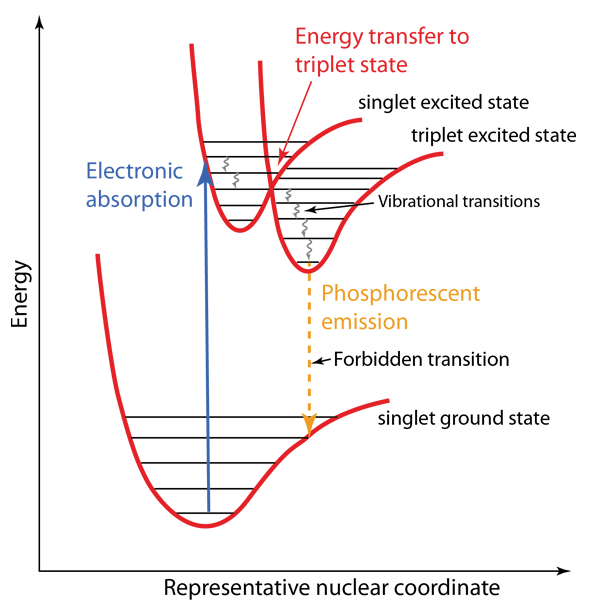
A qualitative understanding of many molecular electronic spectral phenomena can be obtained from the molecular potential diagrams with the application of the Franck-Condon principle and the nature of the quantum harmonic oscillator energy levels. The diagram above follows the suggestion of Beiser to explain how molecular phosphorescence can occur. The electronic absorption shown follows the Franck-Condon principle in making the vertical transition from the highest probability location of the ground vibrational state to a high probability location of the v=4 vibrational state of the excited electronic state. Vibrational transitions can bring the electron down to lower vibrational states, but in this case there is also a triplet excited electronic state. From the v=2 state, the electron can make a transition to this triplet state, and further vibrational deexitations leaves it trapped since transition to the singlet ground state is forbidden. Vibrational transitions can take the electron to the ground vibration state, and this diagram shows a high probability path down to the v=3 vibrational level of the ground state by the Franck-Condon principle. The fact that it is "forbidden" by the selection rules doesn't mean it can't happen, just that it is low in probability. Such transitions have a very long halflife and the lower quantum energy phosphorescent radiation may be emitted minutes or even hours after the initial absorption.

Electronic Spectra
电子光谱
Rotational Spectra
旋转光谱
Vibrational spectra
振动光谱
许多分子电子光谱现象的定性理解可以从分子势能图中获得,结合弗兰克-康登原理和量子谐振子能级的性质。上面的图遵循Beiser的建议,解释分子磷光是如何发生的。所示的电子吸收遵循弗兰克-康登原理,在从基态振动态最高概率位置垂直跃迁到激发态v=4振动态的高概率位置。振动跃迁可以使电子跃迁到更低的振动态,但在此情况下,还有三重激发的电子态。从v=2态,电子可以跃迁到这个三重态,进一步的振动弛豫会使它被困住,因为跃迁到单重基态是被禁止的。振动跃迁可以使电子跃迁到基态振动态,而此图显示了通过弗兰克-康登原理,电子沿着高概率路径跃迁到基态v=3振动态。被选择规则禁止并不意味着它不能发生,只是概率很低。这类跃迁具有很长的半衰期,低量子能量的磷光辐射可能在初始吸收后几分钟甚至几小时后发出。
Index

Molecular spectra concepts

Beiser, Perspectives of Modern Physics
Sec 14.8
索引 分子光谱概念 Beiser, 《现代物理观点》第14章第8节
 
HyperPhysics***** Quantum Physics
HyperPhysics ***** 量子物理
R Nave
Go Back
返回


Singlet and Triplet Molecular States

单重态和三重态分子态

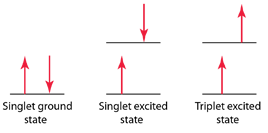
If a pair of electrons occupy the ground electronic state of a molecule, the electron spin states of these two electrons must be opposite according to the Pauli exclusion principle. This state with net zero spin angular momentum will not be split by the application of a magnetic field (Zeeman effect) and is called a "singlet state".
If one electron is elevated to an excited state, the two electrons may be either paired (singlet) or unpaired with both electrons oriented in the same direction. The unpaired spin state has a spin s=1 and has three possible orientations with respect to an applied magnetic field. It is called a "triplet state".
如果一个电子被激发到激发态,两个电子可能处于配对(单重态)或未配对的状态,此时两个电子自旋方向相同。未配对的自旋态具有自旋s=1,并相对于外加磁场有三种可能的取向。这种状态称为‘三重态’。

Electronic Spectra
电子光谱
Rotational Spectra
旋转光谱
Vibrational spectra
振动光谱
如果一对电子占据分子的基态电子态,根据泡利不相容原理,这两个电子的自旋状态必须相反。这种总自旋角动量为零的状态不会因施加磁场(塞曼效应)而分裂,并被称为'单重态'。
Index

Molecular spectra concepts

Beiser, Perspectives of Modern Physics
Sec 14.8

Chemistry Libre
索引 分子光谱概念 Beiser, 《现代物理观点》第14章第8节 化学Libre
 
HyperPhysics***** Quantum Physics
HyperPhysics ***** 量子物理
R Nave
Go Back
返回