FAD - Flavin Adenine Dinucleotide
FAD - 泛酸腺ine二核苷酸
An important mechanism in cellular respiration is the transfer of energy to the molecule flavin adenine dinucleotide (FAD) to convert it to FADH2 This is a process of reduction which stores the energy in high electron states in the FADH2. Much of the energy transfer in the cell involves redox reactions such as this, and FAD is called a "redox cofactor" or a coenzyme. 细胞呼吸中的一个重要机制是将能量转移到荧光腺嘌呤二核苷酸(FAD)分子中,将其转化为FADH₂。这是一个还原过程,该过程将能量储存在FADH₂中的高电子态中。细胞中大部分的能量转移都涉及此类氧化还原反应,FAD被称为"氧化还原辅因子"或"辅酶"。
The reduced coenzyme FADH2 contributes to oxidative phosphorylation in the mitochondria. FADH2 and NADH can be considered to be like "charged batteries" from having accepted electrons and a proton or two. FADH2 is reoxidized to FAD, which makes it possible to produce two molecules of the universal energy carrier ATP. The source of the energized FADH2 in the cell is generally the TCA cycle.
减少的辅酶FADH 2有助于线粒体中的氧化磷酸化。FADH 2和NADH可以被认为像‘充满电的电池’,因为它们已经接受了电子和一个或两个质子。FADH 2被重新氧化为FAD,这使得能够产生两个通用能量载体ATP分子。细胞中充满电的FADH 2的来源通常来自TCA循环。 |  |
FAD is derived from riboflavin, or vitamin B2. FAD是由核黄素,或维生素B2衍生的。 | 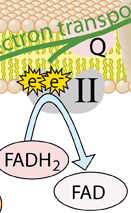 |
| FAD wiki
FAD维基百科 |
Organic chemistry concepts
Chemistry concepts
Reference
Karp
Ch 3
索引 有机化学概念 化学概念 参考 Karp 第3章
| HyperPhysics*****Chemistry
HyperPhysics ***** 化学 | R Nave |
返回