Coenzymes辅酶
Most of the biochemical pathways in living things are enhanced by the control proteins called enzymes. The efficiency of the enzyme-catalyzed reactions is often increased by the presence of helper molecules called coenzymes. A coenzyme present in every living cell is NAD+. It participates in electron transport reactions in cell metabolism processes like glycolysis. Another essential coenzyme is FAD which also contributes to the electron transport process. 大多数生物化学反应路径在生物体内都是通过称为酶的控制蛋白增强的。酶促反应的效率通常可以通过存在称为辅酶的辅助分子来提高。存在于每个活细胞中的辅酶是NAD+。它参与细胞代谢过程中的电子传递反应,如糖酵解。另一种重要的辅酶是FAD,它也参与电子传递过程。
Much of the energy from the TCA cycle in aerobic respiration is used to reduce the coenzymes, thereby giving their electrons higher energy for the electron transport reactions. 在有氧呼吸的TCA循环中,许多能量用于还原辅酶,从而使辅酶的电子获得更高的能量,用于电子传递反应。
The reduced coenzyme NADPH plays a key role in the Calvin cycle for the production of carbohydrates in photosynthetic organisms. 还原型辅酶NADPH在卡尔文循环中起关键作用,用于光合生物合成碳水化合物。
|
Index Biochemical concepts Chemistry concepts 索引 生物化学概念 化学概念 | ||
|
Go Back
返回 |
Reduced Coenzymes as Energy Storage Elements减少的辅酶作为能量存储元素
Most of the biochemical pathways in living things are enhanced by the control proteins called enzymes. The efficiency of the enzyme-catalyzed reactions is often increased by the presence of helper molecules called coenzymes. A coenzyme present in every living cell is NAD+. It participates in electron transport reactions in cell metabolism processes like glycolysis. Another essential coenzyme is FAD which also contributes to the electron transport process. 大多数生物化学反应路径在生物体内都是通过称为酶的控制蛋白增强的。酶促反应的效率通常可以通过存在称为辅酶的辅助分子来提高。存在于每个活细胞中的辅酶是NAD+。它参与细胞代谢过程中的电子传递反应,如糖酵解。另一种重要的辅酶是FAD,它也参与电子传递过程。
Much of the energy from the TCA cycle in aerobic respiration is used to reduce the coenzyme NAD+ to NADH, which is used to give electrons higher energy for the electron transport reactions. 在有氧呼吸中,TCA循环产生的大量能量用于将辅酶NAD+还原为NADH,后者用于为电子传递反应提供高能电子。
In photosynthetic organisms, the light energy drives the electron transport chain of chloroplasts. Much of the energy is used to reduce the coenzyme NADP+ to form NADPH, thereby raising it to a higher energy state. The energy of NADPH is then used in the Calvin cycle as a part of the process of carbohydrate synthesis. 在光合作用生物中,光能驱动叶绿体中的电子传递链。大部分能量被用来将辅酶NADP+还原成NADPH,从而将其提升到更高的能量状态。NADPH的能量然后在卡尔文循环中作为碳水化合物合成过程的一部分被利用。
|
Index Biochemical concepts Chemistry concepts 索引 生物化学概念 化学概念 | ||
|
Go Back
返回 |
Dehydrogenases and Reductases脱氢酶和还原酶
Most of the biochemical pathways in living things are enhanced by the control proteins called enzymes which are assisted by smaller structures called coenzymes. In the general processes of metabolism in living organisms, both the catabolic and anabolic processes are aided by enzymes. 大多数生物化学反应路径在生物体内都是由称为酶的控制蛋白增强的,这些酶由称为辅酶的较小结构协助。在生物体的代谢一般过程中,分解代谢和合成代谢都受到酶的促进。 A dehydrogenase is an enzyme that assists catabolic processes by oxidizing substrates, reducing electron receptors like NAD+/NADP+ and flavin coenzymes such as FAD or FMN. Dehydrogenases oxidize a substrate by transferring hydrogen into an electron acceptor. ![]() 脱氢酶是一种协助分解代谢过程的酶,通过氧化底物,将氢转移到电子受体如NAD+/NADP+和荧光辅酶如FAD或FMN中。脱氢酶通过将氢转移到电子受体来氧化底物。 This is an example of a dehydrogenase using the coenyzme NAD+ to accomplish an oxidation. 这是一种利用辅酶NAD⁺完成氧化反应的脱氢酶的例子。 A reductase is an enzyme that catalyzes a reduction reaction. Reduction is characteristic of the anabolic side of metabolism. Reduction and oxidation (redox reactions) are both extensively used in metabolism.
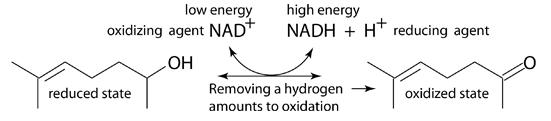
一种还原酶是一种催化还原反应的酶。还原反应是代谢合成侧的特征。还原和氧化(氧化还原反应)都在代谢中被广泛使用。 |
Index Biochemical concepts Chemistry concepts Dehydrogenase wiki 索引 生物化学概念 化学概念 脱氢酶维基 | ||
|
Go Back
返回 |