Lewis Dot Diagrams of Selected Elements
选定元素的路易斯点图
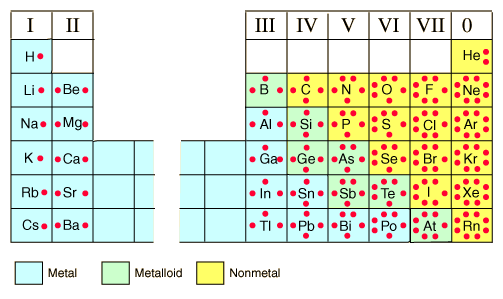
| Lewis Symbols
路易斯符号 | Electron Configuration into Shells
电子壳层配置 |
Chemical concepts
索引 化学概念 元素的化学 化学元素周期表
| HyperPhysics***** Quantum Physics
HyperPhysics ***** 量子物理 | R Nave |
返回
Lewis Dot Diagrams of Selected Elements选定元素的路易斯点图
|
Index Chemical concepts 索引 化学概念 元素的化学 化学元素周期表 | ||
|
Go Back
返回 |
Electron Distributions Into Shells for the First Three Periods前三个周期中电子在壳层的分布
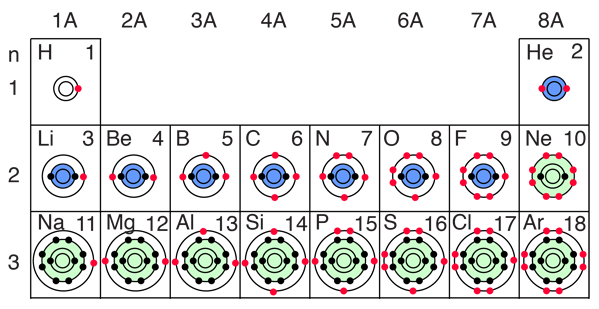 A chemical element is identified by the number of protons in its nucleus, and it must collect an equal number of electrons if it is to be electrically neutral. As electrons are added, they fill electron shells in an order determined by which configuration will give the lowest possible energy. The first shell (n=1) can have only 2 electrons, so that shell is filled in helium, the first noble gas. In the periodic table, the elements are placed in "periods" and arranged left to right in the order of filling of electrons in the outer shell. So hydrogen and helium complete the first period. 化学元素由其原子核中的质子数来标识,如果要保持电中性,它必须拥有相等数量的电子。当电子被添加时,它们会按照能给出最低可能能量的配置来填充电子壳层。第一壳层(n=1)只能容纳2个电子,因此在氦中被填满,氦是第一种惰性气体。在元素周期表中,元素被排列在“周期”中,并按照外层电子填充的顺序从左到右排列。因此,氢和氦完成了第一周期。
The number of electrons in a given shell can be predicted from the quantum numbers associated with that shell along with the Pauli exclusion principle. The second shell, associated with principal quantum number n=2, can have a maximum of 8 electrons and corresponds to the second period of the periodic table. The third shell also has 8 electrons, but things get more complicated after than because the subshells spread out enough that there is overlap between them. 给定壳层中的电子数可以从该壳层相关的量子数以及泡利不相容原理预测。第二壳层,对应主量子数n=2,最多可以容纳8个电子,并对应元素周期表的第二周期。第三壳层也有8个电子,但情况在之后变得更加复杂,因为子壳层扩展足够,导致它们之间出现重叠。
|
Index Chemical concepts 索引 化学概念 元素的化学 化学元素周期表 | ||
|
Go Back
返回 |