Bilingual edition: English is preserved and Chinese follows each unit. Terminology uses the confirmed v20260916 glossary; automated semantic review remains traceable.
中英双语版:英文原文完整保留,中文紧随对应单元;术语采用 v20260916 确认表,自动语义审校结果可追溯。

Respiration

呼吸
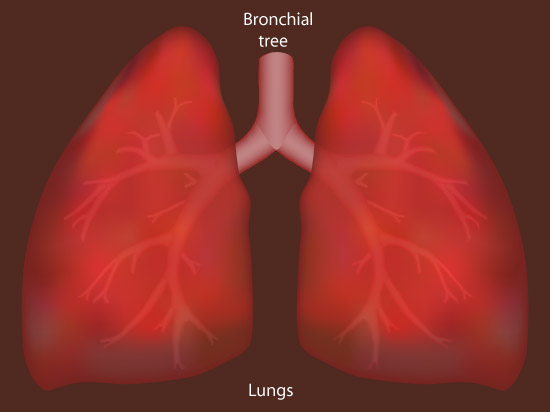
By "respiratory system" we usually mean the passages that transport incoming air to the lungs and to the microscopic air sacs called alveoli where gases are exchanged. The term respiration refers to the whole chain of processes from the inhalation of air to the use of oxygen in the cells.

当我们说“呼吸系统”时,通常指的是将吸入的空气输送到肺以及称为肺泡的微小气囊的通道,在肺泡中进行气体交换。而“呼吸”一词则指从吸入空气到细胞中利用氧气的整个过程。
Index

Reference
Audesirk & Audesirk
Ch 28

Shier, D. et al.
Ch 19
索引 参考 Audesirk & Audesirk 第28章 Shier, D. 等人 第19章
 
HyperPhysics***** Biology
HyperPhysics ***** 生物学
R Nave
Go Back
返回


Breathing or Ventilation

呼吸或通气

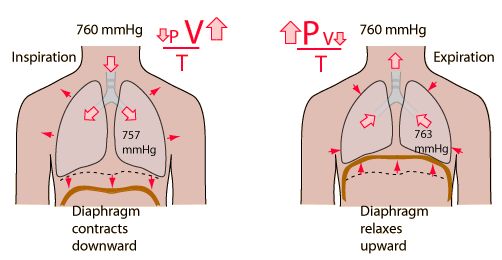
We can inhale by lowering the diaphragm to expand the volume of the chest cavity. By the ideal gas law we know that an expanded volume will lower the pressure and allow air to flow into the lungs through the bronchial passages. Exhalation can be accomplished by just relaxing the chest and allowing the elastic recoil of the alveoli to force the air out of the lungs. This elastic recoil is related to the wall tension of the alveoli and behaves according to LaPlace's law.

我们可以通过降低膈肌来扩张胸腔的体积来进行吸气。根据理想气体定律,体积的扩大将导致压力降低,从而使空气通过支气管流入肺部。呼气可以通过放松胸部并让肺泡的弹性回弹来实现,这种弹性回弹与肺泡壁的张力有关,并遵循拉普拉斯定律。

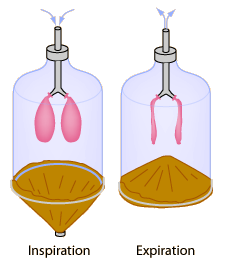
The above diagram follows the perspective of Thibadeau & Patton. Upon inspiration, the pressure in the alveoli is on the order of 2-3 mmHg below the atmospheric pressure of 760 mmHg. The relaxing of the diagphragm plus the elastic recoil of the alveoli provides a pressure some 3 mmHg above atmospheric pressure to accomplish expiration. At right is a sketch of a lung model used to demonstrate the nature of the breathing process. A rubber membrane simulates the action of the diaphragm.

上述图示采用了Thibadeau与Patton的观点。在启发下,肺泡内的压力大约比大气压760 mmHg低2-3 mmHg。膈肌放松加上肺泡的弹性回缩会产生约3 mmHg高于大气压的压力,以完成呼气过程。右侧是一幅用于展示呼吸过程性质的肺部模型示意图。一个橡胶膜模拟了膈肌的作用。
Respiratory System
呼吸系统
More inhalation detail
更多吸入细节
Index

Reference
Audesirk & Audesirk
Ch 28

Shier, D. et al.
Ch 19

Thibadeau & Patton
Ch 24
索引参考Audesirk & Audesirk第28章,Shier, D.等作者第19章,Thibadeau & Patton第24章
 
HyperPhysics***** Biology
HyperPhysics ***** 生物学
R Nave
Go Back
返回


Gas Exchange in the Lungs

肺部气体交换

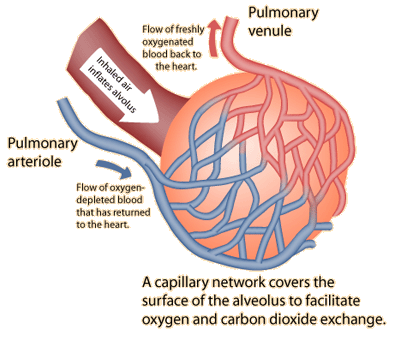
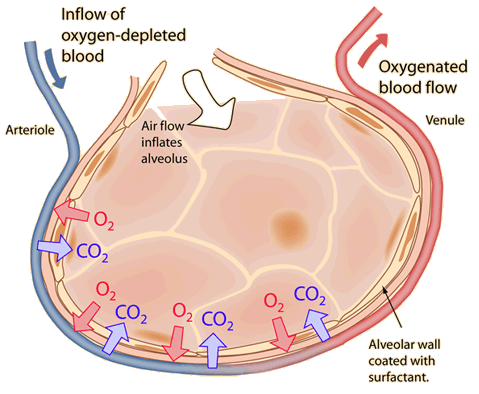
Gas exchange in the lungs takes place in the tiny air sacs called alveoli in the lungs. The process of inhalation must inflate the alveoli, but it can only do so because of the presence of a surfactant fluid that coats the alveoli and lowers the surface tension of their walls.

肺部的气体交换发生在肺中的微小气囊——肺泡中。吸气过程必须使肺泡膨胀,但这是由于肺泡表面覆盖有一层表面活性物质,这种物质降低了肺泡壁的表面张力。
The lungs have millions of alveoli (Thibodeau & Patton) and each lies in contact with capillaries. The combination of the alveolar wall, the capillary wall and the basement membrane that lies between them is a very thin barrier across which oxygen and carbon dioxide diffuse readily.
肺部有数以百万计的肺泡(Thibodeau & Patton),每个肺泡都与毛细血管接触。肺泡壁、毛细血管壁以及它们之间的基底膜共同构成一个非常薄的屏障,氧气和二氧化碳能够轻易地在此屏障上扩散。
Transfer of oxygen and carbon dioxide across the membranes occurs by diffusion, but the solubility of these gases in the material of the membrane also play a role. The influence of solubility on diffusion in modeled in Graham's law.
氧气和二氧化碳穿过膜的转移通过扩散发生,但这些气体在膜材料中的溶解性也起作用。溶解性对扩散的影响在格雷厄姆定律中得到了建模。
Respiratory System
呼吸系统
Index

Reference
Audesirk & Audesirk
Ch 28

Shier, D. et al.
Ch 19

Thibodeau & Patton
Ch 23
索引参考Audesirk & Audesirk第28章,Shier, D.等人第19章,Thibodeau & Patton第23章
 
HyperPhysics***** Biology
HyperPhysics ***** 生物学
R Nave
Go Back
返回


Gas Transport by the Blood

血液中的气体运输

Almost all the oxygen (over 98%) is carried in the blood by attachment to hemoglobin, a protein in the red blood cells. As oxygen is dissolved in the blood, it rapidly combines with the hemoglobin to form oxyhemoglobin. Each hemoglobin molecule can bind up to four oxygen molecules.

几乎所有的氧气(超过98%)都是通过与血红蛋白结合来运输的,血红蛋白是红细胞中的一种蛋白质。当氧气溶解在血液中时,它会迅速与血红蛋白结合形成氧合血红蛋白。每个血红蛋白分子可以结合多达四个氧气分子。
Respiratory System
呼吸系统
Index

Reference
Audesirk & Audesirk
Ch 28

Shier, D. et al.
Ch 19
索引 参考 Audesirk & Audesirk 第28章 Shier, D. 等人 第19章
 
HyperPhysics***** Biology
HyperPhysics ***** 生物学
R Nave
Go Back
返回


Gas Exchange Between Blood and Cells

血液与细胞间的气体交换
By "respiratory system" we usually mean the passages that transport incoming air to the lungs and to the microscopic air sacs called alveoli where gases are exchanged. The term respiration refers to the whole chain of processes from the inhalation of air to the use of oxygen in the cells. The transport of essential oxygen from the lungs to the tissue makes use of the transport protein hemoglobin, which also transports carbon dioxide and protons back to the lungs for exhalation.

当我们提到“呼吸系统”时,通常指的是将吸入的空气输送到肺以及称为肺泡的微小气囊的通道,在肺泡中进行气体交换。而“呼吸”一词则指从吸入空气到细胞中利用氧气的整个过程。将肺部的氧气输送至组织的全过程利用了运输蛋白血红蛋白,它同时也将二氧化碳和质子运输回肺部进行呼出。
Index

Reference
Audesirk & Audesirk
Ch 28

Shier, D. et al.
Ch 19
索引 参考 Audesirk & Audesirk 第28章 Shier, D. 等人 第19章
 
HyperPhysics***** Biology
HyperPhysics ***** 生物学
R Nave
Go Back
返回