Bilingual edition: English is preserved and Chinese follows each unit. Terminology uses the confirmed v20260916 glossary; automated semantic review remains traceable.
中英双语版:英文原文完整保留,中文紧随对应单元;术语采用 v20260916 确认表,自动语义审校结果可追溯。

Show all 26 possible distributions
显示所有26种可能的分布

How many ways can you distribute 9 units of energy among 6 identical, indistinguishable bosons?

将9个单位的能量分配给6个相同的、不可区分的玻色子,有多少种方法?

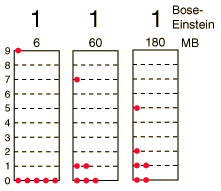
The three distributions of particles at left each have the same energy, the same kind of particles, and the same number of particles. If the particles were distinguishable particles and described by Maxwell-Boltzmann statistics, then the distribution at right would be 30 times more likely than the one on the left because there are 30x as many distinguishable ways to produce it. But if they are indistinguishable bosons, the three states are equally probable and given a statistical weight of 1. This means that instead of 2002 distinguishable microstates arising from 26 macrostates, there are only 26 states.

左边的三个粒子分布具有相同的能量、相同的粒子种类和相同的粒子数目。如果这些粒子是可区分的,并且由麦克斯韦-玻尔兹曼统计描述,那么右边的分布比左边的分布更可能30倍,因为产生它的方式有30倍那么多。但是,如果它们是不可区分的玻色子,这三个状态等概率出现,并且具有统计权重为1。这意味着,原本由26个宏观状态产生的2002个可区分的微观状态,现在只剩下26个状态。

Evaluating the average occupancy of each energy state is much simpler than in the Maxwell-Boltzmann example since each macrostate has a weight of 1. The average occupancy is just the sum of the numbers of particles in a given energy state over all the 26 distributions divided by 26.

Evaluate the average for each energy state.
计算每个能态的平均值。
Compare with Maxwell-Boltzmann example.
与麦克斯韦-玻尔兹曼示例进行比较。
评估每个能量状态的平均占据数比Maxwell-Boltzmann的例子要简单得多,因为每个宏观状态的权重为1。平均占据数只是将所有26种分布中特定能量状态的粒子数之和除以26。
Index

Reference
Blatt
Ch. 11
索引参考Blatt第11章
 
HyperPhysics***** Quantum Physics
HyperPhysics ***** 量子物理
R Nave
Go Back
返回


The average distribution of 9 units of energy among 6 identical particles

9个单位的能量在6个相同粒子间的平均分布
Energy
level
能级
Average
number
Maxwell-
Boltzmann
平均麦克斯韦-玻尔兹曼数
Average
number
Bose-
Einstein
平均数玻色-爱因斯坦
0
2.143
2.269
1
1.484
1.538
2
0.989
0.885
3
0.629
0.538
4
0.378
0.269
5
0.210
0.192
6
0.105
0.115
7
0.045
0.077
8
0.015
0.038
9
0.003
0.038

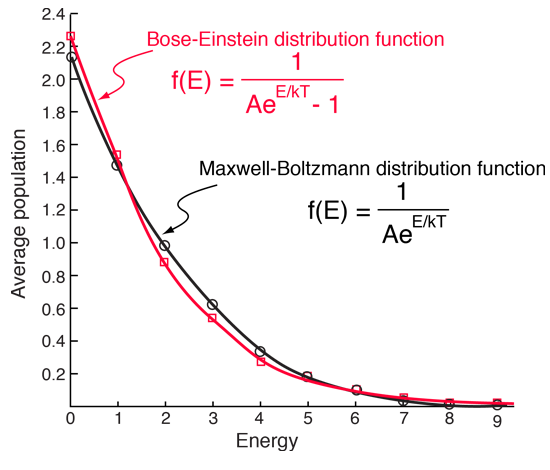
There are 26 possible distributions of 9 units of energy among 6 particles, and if those particles are indistinguishable and described by Bose-Einstein statistics, all of the distributions have equal probability. To get a distribution function of the number of particles as a function of energy, the average population of each energy state must be taken. The average for each of the 9 states is shown below compared to the result obtained by Maxwell-Boltzmann statistics.

有26种可能的能量分配方式,将9个单位的能量分配给6个粒子。如果这些粒子是不可区分的,并且由玻色-爱因斯坦统计描述,则所有分配方式的概率相等。为了得到粒子数随能量变化的分布函数,必须计算每个能量态的平均人口。下面显示了9个状态的平均值,与通过麦克斯韦-玻尔兹曼统计得到的结果进行比较。

Low energy states are more probable with Bose-Einstein statistics than with the Maxwell-Boltzmann statistics. While that excess is not dramatic in this example for a small number of particles, it becomes very dramatic with large numbers and low temperatures. At very low temperatures, bosons can "condense" into the lowest energy state. The phenomenon called Bose-Einstein condensation is observed with liquid helium and is responsible for its remarkable behavior.

低能态在玻色-爱因斯坦统计中比在麦克斯韦-玻尔兹曼统计中更可能。虽然在这个小粒子数的例子中,这种优势并不显著,但在大量粒子和低温下,这种差异会变得非常显著。在极低温下,玻色子可以‘凝聚’到最低能量态。这种称为玻色-爱因斯坦凝聚的现象在液氦中被观察到,并导致其非凡的行为。
Compare with Fermi-Dirac example.
与费米-狄拉克示例比较
Compare with Maxwell-Boltzmann example.
与麦克斯韦-玻尔兹曼示例进行比较。
Index

Reference
Blatt
Ch. 11
索引参考Blatt第11章
 
HyperPhysics***** Quantum Physics
HyperPhysics ***** 量子物理
R Nave
Go Back
返回