Bilingual edition: English is preserved and Chinese follows each unit. Terminology uses the confirmed v20260916 glossary; automated semantic review remains traceable.
中英双语版:英文原文完整保留,中文紧随对应单元;术语采用 v20260916 确认表,自动语义审校结果可追溯。

The Energy Distribution Function

能量分布函数

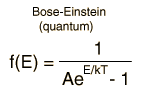
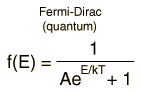
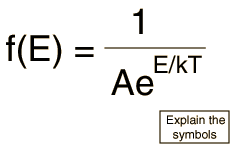
The distribution function f(E) is the probability that a particle is in energy state E. The distribution function is a generalization of the ideas of discrete probability to the case where energy can be treated as a continuous variable. Three distinctly different distribution functions are found in nature. The term A in the denominator of each distribution is a normalization term which may change with temperature.

分布函数 f(E) 是粒子处于能量态 E 的概率。分布函数是将离散概率概念推广到能量可以视为连续变量情况的泛化。在自然界中发现三种截然不同的分布函数。每个分布函数分母中的项 A 是一个归一化项,可能随温度变化而变化。
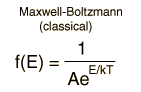
Identical but distinguishable particles.
相同但可区分的粒子
Identical indistinguishable particles with integer spin (bosons).
具有整数自旋(玻色子)的相同不可区分粒子。
Identical indistinguishable particles with half-integer spin (fermions).
具有半整数自旋(费米子)的相同不可区分粒子。
Examples:
例子:
Molecular speed distribution
分子速度分布
Examples:
例子:
Thermal radiation
Specific heat
热辐射比热
Examples:
例子:
Electrons in a metal
Conduction in semiconductor.
金属中的电子 半导体中的传导
The distribution of energy
能量的分布
Basic distribution functions
基本分布函数
Index

Quantum statistics concepts

Applied statistics concepts

Kinetic theory concepts
索引 量子统计学概念 应用统计学概念 气体动理论概念
 
HyperPhysics***** Quantum Physics ***** Thermodynamics
HyperPhysics ***** 量子物理 ***** 热力学
R Nave
Go Back
返回


The Maxwell-Boltzmann Distribution

麦克斯韦-玻尔兹曼分布

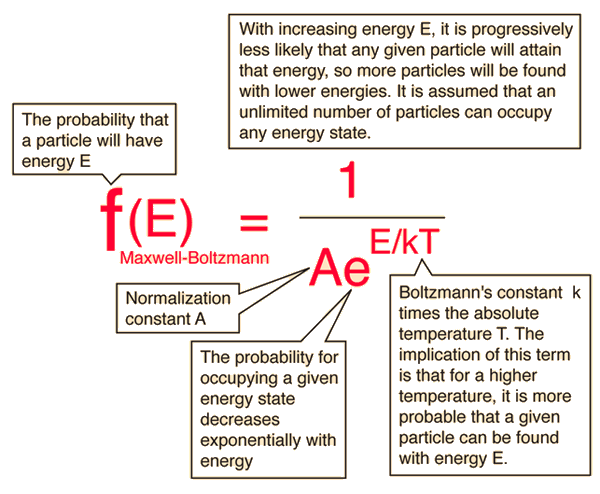
The Maxwell-Boltzmann distribution is the classical distribution function for distribution of an amount of energy between identical but distinguishable particles.

麦克斯韦-玻尔兹曼分布是经典分布函数,用于描述能量在相同但可区分的粒子之间的分配。

Besides the presumption of distinguishability, classical statistical physics postulates further that:

除了可区分性的假设之外,经典统计物理还假设有:
  • There is no restriction on the number of particles which can occupy a given state.
    没有任何粒子数目的限制,可以占据给定的状态。
  • At thermal equilibrium, the distribution of particles among the available energy states will take the most probable distribution consistent with the total available energy and total number of particles.
    在热平衡时,粒子在可用能态中的分布将取最可能的分布,该分布与总可用能量和总粒子数一致。
  • Every specific state of the system has equal probability.
    系统每个特定状态具有相等的概率。

One of the general ideas contained in these postulates is that it is unlikely that any one particle will get an energy far above the average (i.e., far more than its share). Energies lower than the average are favored because there are more ways to get them. If one particle gets an energy of 10 times the average, for example, then it reduces the number of possibilities for the distribution of the remainder of the energy. Therefore it is unlikely because the probability of occupying a given state is proportional to the number of ways it can be obtained.

这些公理中包含的一个普遍思想是,单个粒子获得远高于平均的能量(即远多于其应得份额)的可能性不大。低于平均的能量更受青睐,因为实现这些能量的方式更多。例如,如果一个粒子获得的是平均能量的10倍,那么这会减少剩余能量分布的可能性。因此,这种情形发生的可能性不大,因为占据某一状态的概率与其能被获得的方式数成正比。
Classical applications of the Boltzmann distribution
玻尔兹曼分布的经典应用
Distribution functions
分布函数
Numerical example
数值例子
Index

Applied statistics concepts

Reference
Blatt
Ch. 11.
索引 应用统计学概念 参考 Blatt 第11章
 
HyperPhysics***** Quantum Physics ***** Thermodynamics
HyperPhysics ***** 量子物理 ***** 热力学
R Nave
Go Back
返回


Maxwell-Boltzmann Details

Maxwell-Boltzmann细节

The Maxwell-Boltzmann distribution.
麦克斯韦-玻尔兹曼分布
Comments on developing Maxwell-Boltzmann distribution.
关于发展Maxwell-Boltzmann分布的评论
Index

Applied statistics concepts
索引应用统计学概念
 
HyperPhysics***** Quantum Physics ***** Thermodynamics
HyperPhysics ***** 量子物理 ***** 热力学
R Nave
Go Back
返回