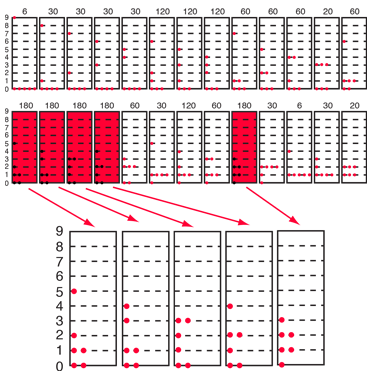
 显示所有26个经典分布 |
How many ways can you distribute 9 units of energy among 6 identical, indistinguishable fermions?如何将9个单位的能量分配给6个相同的、不可区分的费米子? Fermi-Dirac statistics differ dramatically from the classical Maxwell-Boltzmann statistics in that fermions must obey the Pauli exclusion principle. Considering the particles in this example to be electrons, a maximum of two particles can occupy each spatial state since there are two spin states each. Whereas there were 26 possible configurations for distinguishable particles, these are reduced to the 5 states which have no more than two particles in each state. 费米-狄拉克统计与经典的麦克斯韦-玻尔兹曼统计有显著不同,因为费米子必须遵守泡利不相容原理。考虑到这些粒子为电子,每个空间状态最多只能容纳两个粒子,因为每个空间状态有自旋的两个状态。而对于可区分粒子来说,有26种可能的配置,这些配置被减少到只有5种,每种状态中最多有两个粒子。
|
Evaluating the average occupancy of each energy state is much simpler than in the Maxwell-Boltzmann example since each macrostate has a weight of 1. The average occupancy is just the sum of the numbers of particles in a given energy state over all the 5 distributions divided by 5.
| Evaluate the average for each energy state.
计算每个能态的平均值。 | Compare with Maxwell-Boltzmann example.
与麦克斯韦-玻尔兹曼示例进行比较。 |
Reference
Blatt
Ch. 11
| HyperPhysics***** Quantum Physics
HyperPhysics ***** 量子物理 | R Nave |
